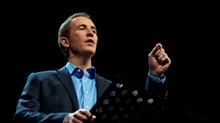
A hand-written Bible traveled 22,000 miles across 124 cities in 40 states.

Charles Honey, Religion News Service | June 25, 2009

Nearly nine months after it hit the road, Zondervan's hand-written Bible Across America came home Wednesday bearing Scripture verses inscribed by 31,173 people.

Among them: a little girl who guided her blind sister's hand; a father who flew from Baltimore to Los Angeles to write in it with his son; and Antoinette and Jim Barry, a couple from Palos Heights, Ill., where church leaders 44 years ago conceived of the New International Version Bible.

The Barrys' daughter, Maureen "Moe" Girkins, is president of Zondervan, the mega Christian publishing house. Last year, she inscribed the first verse ("In the beginning ...") from Genesis 1:1, and on Wednesday penned the final verse from Revelation 22:21: "The grace of the Lord Jesus be with God's people. Amen."

"It was just really impactful to them to know their daughter was involved in something like this, and they got to participate," Girkins said afterward, wiping away tears.

It was one of many powerful moments along the Bible's 22,000-mile journey to mark the 30th anniversary of the NIV, the most popular modern-English Bible translation.

Girkins was one of about a dozen people who wrote the Bible's final verses in a ceremony at Zondervan headquarters. They included nine members of the Committee on Bible Translation, the original translators and continuing caretakers of the NIV.

"It is encouraging to see so many readers and users of the NIV scattered through the whole country," said Ken Barker, a committee member since 1971. "It's also an awesome privilege to be able to write a verse in it myself."

The cross-country trek began on Sept. 30 and traveled 22,000 miles across 124 cities in 40 states.

Writers included authors, NASCAR fans, farmers and soldiers who wrote verses on the Bible's cross-country tour. Volunteers drove a motorhome and set up tents from Manhattan to the Rocky Mountains.

As the RV pulled out on the first night, a homeless man ran up and asked to write a verse, Girkins said. "It became evident to us that all across this great country, people love the Bible," she said.

Two original copies will be produced, one to be offered to the Smithsonian Institution and the second auctioned to benefit the International Bible Society, which holds the copyright to the NIV. A retail version will go on sale in October.

Posted by Sarah Pulliam at June 25, 2009 | Comments (1)

A possible sign of a coming backlash.

Ted Olsen | May 6, 2009

Yesterday, Collin Hansen profiled Tullian Tchividjian, the 36-year-old Florida pastor whose church recently merged with Coral Ridge Presbyterian Church (formerly led by D. James Kennedy).

unfashionable.jpg

We weren't the only ones talking about Tchividjian yesterday. Popular Reformed blogger Tim Challies reviewed Tchividjian's new book, Unfashionable: Making a Difference in the World by Being Different, and found himself surprisingly in disagreement with large sections of it.

While Challies liked a lot of the book, he thinks Tchividjian has a "theology of God's kingdom that I just was not able reconcile with Scripture ?. He writes about transformationalism, the view that God seeks to redeem and renew not just people but nations and cultures. My concern is that such theology emphasizes the continuity between the world today and the world after the consummation of history and does so at the expense of the kind of radical discontinuity Scripture teaches."

Challies is quick to explain that he believes in a real resurrection of the earth and of bodies "that somehow, are still our bodies." He writes, "I know that when history is consummated in Christ, we will not go to some kind of ethereal cloud-land heaven. ?. [T]here will be some genuine continuity between life now and life hereafter. As we read Scripture we wrestle with reconciling both continuity and discontinuity."

But Challies doesn't think that Scripture emphasizes, as Tchividjian says, that "Churches are designed by God to be instruments of renewal in the world, renewing not only individual lives but also cultural forms and structures, helping to make straight all that is crooked in our world."

"I do not see Paul's concern with culture except as a means to reach souls," Challies writes.

Our mission involves both evangelism and cultural renewal, Tchividjian says in his book. "This is true because God exercises his domination both through saving grace (the means by which he converts people, raising them from spiritual death to spiritual life in Christ) and common grace (the goodness he shows to all people, Christians and non-Christians)."

The debate may be an early signal of a coming backlash against the eschatology that has become very common and much promoted in evangelical circles over the last decade or so, in part (though far from exclusively) led by theologian N.T. Wright's work on the meaning of the Resurrection.

In a recent interview with theologian Ben Witherington, Wright addressed what he sees as a common misconception about his views on the continuity between Christians' work in this world and the coming Kingdom of God:

We are not building the kingdom by our own efforts, no. The Kingdom remains God's gift, new creation, sheer grace. But, as part of that grace already poured out in Jesus Christ and by the Spirit, we are building for the kingdom. I use the image of the eleventh-century stonemason, probably illiterate, working away on one or two blocks of stone according to the orders given to him. He isn't building the Cathedral; he is building for the Cathedral. When the master mason/architect gathers up all the small pieces of stone at which people have been working away, he will put them into the great edifice which he's had in mind all along and which he alone can build - but for which we can and must build in the present time. Note 1 Corinthians 3, the Temple-building picture, and the way it relates directly to 1 Cor 15.58: what you do in the Lord is not in vain, because of the resurrection.

I have absolutely no idea how it might be that a great symphony or painting, or the small act of love and gentleness shown to an elderly patient dying in hospital, or Wilberforce campaigning to end the slave trade, or the sudden generosity which makes a street beggar happy all day - how any or all of those find a place in God's eventual kingdom. He's the architect, not me. He has given us instructions on the little bits of stone we are meant to be carving. How he puts them together is his business.

A question for Christian leaders (whether in the church or elsewhere): have you found the recent Christian emphasis on "building for the kingdom" and cultural renewal to detract from evangelism? Or is it actually helping to "reach souls"? Do you resonate more with Challies's view of Scripture or with Tchividjian's?

Posted by Ted Olsen at May 6, 2009 | Comments (37)

ECPA president and CEO Mark Kuyper: “We want to clean up the debt before we consider future options."

Stan Guthrie | April 28, 2009

The Evangelical Christian Publishers Association has decided to not stage another consumer-focused Christian Book Expo next year. This year's event, held last month in Dallas, drew only 1,500 of an anticipated 10,000 to 15,000 attendees and left the ECPA with $250,000 in bills. Christianity Today participated in the event by convening five author panel discussions on topics such as "Does the God of Christianity Exist, and What Difference Does It Make?" (Podcasts and videos of these discussions are available.) Mark Kuyper, ECPA's president, told Publisher's Weekly, ""We want to clean up the debt before we consider future options."

Posted by Stan Guthrie at April 28, 2009 | Comments (3)

Stan Guthrie moderates a Christian Book Expo panel with Lee Strobel, William Lane Craig, Douglas Wilson, Christopher Hitchens, and Jim Denison.

| April 1, 2009

The New Atheists usually make two charges against Christianity: (1) that it is untrue and (2) that it is harmful. A panel of apologetics experts responds to an atheist critic with evidence from Scripture, science, and history about why the faith is both reasonable and good for the world. Christianity Today’s Stan Guthrie moderated this panel on March 21, 2009 for the Christian Book Expo in Dallas.

Panelists:
Lee Strobel, The Case for the Real Jesus, The Case for a Creator (Zondervan)
William Lane Craig, Reasonable Faith (Crossway)
Douglas Wilson, Is Christianity Good for the World? (Canon Press)
Christopher Hitchens, Is Christianity Good for the World? (Canon Press) and God Is Not Great (Twelve Books)
Jim Denison, Wrestling with God (Tyndale)

Posted by Sarah Pulliam at April 1, 2009 | Comments (0)

Mark Galli moderates a Christian Book Expo panel with Scot McKnight, Tony Jones, Kevin DeYoung, and Alex and Brett Harris.

|

We hear much about the emerging church, but pinning down its beliefs and goals can be challenging. What is the movement emerging from and where is it headed? How influential is the emerging church? Participants, observers, and critics examine this movement from all angles - biblical, theological, pastoral, and missional. Christianity Today's Mark Galli moderated this panel on March 21, 2009 for the Christian Book Expo in Dallas.

Panelists:
Scot McKnight, The Blue Parakeet (Zondervan)
Tony Jones, The New Christians (Jossey-Bass)
Kevin DeYoung, Why We Are Not Emergent (Moody)
Alex and Brett Harris, Do Hard Things (WaterBrook Multnomah Publishing Group)

Posted by Sarah Pulliam at April 1, 2009 | Comments (6)

Andy Crouch moderates a Christian Book Expo panel with Donald Miller, Ruth Haley Barton, Randy Frazee, and Mary DeMuth.

|

A Christian consensus could once be pretty much assumed for Western culture, even if many people didn't possess personal faith. That is no longer true. Christianity is today viewed as just one of many spiritual options - and often with suspicion. How do followers of Christ respond in both word and deed? Christianity Today's Andy Crouch moderated this panel on March 20, 2009 for the Christian Book Expo in Dallas.

Panelists:
Donald Miller, Blue Like Jazz (Nelson)
Ruth Haley Barton, Sacred Rhythms (Inter-Varsity Press)
Randy Frazee, Making Room for Life (Zondervan)
Mary E. DeMuth, Authentic Parenting in a Postmodern Culture (Harvest House)

Posted by Sarah Pulliam at April 1, 2009 | Comments (1)

Mark Galli moderates a Christian Book Expo panel with Don Piper, Sam Storms, Randy Alcorn, and Jim Packer.

|

Polls show that more Americans believe in heaven than in hell. The Bible, however, tells us both are real destinations. What are heaven and hell like, and how do we enter one and avoid the other? Author experts examine the afterlife from theological, pastoral - and personal - perspectives. Christianity Today's Mark Galli moderated this panel on March 20, 2009 for the Christian Book Expo in Dallas. Here's a video courtesy of Tangle.

Panelists:
Don Piper, 90 Minutes in Heaven: A True Story of Death & Life (Baker)
Sam Storms, The Hope of Glory (Crossway)
Randy Alcorn, Heaven (Tyndale)
J I Packer, Knowing God (Inter-Varsity Press)

Posted by Sarah Pulliam at April 1, 2009 | Comments (2)

Darrell Bock moderates a Christian Book Expo panel with Richard Stearns, Mark D. Roberts, Tullian Tchividjian, and Justin Taylor.

|

Is there one gospel, or many? A panel of pastors and scholars shows why we can trust our Bibles - and how to separate the doctrinal wheat from the chaff. Darrell Bock moderated this panel on March 20, 2009, for the Christian Book Expo in Dallas. Here's a video courtesy of Tangle.

Panelists:
Richard Stearns, President, World Vision International and author of The Hole in Our Gospel (Nelson)
Mark D. Roberts, Can We Trust the Gospels? (Crossway)
Tullian Tchividjian, Do I Know God? (Multnomah)
Justin Taylor, The Supremacy of Christ in a Postmodern World (Crossway)

Posted by Sarah Pulliam at April 1, 2009 | Comments (1)

Sarah Pulliam | March 20, 2009

Yes, many of evangelicalism's best authors are all in one place this weekend: Dallas.

"Is Dallas' new mega-event for Christian book lovers really featuring a best-selling atheist author who delights in arguing that 'religion poisons everything'? You better believe it," Sam Hodges wrote for a front-page story in today's Dallas Morning News.

Hodges was writing about the Christian Book Expo taking place today through Sunday. CT's own Stan Guthrie, Mark Galli, and Andy Crouch will be moderating panels with several big-name authors from the Christian world.

"John Calvin, age 499, shapes book award winners," writes Cathy Lynn Grossman at USA Today. Three of the six book of the year awards -- a best-selling study Bible, which took top honors in two categories, and a new book by popular pastor/author John Piper -- draw from John Calvin's writings. And atheist Christopher Hitchens will battle some Christian authors tomorrow afternoon.

On Twitter, Mark Galli is soliciting some questions for interviews he's conducting.

What is the Gospel?
Friday, March 20, 2009 / 9:00 - 10:30 AM
Our post-Christian culture loves spirituality but can be suspicious or ignorant of the historic Christian faith. We prefer a do-it-yourself spirituality and a Jesus of our choosing to the good news offered in Scripture. Is there one gospel, or many? A panel of pastors and scholars shows why we can trust our Bibles—and how to separate the doctrinal wheat from the chaff.

Moderator : Darrell Bock, Jesus According to Scripture (Baker Academic)
Panelists:
Richard Stearns, President, World Vision International and author of The Hole in Our Gospel (Nelson)
Mark D. Roberts, Can We Trust the Gospels? (Crossway)
Tullian Tchividjian, Do I Know God? (Multnomah)
Justin Taylor, The Supremacy of Christ in a Postmodern World (Crossway)

A Guided Tour of Heaven and Hell
Friday, March 20, 2009 / 1:00 - 2:30 PM
Polls show that more Americans believe in heaven than in hell. The Bible, however, tells us both are real destinations. What are heaven and hell like, and how do we enter one and avoid the other? Author experts examine the afterlife from theological, pastoral—and personal—perspectives.

Moderator: Mark Galli, Christianity Today
Panelists:
Don Piper, 90 Minutes in Heaven: A True Story of Death & Life (Baker)
Sam Storms, The Hope of Glory (Crossway)
Randy Alcorn, Heaven (Tyndale)
J I Packer, Knowing God (Inter-Varsity Press)

Living Christianly in a Post-Christian Culture
Friday, March 20, 2009 / 3:30 - 5:00 PM
A Christian consensus could once be pretty much assumed for Western culture, even if many people didn't possess personal faith. That is no longer true. Christianity is today viewed as just one of many spiritual options—and often with suspicion. How do followers of Christ respond in both word and deed?

Moderator: Andy Crouch, Culture Making (IVP), Global Conversation editor at Christianity Today
Panelists:
Donald Miller, Blue Like Jazz (Nelson)
Ruth Haley Barton, Sacred Rhythms (Inter-Varsity Press)
Randy Frazee, Making Room for Life (Zondervan)
Mary E. DeMuth, Authentic Parenting in a Postmodern Culture (Harvest House)

The Emerging Church
Saturday, March 21, 2009 / 9:00 - 10:30 AM
We hear much about the emerging church, but pinning down its beliefs and goals can be challenging. What is the movement emerging from and where is it headed? How influential is the emerging church? Participants, observers, and critics examine this movement from all angles—biblical, theological, pastoral, and missional.

Moderator: Mark Galli, Christianity Today
Panelists:
Scot McKnight, The Blue Parakeet (Zondervan)
Tony Jones, The New Christians (Jossey-Bass)
Kevin DeYoung, Why We Are Not Emergent (Moody)
Alex and Brett Harris, Do Hard Things (WaterBrook Multnomah Publishing Group)

Does the God of Christianity Exist, and What Difference Does It Make?
Saturday, March 21, 2009 / 1:00-3:00 PM
The New Atheists usually make two charges against Christianity: (1) that it is untrue and (2) that it is harmful. A panel of apologetics experts responds to an atheist critic with evidence from Scripture, science, and history about why the faith is both reasonable and good for the world.

Moderator: Stan Guthrie, Christianity Today
Panelists:
Lee Strobel, The Case for the Real Jesus, The Case for a Creator (Zondervan)
William Lane Craig, Reasonable Faith (Crossway)
Douglas Wilson, Is Christianity Good for the World? (Canon Press)
Christopher Hitchens, Is Christianity Good for the World? (Canon Press) and God Is Not Great (Twelve Books)
Jim Denison, Wrestling with God (Tyndale)

Posted by David Neff at March 20, 2009 | Comments (0)

| February 26, 2009
0226encyclopedia2.jpg


CT has looked into the debate over whether George Kurian's Encyclopedia of Christian History is being suppressed for being "too Christian." You can find our take on the controversy here.


Posted by Jeremy Weber at February 26, 2009 | Comments (0)

Jeremy Weber | February 20, 2009
227.jpg

Update (11:50 a.m. Thurs., Feb. 26): CT has posted our take on the controversy here.

CT is looking into the commotion over veteran editor George Kurian's four-volume Encyclopedia of Christian Civilization being allegedly censored for being "too Christian."

Kurian, the lead editor, has been remarkably pointed in his accusations, while the publisher Wiley-Blackwell has offered plausible yet incomplete defenses. All in all, highly unusual to see such a big academic project unravel at such a late stage in the game.

Inside Higher Ed has the best coverage here. You can find Kurian's complaint posted here, and Wiley-Blackwell's first defense here and second defense here. The gist:

1) Kurian says the encyclopedia was pulled because a small group of critics didn't like the tone of his Christian language, feeling the reference needed to be more critical of Christianity and more positive towards Islam.
2) Wiley insists it pulled the volumes not out of anti-Christian bias but because editorial review procedures were bypassed without its knowledge.
3) Observers say it's highly unusual for a publisher to pull such a major project so late in the game and wonder how Wiley-Blackwell bumbled its editorial process.

A number of UK papers and Catholic News Agency have covered the controversy, and contributors have discussed in the comments section of this blog. Terry Mattingly at Get Religion is annoyed no mainstream press is covering it.

Much of this follows this National Review blog post done by Edward Feser, a contributor to the book. Feser follows up in this post where he presses Wiley to say whether Kurian is lying or not and Wiley in turn keeps dodging. Feser's conclusion:

So where does all of this leave us? In three consecutive statements now - their first two public statements, and Susan Spilka's emailed response to my questions - Wiley-Blackwell has failed directly to address any of Kurian's specific allegations to the effect that the publisher and/or editorial board demanded that certain changes of content be made so that the Encyclopedia would be less pro-Christian, more friendly toward Islam, and so forth. ... One might be tempted to dismiss all this as a case of "he said/they said." But it seems fair to conclude that while Kurian's claims have been clear, consistent, and specific, Wiley-Blackwell's statements have seemed piecemeal, vague, incomplete, and bureaucratic.

CT has a reporter on the story and will let our readers know what we turn up.

Posted by Jeremy Weber at February 20, 2009 | Comments (3)

The Pulitzer winner surveyed the spiritual emptiness of post-World War II family life.

Katelyn Beaty | January 27, 2009

Prolific American novelist John Updike died Tuesday in Beverly Farms, Massachusetts, after a battle with lung cancer. He was 76. Winning the Pulitzer Prize for two books in his best-known Rabbit quartet, Updike's novels and short stories frequently chronicled the spiritual and moral confusion of the middle-class American family adrift of its Judeo-Christian moorings.

Never afraid to explore sexual exploits frankly, the lifelong churchgoer also deftly wove theological themes into many of his novels, most overtly in Roger's Version (1986), In the Beauty of the Lilies (1996), and Seek My Face (2002). He was strongly influenced by the works of modern theologians Soren Kierkegaard and Karl Barth, but in later years credited his hometown church in Massachusetts as his spiritual foundation.

updike.jpg

Jesuit magazine America awarded Updike its Campion Award in 1997 as "a distinguished Christian person of letters," and President George W. Bush gave him the National Medal for the Humanities in 2003.

Christianity Today
contributing editor Mark Buchanan called Updike "North America's most theological novelist" in his profile of the author from July 2003. He wrote,

Nearly [Updike's] entire life's work is concerned with theological questions, and a good number of his works hinge on these. How many other contemporary authors could - or would - bandy about the theology of Barth, Tillich, or Bultmann in their novels? Or have page after page of dialogue between characters working out intricate doctrinal positions? Updike does this repeatedly and with discernment.

Mark Oppenheimer also profiled Updike in sister magazine Books & Culture in 2004, observing of his angst-ridden protagonists, "Updike's characters were raised in church, and they want truly to believe in God, but the disciplines God requires inhibit the joy he is supposed to bring."

Read more obituaries from The New York Times (which also has a slideshow), the Associated Press, Time magazine, and PBS's Religion and Ethics Newsweekly.

Kendall Harmon at TitusOneNine posted "Seven Stanzas at Easter," Updike's well-known poem on the Resurrection, last March.

Posted by Katelyn Beaty at January 27, 2009 | Comments (2)

Continued drug company payouts prompt questions about who's minding medicine.

Derek R. Keefe | January 21, 2009

Last week the Justice Department announced that drug company Eli Lilly had agreed to pay $1.42 billion to settle criminal and civil charges that it had illegally marketed its blockbuster antipsychotic drug Zyprexa. The case accused company sales reps of promoting the drug for conditions beyond its narrow FDA-approved use of treating schizophrenia and symptoms of bipolar disorder, and for populations (children and the elderly) for whom its known side effects are particularly risky. The New York Times report indicates that claims and evidence in the case were similar to a California state lawsuit which alleged that company studies of the drug circulated among its sales force were "Lilly's thinly veiled marketing of Zyprexa as an effective chemical restraint for demanding, vulnerable and needy patients."

While the settlement was the largest amount paid by a single defendant in the history of the US department of Justice, it is dwarfed by the $39 billion in sales Zyprexa has generated since its approval in 1996, and is less than half of its $3.5 billion in sales in the first nine months of 2008.

This most recent case adds to the already sordid backdrop to Marcia Angell's scathing indictment of drug companies and the physicians, medical schools, and professional organizations happy to collude with them published in the latest New York Review of Books. Angell, the Senior Lecturer in the Department of Social Medicine at Harvard Medical School who served as editor-in-chief for the New England Journal of Medicine for two decades, believes these massive payouts are "just the cost of doing business" and "well worth it" for drug companies so long as the drug continues to rake in billions.

In Angell's telling, the particular offenses reported in the government Zyprexa case represent only a fraction of drug company improprieties, a discouraging litany she candidly rehearses. Yet without countenancing or minimizing their contributions to a corrupt system, she reserves her sharpest rebuke for her colluding peers.

It is easy to fault drug companies for this situation, and they certainly deserve a great deal of blame...Still, apologists might argue that the pharmaceutical industry is merely trying to do its primary job - further the interests of its investors - and sometimes it goes a little too far.

Physicians, medical schools, and professional organizations have no such excuse, since their only fiduciary responsibility is to patients. The mission of medical schools and teaching hospitals - and what justifies their tax-exempt status - is to educate the next generation of physicians, carry out scientifically important research, and care for the sickest members of society. It is not to enter into lucrative commercial alliances with the pharmaceutical industry.

Angell is concerned that unless the medical profession reasserts its independence by sharply breaking its improper financial dependence on the pharmaceutical industry, the integrity of its work will continue to decline, and with it, the trust of the public.

And no payout, however staggering, can buy that back.

Posted by Derek Keefe at January 21, 2009 | Comments (3)

Crossway runs out of stock because of unexpected demand.

Susan Wunderink | January 13, 2009

In just three months, Crossway has run out of the ESV Study Bible. They placed a reprint order for more ESV study Bibles a couple months ago, which should arrive at the end of February. Once that order is in, 250,000 copies will be in print.

"It has been a huge challenge to keep up with the demand ? especially since the lead time for doing a Bible reprint on this scale is 4 to 6 months," wrote Lane Dennis. It's remarkable that any book would be this hot at the end of 2008. Why is a 4 lb book flying off the shelves like this? Justin Taylor, managing editor of the ESV Study Bible, speculated that the sales are due to "Tens of thousands who want to invest in tools to better understand the hope and promises of God's Word."

Collin Hansen chose the surge in study Bibles (including the ESV) as his top theology story for 2008.

Posted by Susan Wunderink at January 13, 2009 | Comments (1)

Philip Jenkins is writing about a Christian history we don't know--and would probably rather avoid.

Katelyn Beaty | January 7, 2009

Philip Jenkins, one of today's authorities on the global church's past and future, has released another highly regarded - if sobering - account of Christianity outside the West. The Lost History of Christianity (Oxford, 2008) tells the winding story of the faith's rise and fall in the Middle East and Central Asia, particularly in Mesopotamia, which became the center of the early church and its wide-reaching cross-cultural missions. The theologies practiced here, those of the Jacobites and Nestorians, were later considered heretical by the Christianized Roman Empire. Yet most of today's dwindling Iraqi Christian population considers one of the strands its "spiritual ancestor," says Jenkins in his most recent CT article, "Recovering Church History."

Jenkins sat down with Beliefnet editor (and CT contributor) Patton Dodd to talk about the book. Here are some of the most provocative excerpts:

On the Eastern church:

[The] Eastern world has a solid claim to be the direct lineal heir of the earliest New Testament Christianity. Throughout their history, the Eastern churches used Syriac, which is close to Jesus's own language of Aramaic, and they followed Yeshua, not Jesus. Everything about these churches runs so contrary to what we think we know. . . .

Just a suggestion. Perhaps we should think of these Eastern communities - the Nestorians and Jacobites - as the real survivors of ancient Christianity. In that case, the great Western churches we know, the Catholic and Orthodox, are the "alternative Christianities."

On early Christianity and Islam:

Christians survive perfectly well for centuries under Muslim regimes, and the relations between the two are often excellent. In fact, Islam borrows massively from those ancient Christian churches. They borrow a lot of the architectural styles of mosques, the worship practices, and customs like Lent, which becomes the Muslim Ramadan. In fact, if a sixth or seventh century Eastern Christian came back today, that person would probably feel more at home in a mosque than a typical Western church service. That comfort level might change once they explored the doctrines being taught, but the general atmosphere would be very similar. The more you look at these Eastern Christianities, the easier it is to understand that Islam and Christianity emerged as sister faiths.

On ?dying' religions:

We really don't know why religions die, and if they do, in what sense they might leave ghosts. One thing that strikes me is how much a dead religion influences its successor - how for instance the old Christianity left its mark on the successor faith of Islam.

Finally, there is a major theological issue that nobody addresses, the theology of extinction. How do Christians explain the death of their religion in a particular time and place? Is that really part of God's plan? Or maybe our time scale is just too short, and one day we will realize why this had to happen. But as I say, nobody is really discussing these questions.

Read the rest of the interview here, and share your reactions here.

Posted by Katelyn Beaty at January 7, 2009 | Comments (14)

Oxford cuts churchy words from newest children's dictionary.

Katelyn Beaty | December 9, 2008

Sunday's Daily Mail and yesterday's Telegraph covered the removal of words associated with Christianity (and therefore, British history), fairy tales, and nature in the latest edition of the Oxford Junior Dictionary.

Words such as disciple, devil, monk, fern, elf, pasture, and willow have been removed from the 10,000-word dictionary and replaced with words such as MP3 player, blog, tolerant, democratic, and biodegradable - all to reflect England's multicultural, technological ethos, says publisher Oxford University Press.

Vineeta Gupta, head of children's dictionaries at Oxford, told the Telegraph, "Nowadays, the environment has changed. We are also much more multicultural. People don't go to Church as often as before. Our understanding of religion is within multiculturalism, which is why some words such as Pentecost or Whitsun would have been in 20 years ago but not now."

(That was probably a good call on Whitsun.)

It's a little unclear why both papers are reporting on the changes now, as the newest edition of the Oxford Junior Dictionary came out in 2007. Both papers cite an Irish mother of four, Lisa Saunders, who compared six editions of the dictionary from the last 30 years and was "horrified" by the number of words that had been removed.

"The Christian faith still has a strong following," Saunders told the Daily Mail. "To eradicate so many words associated with the Christianity will have a big effect on the numerous primary schools who use it."

The Atlantic's Ross Douthat aptly noted that the removal of animals like gerbil and porcupine from a children's dictionary is particularly perplexing, perhaps more so than the removal of churchy words. Vox Day of World Net Daily, on the other hand, sees the word-swaps as warning signs of the destruction of Western culture due to immigration and pluralism.

A sampling of words removed:
Dwarf, elf, goblin, abbey, altar, bishop, chapel, christen, disciple, minister, monastery, monk, nun, nunnery, parish, pew, psalm, pulpit, saint, sin, devil, vicar, beaver, cheetah, colt, doe, ferret, gerbil, goldfish, guinea pig, hamster, heron, herring, kingfisher, lark, leopard, lobster, porcupine, porpoise, raven, thrush, weasel, wren, acorn, bacon, buttercup, canary, carnation, catkin, cauliflower, chestnut, county, cowslip, gorse, hazel, hazelnut, heather, holly, horse chestnut, ivy, liquorice, oats, pasture, prune, radish, rhubarb, sycamore, vine, violet, walnut, willow

A sampling of words added:
Blog, broadband, MP3 player, voicemail, attachment, database, export, chatroom, bullet point, cut and paste, analogue, celebrity, tolerant, interdependent, creep, citizenship, childhood, conflict, common sense, debate, boisterous, cautionary tale, bilingual, committee, compulsory, cope, democratic, allergic, biodegradable, dyslexic, donate, endangered, Euro, apparatus, food chain, incisor, square number, alliteration, colloquial, idiom, curriculum, chronological, block graph

Posted by Katelyn Beaty at December 9, 2008 | Comments (4)

Sales of religious books have declined by 8.9 percent this year.

Sarah Pulliam | December 3, 2008

Christian book publisher Thomas Nelson cut 10 percent of its workforce today, Michael S. Hyatt, President and CEO of the company wrote on his blog.

The company laid off 54 employees, the second round of layoffs at Thomas Nelson this year.

Wendy Lee writes at The Tennessean that sales of religious books alone have declined by 8.9 percent year to date, according to Subtext, a newsletter published by Open Book Publishing Inc.

In April, the company cut roughly 60 of its 600-plus employees at the time as it trimmed the number of book titles it publishes by half.

The decline in religious book sales follows a robust period for the sector from 2002 to 2006.

Another Christian publishing company, Zondervan, cut 18 positions earlier this year.

Posted by Sarah Pulliam at December 3, 2008 | Comments (0)

Recent book has the mainstream press 'wordy' about the Puritans.

| November 25, 2008

Every November America's thoughts turn briefly toward those curious early settlers of New England. While it's the Pilgrims of Plymouth Plantation--those Separatists from the Church of England at the center of our much-contested Thanksgiving myth--who normally receive our attention, this year regular NPR contributor Sarah Vowell's bestseller, The Wordy Shipmates, has directed our gaze to their Puritan cousins to the north.

Vowell's breezy style and playful manner may put off those who hold the Puritans in high esteem as models of devotion. And her occasionally freewheeling conjectures will no doubt be deemed incautious by the guild of historians. Nevertheless, those serious about their Christian faith and those serious about history should take heart that she's respectfully mainstreamed both while offering a better-than-cursory treatment. Any book that sparks worthwhile conversation about the Puritans in the national press is a reason to give thanks.

Some of the more notable reviews:

Marc Arkin in The Wall Street Journal

Erika Schickel in the Los Angeles Times

Stephen Prothero in The Washington Post

And a brief interview in The Boston Globe.

Posted by Derek Keefe at November 25, 2008 | Comments (2)

Is the romance novel about Muhammad a religion story?

Susan Wunderink | September 8, 2008

When Random House dropped the The Jewel of Medina, a romance novel about Muhammad and his child bride, they said it was because it "could incite acts of violence by a small, radical segment." Were they talking about literary critics?

A Wall Street Journal op-ed quotes the professor who, according to the article, sparked fears of violent retribution, saying the novel was "a very ugly, stupid piece of work. . . . You can't play with a sacred history and turn it into soft core pornography."

NPR posted an excerpt of the prologue of the book, now to be published by Beaufort Books: "Scandal blew in on the errant wind when I rode into Medina clutching Safwan's waist. My neighbors rushed into the street like storm waters flooding a wadi." Ugh.

Further down in the passage, Muhammad is reverently and sympathetically portrayed. But kind intentions and literary mediocrity didn't render the book passable in Serbia, where a publisher pulled the book and apologized to an Islamic society that was getting ready to protest. It remains to be seen how "small, radical segments" will react this year when the book is published in the U.S., U.K., Spain, Hungary, Italy, Russia, Macedonia, Brazil and Germany.

Beaufort Books also published HarperCollins/Regan Books castoff If I Did It by O.J. Simpson.

Posted by Susan Wunderink at September 8, 2008 | Comments (2)

Has male-bashing crept into your church?

Katelyn Beaty | August 15, 2008

Nationally syndicated columnist Kathleen Parker released a book this summer that may prove an unlikely ally for those concerned about the lack of engaged men in American churches. In Save the Males: Why Men Matter, Why Women Should Care, Parker identifies our cultural moment as one in which it's acceptable to portray men as dumb, violent, sex-crazed, or irresponsible husbands and fathers. (Movies and TV shows like Everybody Loves Raymond, Two and a Half Men, and Knocked Up, to name but a few, typify this depiction.)

Parker, who frequently writes on families and sexuality, believes cultural "male-bashing" in part comes from the mainstreaming of a feminism that assumes men must be devalued so that women may rise to a place of equal treatment politically and professionally. What is refreshing about Parker's argument is that it's rooted not in shrill, anti-feminist rhetoric (she calls herself a feminist), but in Parker's personal history and current family situation: She was raised by a single father after her mother died, and now has three young boys. Her adolescence was marked by the realization that men are, well, human. Here's how she described it to Karen Spears Zacharias:

Each day after school, I joined [my father] at his law office where I did my homework until he finished up. Once home, we convened in the kitchen where he cooked while I perched on a wooden stool peeling potatoes. We talked.
In that ritualized communion, I learned many useful lessons about the opposite sex. I learned that men like to talk while doing something else. . . . I learned that fathers adore their children and will sacrifice anything to help them succeed. I learned that fathers will lay their lives down for their children. I learned that men are capable of honor, valor, compassion and courage and that they are essential to instilling those virtues in their sons and daughters.

Given Parker's thoroughly personalized vision of men and subsequent sensitivity to male-bashing, some of the antidotes to American churches' lack of men offered by David Murrow, author of Why Men Hate Going to Church and ChurchforMen.com, strike me as ironic. Could it be that Murrow's solutions -- shorter, to-the-point sermons, action-oriented worship songs like "Onward Christian Soldiers," ministries that feature cars or extreme sports -- play on the very caveman stereotypes that belittle men instead of help them utilize their gifts through full participation in church life?

Posted by Katelyn Beaty at August 15, 2008 | Comments (5)

The cover of the Gospels will sport an Olympics logo.

Sarah Pulliam | July 7, 2008

China will provide free copies of the Bible to athletes, spectators and anyone else who wants one at the Olympic Games, the Associated Press reports.

About 10,000 bilingual copies of the Bible will be distributed and another 30,000 copies of the New Testament will also be available during the games, but none will be provided in public hotels, according to the AP. The cover of the Gospels will sport an Olympics logo. Places of worship for other religions will also be available.

The country has had to combat reports that said there would be restrictions on Bibles being brought into Beijing. See CT's other coverage of China.

Posted by Sarah Pulliam at July 7, 2008 | Comments (4)

A new book says Bush fired Rove in church.

Susan Wunderink | June 10, 2008

In a piece subtitled, "Fired and brimstone," The Examiner relays that George Bush canned Karl Rove in church.

The information comes from yet another pre-postmortem book on the Bush administration, Machiavelli's Shadow: The Rise and Fall of Karl Rove, by former Time reporter Paul Alexander. The Examiner summarizes:

"On a Sunday in midsummer, George W. Bush accompanied Karl Rove to the Episcopalian Church Rove sometimes attended," writes Alexander. "They made their way to the front of the congregation. Then, during their time in the church, Bush gave Rove some stunning news. ?Karl,' Bush said, ?there's too much heat on you. It's time for you to go.'"

Maybe Bush knew what he was doing in breaking such bad news in such serene atmosphere: As Alexander documents, Rove has quite the temper.

Posted by Susan Wunderink at June 10, 2008 | Comments (1)

The professor offers his response to the criticisms that got him suspended from Westminster Theological Seminary.

Susan Wunderink | June 9, 2008

Now that Peter Enns's suspension from Westminster Theological Seminary on account of his 2005 book, Inspiration and Incarnation, has gone into effect, the tenured professor has begun to post "thoughts, musings, interactions, responses?about or inspired by the book" on his blog.

At the request of Westminster, he submitted a 38-page paper responding to his critics:

My original intention was simply to leave the matter where it was, in the hands of the faculty and board, so as not to draw undo [sic] attention to seminary matters (even though I felt that this paper would have proved helpful to numerous readers). As it stands now, the attention drawn to this issue is quite pervasive, comes from various sources, and without any aid from me.

In light of these developments, reproducing certain portions of that paper makes a degree of sense.

What he is posting now are discussions with (and responses to) his critics and an abridged and appended version of the parts of his paper that he feels best relate to the theological discussion.

Here's Enns on the authority of Scripture:

That an emphasis, etc., on the humanity of Scripture somehow compromises biblical authority is not only wrong, it also fails to capture the intention or content of I&I. To put it directly, neither I nor I&I deny, implicitly, functionally, or any other way, biblical authority. To put it even more directly, biblical authority is not the topic of I&I.

On the Westminster Confession:

To expect [the Westminster Confession of Faith] to give the final word on, say, Genesis and [Ancient Near East] literature or the [New Testament] and Second Temple literature (to name just two general issues), even in principle, strains credulity and places a greater burden on this tremendous document than it can bear, and may in fact come very close to making it, rather than Scripture, the final court of appeal.

On inerrancy:

If I may offer a thumbnail definition, the Bible as it is is without error because the Bible as it is is God's Word.

And on his intended audience:

I&I is aimed at lay readers for whom a commitment to Scripture as God's Word is deep and non-negotiable, but for whom things like the historical context of Scripture have been posed to them as a threat to inspiration, and therefore to the Bible as being God's word. This is a very real, and we feel often neglected, population of evangelicalism.

The board will decide whether to terminate Enns' employment by December 2008.

Previous articles from Christianity Today and Books & Culture about Enns include:
Westminster Theological Suspension | Peter Enns's book Inspiration and Incarnation created a two-year theological battle that resulted in his suspension. (April 1, 2008)
Two Testaments, One Story | Top evangelical scholars team up for landmark commentary on New Testament use of Old Testament. (February 8, 2008)
Messy Revelation | Why Paul would have flunked hermeneutics. (Books & Culture's review of Inspiration and Incarnation)

Posted by Susan Wunderink at June 9, 2008 | Comments (0)

William Young's surprise bestseller sparks heated response and prompts important questions

Derek Keefe | May 30, 2008

Cathy Lynn Grossman's recent USA Today article on William Young's surprise bestseller The Shack is her second in a month, this one shifting attention to the long-developing and growing backlash against the book coming from a number of influential voices concerned about the book's implicit theological claims.

Several conservative Protestant heavyweights--Al Mohler, Chuck Colson, Mark Driscoll, and influential blogger Tim Challies--have sounded off on the dangers of The Shack's vision of God, salvation, and the Church, creating a quartet of caution for the casual Christian reader. These strong cautions are all the more notable in light of the over-the-top endorsement from one of evangelicalism's most respected spiritual sages, Eugene Peterson, which is featured on the book's back cover.

Among other things, this growing backlash broaches important questions about the proper relationship between art, theology, and the Church for evangelicals and their close kin. What does it mean for artists to be faithful to the confessional Christian traditions and communities of which they are a part, especially that largest of communions--the communion of the saints across time, space, and tradition? If we regard the Nicene Creed as a shared expression of that broad communion, what does it mean for an artist, perhaps a writer such as William Young, to be faithful to that confession?

Switching directions, we must also ask what it means for Christian traditions and communities to be faithful to artists and their craft. This, too, is a theological question: How does the Church show good faith toward those sub-creators in God's human economy whose very creative inclinations are evidence that they bear the image of a God who delights in creating? Making a place for art and the artist is a way of affirming the human and creational pattern that the Christian God calls "very good."

My hunch is that we probably see a failure to keep faith on both sides here, and that it would be a good thing for all of God's Church to discuss the when's, where's, why's, and how's of our mutual infidelities.

Along the way we might also want to pause to think about what the phenomenal grassroots popularity of an iconoclastic novel such as The Shack--1.1 million copies in print, 500,000 more to be printed in June, UK rights just purchased--tells us about the attitudes and pastoral realities churches must reckon with on the ground.

Posted by Derek Keefe at May 30, 2008 | Comments (63)

Her and Eckhart Tolle's webinars on A New Earth attracted 2 million participants.

Katelyn Beaty | May 9, 2008

Never underestimate the power of an Oprah endorsement. Ever since she branded German-born spirituality guru Eckhart Tolle's A New Earth: Awakening to Your Life's Purpose the 61st Oprah Book Club selection in January 2008, the book has sold 3.5 million copies. Over the past several weeks Oprah and Tolle have hosted unprecedented free "webinars," on which Oprah-Tolle discuss a chapter from the book each week and field live questions from the online audience. That audience grew to 2 million people.

Tolle's message is based largely in Eastern spirituality, though he draws from Christian language and imagery (such as the book's title). Tolle defines the human problem as a false self - what he calls "egoic mind patterns," which can be overcome by acknowledging oneness with ultimate reality, or "God." Here's how Greg Boyd, senior pastor at Woodland Hills Church in St. Paul, Minnesota, summarizes it:

Tolle espouses a rather typical Eastern metaphysics in which the true "you" is not the "you" that is distinct from other people, but the (alleged) "you" that is one with the universe. To grasp this, imagine waves on an ocean. Your individual ego is one such wave, but the true "you" in the Eastern religious worldview is the ocean itself - as it is for me and every other "wave." The wave-"you" is limited and temporary, but the ocean-"you" is unlimited and eternal.

Oprah's website reports that she and Tolle will be offering another webinar session beginning June 16.

Boyd aside, seemingly few evangelicals have taken the time to engage A New Earth and offer a thoughtful, biblical response - perhaps because, as Peter Jones, writing for Christian Science Monitor puts it, A New Earth's missteps are rather old:

For Tolle, "knowing self and knowing God become one and the same." The millions who've turned to Tolle might naturally conclude: I am the "I Am." Sound familiar? It should. According to the Bible, such "knowledge" springs from the oldest error of all: man's desire to be "as gods."

Stay tuned to CT for our upcoming analysis of the Oprah-Tolle craze in the next two weeks.

Related coverage:

Greg Boyd's review of A New Earth
at his blog, "Random Reflections"

The Real Secret of the Universe | Why we disdain feel-good spirituality but shouldn't. (May 2007)

The Church of O | With a congregation of 22 million viewers, Oprah Winfrey has become one of the most influential spiritual leaders in America. (April 2002)

Share this:  Add to facebook?  Add to Del.icio.us?  Add to digg?  Add to reddit?  Add to stumbleupond?   

Posted by Katelyn Beaty at May 9, 2008 | Comments (6)

The project leader of a magazine-format Bible hopes images will provoke people to read Scripture.

Madison Trammel | May 1, 2008

TheBook.jpg

Apocalypse Now: Images of war, death, and ecological disaster portray the Book of Revelation in a 2007 Swedish edition of the New Testament. Called Bible Illuminated: The Book, the version's magazine format features arresting news and fashion photography, some sexually charged. Project leader Dan S?derberg, who has a background in advertising, said the intent of the photography is simply to draw readers into the text. "The Bible in its current state tends to alienate so many people," he said. "You can't dismiss the Bible unless you know it, and the more you know, the more you can take part in things. After all, the Bible is used in many aspects of life - even as an excuse for starting wars. You have to inform yourself."

Share this:  Add to facebook?  Add to Del.icio.us?  Add to digg?  Add to reddit?  Add to stumbleupond?   

Posted by Susan Wunderink at May 1, 2008 | Comments (6)

The top five computer helps for Bible research.

Collin Hansen | April 11, 2008

The Resurgence Greek Project
Free
Look no further if you need only to scan the Greek text, double-check parsing, or look up a quick definition. Zack Hubert’s program has only recently been linked up with Mark Driscoll’s Resurgence movement, and exposes this Internet-only resource to church planters and lay leaders who might not otherwise have the time to learn the biblical languages. (More at Zhubert.com)

Logos Bible Software 3
$629.95 for Scholar’s Library
This standard package puts an entire library at your fingertips. The passage and exegetical guides employ a host of resources to dissect Bible verses and help you discern the meaning of original-language texts. Charts and graphs help visual learners. Entire commentary sets can be added for additional cost. (More at Logos.com/scholars)

BibleWorks 7
$349
The popular BibleWorks program focuses more tightly on powerful exegesis tools. New to this version, a three-window interface fills the computer screen with a bounty of information. Sentence diagrams for the Greek New Testament will help advanced users visualize an author’s inspired intent. (More at BibleWorks.com)

Zondervan’s Greek & Hebrew Library 6.0

$149.99
If you want digital access to many indispensable Zondervan resources, you'll want to stick with this software. This publisher has not made some resources available to Logos and Bibleworks. This library doesn’t boast all the powerful tools featured in other programs, but that makes it easier to master in less time. (More at Zondervan.com/software)

Accordance
$249 for Scholar’s Collection
Mac users swear by this program, available for Windows only with an emulator. Accordance runs quickly and presents a clear interface. Offered for separate purchase, customizable 3-D Bible maps take you into Scripture’s stories. (More at AccordanceBible.com)

Posted by Susan Wunderink at April 11, 2008 | Comments (9)

Tim Keller says both believers and unbelievers need to confront questions about Christianity.

Susan Wunderink | February 26, 2008

First Things' managing editor interviewed Tim Keller on the occasion of his new book, The Reason for God: Belief in an Age of Skepticism, which Keller calls "Mere Christianity for Dummies." The table of contents is a list of common doubts about what orthodox Christians believe, which Keller answers in short, accessible arguments.

Keller says his motive in starting to write it was to lay out the big ideas behind what he had been preaching as a resource for members of his church, Redeemer Presbyterian. "And I think probably the other thing was this thing called aging," he told Anthony Sacramone.

While the interview loops back to the significance of denomination and affiliation, it also covers a broad range of topics. Some of the ground they covered:

On how this is different from the world Mere Christianity was broadcast in:

Lewis definitely lived at a time in which people were more certain across the board that empirical, straight-line rationality was the way you decided what truth was, and there's just not as much of a certainty now. Also, when Lewis was writing, people were able to follow sustained arguments that had a number of points that built on one another. I guess I should say we actually have a kind of rationality-attention-deficit disorder now. You can make a reasonable argument, you can use logic, but it really has to be relatively transparent. You have to get to your point pretty quickly.

I don't think they're irrational, they are as rational, but they want something of a mixture of logic and personal appeal.

On why believers should doubt:

Sacramone: You say early on in The Reason for God that a little doubt is necessary to test the integrity of your faith. Does this mean that Christians need to become amateur apologists to some extent, to be ready to give an answer for the hope that is within them?

Keller: I don't mention it in [The Reason for God], but I think there are always doubts that, if you come to grips with them - I think there's doubts that you have, that you always have, that you ought to be more forthright and address them, for two reasons. One is, then you're a better apologist. Because now people are coming shootin' stuff at you in a way they wouldn't when I was growing up.

As I was reading [N. T. Wright's The Resurrection of the Son of God], I realized I was coming to greater certainty, and that when I closed the book, I said, at a time when it was very important to me to feel this way, I said, "He really really really did rise from the dead." And I said, "Well, didn't I believe that before?" Of course I believed it before - I defended it, and I think before I certainly would have died for that belief. But actually, there were still doubts in there, and the doubts were taken down 50 percent or something. I didn't even know they were there. And it was a wonderful experience It was both an intellectual and emotional experience: You're facing death, you're not sure you're going to get over the cancer. And the rigorous intellectual process of going through all the alternative explanations for how the Christian Church started, except the resurrection - none of them are even tenable. It was quite an experience.

On dealing with creation and evolution:

How could there have been death before Adam and Eve fell? The answer is, I don't know. But all I know is, didn't animals eat bugs? Didn't bugs eat plants? There must have been death. In other words, when you realize, "Oh wait, this is really complicated," then you realize, "I don't have to figure this out before I figure out is Jesus Christ raised from the dead."

Tim Keller is taking the book tour to Veritas forums at various colleges throughout the U.S.

Posted by Susan Wunderink at February 26, 2008 | Comments (0)

Two agnostic authors face suffering--and come out at different spots on the faith spectrum.

Katelyn Beaty | February 18, 2008

Controversial biblical scholar Bart Ehrman has a new book out, but this time he's not bent on tackling issues of scriptural discrepancies, as he did in his most (in)famous work, Misquoting Jesus (see Books and Culture's review from 2005). This time, Ehrman founds his agnosticism on the Bible's seemingly equivocal answers to the question, How can a loving God allow terrible things to happen to people?

"I realized I couldn't explain any longer why there could be such pain and misery in the world that was supposedly ruled by an all-powerful and loving God," the religion professor at University of North Carolina, Chapel Hill, told the San Diego Union-Tribune over the weekend. The problem of suffering "put me over the top," says Ehrman. "So, I became an agnostic."

God's Problem: How the Bible Fails to Answer Our Most Important Question - Why We Suffer (HarperOne) traces Ehrman's change in convictions about God and Scripture based on his inability to reconcile the goodness of God with the suffering of man. Ehrman explores and ultimately disputes the way suffering is handled in biblical accounts: as punishment for wrongdoing (Genesis), as an outcome of others' wrongdoing (throughout the Psalms), as part of redemption (the Gospels), or as part of the mystery of God (Job).


Ehrman finds these varied explanations problematic, as he does chalking the question of theodicy up to something beyond human knowledge: "If you say it's a mystery, then what you're saying is there's no answer." And having no answer is apparently insufficient for Ehrman.

For other agnostics, though, encountering believers who have profound hope and peace despite suffering is enough to at least crack a window open for belief. This is what happened to John Marks, a former 60 Minutes producer who traces his journey into and out of faith in his new spiritual memoir, Reasons to Believe: One Man's Journey Among the Evangelicals and the Faith He Left Behind (Ecco). In a striking interview in this weekend's Boston Globe, Marks tells of a close friendship with an evangelical couple, the McWhinneys, that emerged from Marks's research for his book:

When I first met the McWhinneys, [I thought] they were almost walking caricatures of the evangelical Christian. They believe in the Rapture, that when the end time comes, people will be taken up into the air, and the nonbelievers will be left behind on earth to suffer. There was a cardboard quality, I thought, to their belief.

When I met them the second time, after we'd done the "60 Minutes" piece, they told me about their bipolar son, roughly my age, who had tried to kill himself [and] had disappeared and was believed to be living in a homeless shelter in Dallas and whom they had decided to commit. They spoke with great sorrow. They didn't say he was possessed by the devil. They resented that characterization - and remember, these are Christians who believe there is a living Satan. We agreed I would join them for church [the following] Sunday.

Five hours later, their son walked up the onramp of a highway and was killed by a car. On Sunday, I got in the car, we were having a chat, and then Don suddenly told me their son had been killed. [He said] his son was not gone - he was walking the streets of the heavenly city, and we know from Revelations that that city has walls made of pure jasper - describing this world that, for nonbelievers, is just pure fantasy. I became aware of the way this sense that God is real, that there is this heavenly kingdom - it is not window-dressing. In moments of grief and deep sorrow, people like the McWhinneys do reach for this, and it is the consolation.

While believers may not be able to give a thoroughly coherent reason for why God allows his followers to suffer - and debates about theodicy will likely continue among theologians until Judgment Day - we may at least be able to provide a glimpse into "the peace that passes all understanding" as we respond to crises in our own lives and come out praising the Creator for his unbounded goodness.

Posted by Katelyn Beaty at February 18, 2008 | Comments (8)

Norman Mailer dies less than a month after his book on God is published.

Kristen Scharold | November 12, 2007

Novelist and New Journalist Norman Mailer died Saturday morning of renal failure at age 84. A controversial but highly recognized writer, Mailer pushed the boundaries of content and style, even tackling the subject of God and religion in his last work, "On God: An Uncommon Conversation."

ABC said,

"In probing, amusing, and uncommon dialogues conducted over three years but whose topics he has considered for decades, Mailer establishes his own system of belief, one that rejects both organized religion and atheism," according to a statement issued Monday [September 24, 2007] by Random House.

"He presents instead an artistic God who often succeeds but can also fail in the face of contrary powers in the universe, with whom war is waged for the souls of humans."

For more on this writer who helped changed the landscape of both fiction and non-fiction while garnering great praise and criticism, visit these links.

BBC: Obituary

New York Times: "Towering Writer with a Matching Ego Dies at Age 84"

CNN: "The Death of the Literary Lion"

The Guardian: "Mailer's Talent Never as Big as his Ego"

National Post: "The Failed Career of Norman Mailer"

Publisher's Weekly: "On God"

Posted by Kristen Scharold at November 12, 2007 | Comments (2)

Two authors with new books arrive at different points on the belief spectrum.

Katelyn Beaty |

The same week the New York Times magazine featured Mark Oppenheimer's skeptical commentary on Antony Flew's late-in-life journey from atheism to theism (which CT editor in chief David Neff responded to here), another NYT columnist, Stanley Fish, offered a thoughtful and generous survey of two recent books that add to the ever-continuing discussion of God, his attributes, and the presence of evil. In his review, Fish displays a keen understanding of classic Christian writers, from Milton to Epicurus to St. Paul, and opens a larger discussion on evil and the meaning of suffering--a discussion worth having by believers and nonbelievers alike.

The first book Fish surveys is from Bart D. Ehrman, who, since his young adulthood, has moved from theism to agnosticism, partially due to an inability to get past the terrific amount of seemingly meaningless suffering in the world. His new book is titled God's Problem: How the Bible Fails to Answer Our Most Important Question-Why We Suffer. The other book Fish surveys, There Is a God, is from the aforementioned philosophy professor Antony Flew, and documents his famous "conversion" to theism in 2004.

As Fish notes, these two writers are approaching questions of God's (and evil's) existence from opposite frames of mind. From beginning to end, Ehrman writes with emotionally charged indignation and a frustrated inability to reconcile the pervasiveness of suffering with the supposed benevolence of God. Contrarily, Flew writes with the detached (some would say "cold") demeanor typical of much philosophical literature.

Here, Flew epitomizes Ehrman's frustration with people who make statements about God and don't seem to take into account "real life." As Fish observes,

"Will Ehrman be moved to reconsider his present position and reconvert if he reads Flew’s book? Not likely, because Flew remains throughout in the intellectual posture Ehrman finds so arid. Flew assures his readers that he 'has had no connection with any of the revealed religions,' and no 'personal experience of God or any experience that may be called supernatural or religious.' Nor does he tells us in this book of any experience of the pain and suffering that haunts Ehrman’s every sentence."

What Fish rightly points out is that while both books arrive at different locations on the belief spectrum, each book attests to the continuing importance and vitality of such questions--even in a time when screeds from atheists who want to throw out the conversation all-together are now nearly clichéd.

Posted by Katelyn Beaty at November 12, 2007 | Comments (7)

Chinese spokesman denounces news reports.

Sarah Pulliam | November 8, 2007

There will be no restrictions on Bibles being brought into the Olympic village in Beijing next year, contrary to news reports that said that said Bibles would be banned in a nation that is hesitant to embrace Christianity.

The Associated Press reports that a story posted on the Catholic News Agency Web site said a list of prohibited items in the Olympic Village included Bibles. The Associated Press reports that the U.S. Olympic Committee contacted the International Olympic Committee in response to the story, and was told that Bibles would be allowed - and most likely provided alongside Korans.

A notice on the official Beijing Olympics Web site explaining entry procedures into the country said "each traveler is recommended to take no more than one Bible into China."

As the communist nation prepares to host the international event, the world is watching to see how it responds to freedom of speech issues. Just a month ago, the organizers pledged to hold a variety of religious services during the Olympic games.

Posted by Sarah Pulliam at November 8, 2007 | Comments (8)

Robert Alter's new translation of Psalms returns text to Hebraic roots.

Katelyn Beaty | October 30, 2007

Renowned Hebrew scholar Robert Alter has just released another translation of a portion of the Old Testament, this time of the Psalms--perhaps the most familiar and beloved book of Scripture among believers and nonbelievers alike. The Book of Psalms (Norton) is a near-600-page tome featuring Alter's translation of all 150 psalms, along with extensive historical and cultural commentary, which comprises nearly half of each page. Psalms is the next installment of Alter's biblical translations, following The Five Books of Moses (2004), Genesis (1997), and The Art of Biblical Narrative (1983), a foundational primer in how to read the Bible for its literary qualities.

Alter states in an interview with online Jewish arts magazine NextBook that his intent in translating has always been to capture and remain faithful to the intent and rhythm of the original Hebrew text. Such literary qualities that he says are often overlooked in some popular English translations are the parallelisms, plays on words, and what he calls the "terrific compactness of the Hebrew expression." Thus, some of the most well-known psalms, like Psalm 23, begin to take a different shape with Alter's translation:

Though I walk in the vale of death's shadow,
I fear no harm, For You are with me.
Your rod and Your staff - it is they that console me.
You set out a table before me in the face of my foes.
You moisten my head with oil, my cup overflows.
Let but goodness and kindness pursue me
all the days of my life.
And I shall dwell in the house of the LORD for many long days.

Alter's translation epitomizes one of many ways to read Scripture. He and culture-makers who consistently give his translations glowing reviews (like the New Yorker's James Wood) understand the biblical text primarily as a piece of literature that features several passages of exquisite poetry and insight into the human condition.

What can confessing Christians, who believe that the Bible is so much more than a piece of great literature, gain from scholars who approach Scripture primarily as a literary text? Do we ignore translations like Alter's as being inconsequential in light of the Bible's transformative power as the very Word of God? Or do we embrace Alter's translations as fine pieces of scholarly rigor and great supplementary books to keep alongside our KJVs? How do we affirm the literary genius of the scriptural text, or should we?

To answer these questions, it may be helpful to consider a unique educational project that launched two years ago to address the overwhelming ignorance of the Bible among today's high school students. The Bible Literacy Project (for which Alter is a board member), offers curriculum to high school teachers to teach the Bible as the most important literary text of the Western world. The curriculum, titled The Bible and Its Influence, has been praised for its scholarship among secular and religious news sources alike.

Writing as a confessing Christian, it's worthy of celebration to hear that people who may never have opened a Bible otherwise are digging deep into the historical and cultural roots of this powerful text. Whenever the Bible is studied, even if it is being studied primarily as a piece of literature, who knows how the Lord might use those instances to illuminate the text far beyond a great book, but indeed, his very Word with its power to shine Light into our darkness? And who is to say that Alter's translations might not be used by the Lord in the same way--especially for New Yorker editors who may never otherwise touch a Bible with a 10-foot pole?

Yet the church has the opportunity to pick up where Alter's translations fall short and teach Scripture primarily as the Word of Life, and only secondarily as a remarkable piece of literature. We shouldn't be afraid to recognize the stunning beauty of passages like Psalm 103, Isaiah 43, or the entire book of Ecclesiastes (one of my favorites), knowing that this beauty is a mere vehicle for the power of a "two-edged sword ... able to judge the thoughts and intentions of the heart" (Heb. 4:12).

Posted by Katelyn Beaty at October 30, 2007 | Comments (4)

A new novel explores sex and abstinence in the evangelical subculture.

Kristen Scharold | October 15, 2007

They shall know we are Christians by our love, or in some cases by our sex. Evangelicals are not only marked by conservative political views, anti-evolutionist beliefs and Ten Commandment fights. We are getting a reputation for sexiness. (Visit our past post "Making Sunday Sexy," for another example.)

The most recent witness of our sexiness is Tom Perrotta, a novelist whose newest book, according the New York Times, is not just about sex, but about evangelicals and sex.

With his latest novel, "The Abstinence Teacher," out Tuesday from St. Martin's Press, Mr. Perrotta returns to the anxious and striving contemporary suburban landscape that he has made his literary home, this time tackling the evangelical movement, which has produced chastity events like the one in Wayne.

But why is he interested in the evangelical movement on abstinence? Surprisingly, it is not primarily because he wants to mock the Christian mantra, "Save sex for marriage!" (though there could be some of that). Rather, he seems to be irresistibly intrigued with the evangelical glorification of sex.

Raised Roman Catholic (he has since lapsed), he was exposed to the self-abnegating form of religion that the evangelicals, he said, had turned on its head, particularly in regard to sex. "Catholic theology is that sex should be for procreation," he said. "But this evangelical culture really embraces orgasms and pleasure. I was really interested in that strain of Christianity that didn't want to fight American culture and that's a vibrant, prosperous and actually kind of sexy culture."

How he came to discover this sexy culture is even more interesting, and even more indicative of the growing presence of evangelicalism in the public's eye.

Mr. Perrotta said the idea for the novel emerged from the 2004 presidential election, when evangelical voters were widely credited with swinging the result for George W. Bush.

"I was surrounded by people who kept saying, ?Who are these people?'" recalled Mr. Perrotta, who has lived in Belmont, Mass., for the past eight years with his wife and two children. "I did feel somewhat inadequate as a novelist, just like I'd missed something huge happening in the country. I really did set out to kind of investigate that world."

[Perrotta] said he had no idea how an evangelical Christian audience would respond to the book. One character in particular, the aggressively pious Pastor Dennis, seems in some respects to fit a typical liberal perception of an evangelical preacher. But Mr. Perrotta said he actually admired the character's integrity and authentic caring for Tim. Above all Pastor Dennis is not a hypocrite, Mr. Perrotta said. "Like a lot of secular Americans after that first wave of evangelical televangelists crashed and burned, like Jimmy Swaggart and Jim and Tammy Faye, there was this sense of, ?I know who those people are, they're just a bunch of hypocrites,'" he said. "It took me a long time to understand that a lot of them were completely genuine.

What is especially curious about Perrotta's observations is that it appears that our biblical glorification of sex might prove to be an unexpected entrance point for engaging a sex-obsessed culture.

Posted by Kristen Scharold at October 15, 2007 | Comments (8)

In defense of audiobooks.

Ted Olsen | August 2, 2007

Audiobooks are "Reading Lite"? There's a stigma against audiobooks? That's what I learned from The New York Times this morning.

This strikes me as snobbery for snobbery's sake. I don't quite understand the argument against audiobooks, which, unfortunately, the Times doesn't explain. I can't help but wonder: is there really a stigma? I suppose there is now, since The New York Times says there is. But really, if you're going to mock someone in your group for being lowbrow because they listened to He’s Just Not That Into You rather than read a paper copy, you might want to check your irony detector.

I suppose you can "tune out" while listening to audio, but then again, audiobooks work against skimming . (I gave up on the audio version of The Fellowship of the Ring because I decided I wanted the "songs about my sword" and similar sections to pass by a bit faster than the rest of the narrative.) I've benefited greatly from using audio Bibles devotionally, in large part because they focus my attention on the narrative. (Many times I've found myself sitting in the driveway engrossed by the audio version of The Message.)

Maybe the argument is against abridged audiobooks? I can certainly understand the argument there (it's like watching the film version of a book, only without pictures). But unabridged copies of book-group-friendly novels? Which often take much longer to listen to as they would to read? What's the problem?

If you're a CT reader who's eager to stick it to the man by listening to audiobooks, I heartily recommend ChristianAudio.com. There are other good Christian audio outlets, but Christian Audio focuses on thoughtful, intellectually stimulating volumes, many you won't find elsewhere. It also offers several free first chapters and classic titles. (Disclosure of sorts: I think our parent company might have some sort of partnership with this company; I'm recommending it because I actually use it.)

And speaking of ChristianAudio.com, cofounder Dave Bruno has an article on our site today about the Bible and Harry Potter and the Deathly Hallows.

Posted by Ted Olsen at August 2, 2007 | Comments (4)

Some of Books & Culture editor John Wilson�s favorite magazine book review sections (besides CT�s). ���

| July 18, 2007

The Christian Century
Wasn't CT founded as an evangelical alternative to the Century? Yes, but while differences remain, the dividing lines have grown blurrier. For example, senior editor Richard Kauffman, who presides over the Century's excellent books coverage, was formerly at CT. See the May 1 issue - the spring books issue - for a good sampling, starting with Bill Placher on the concluding volume of Gary Dorrien's The Making of American Liberal Theology. You'll find enough that's familiar to make the reading congenial and enough that's different to keep it interesting. Because the Century is published biweekly, you will also encounter a lot more reviews. Value added: The magazine regularly features poetry, selected by poetry editor Jill Pel?ez Baumgaertner.

First Things
Catholic at its core, ecumenically orthodox in its scope, with friendly visitors from the Jewish community (David Novak, for example), First Things routinely features substantial essay reviews as well as shorter pieces and a handful of mini-reviews. Richard John Neuhaus's back of-the-book feature "The Public Square," where most readers turn first, often comments on books and their authors, always with wit and penetration, occasionally with withering scorn. And like the Century, First Things has poetry in every issue.

The Atlantic
This was already the best general-interest magazine on the market. Several years ago, its books section was beefed up and otherwise improved to match the rest of the menu. I miss the hand of longtime editor Cullen Murphy, who left when the magazine moved to Washington, D.C., forsaking its ancestral home in Boston. But the coverage of books remains superb. Literary editor Benjamin Schwarz leads off every section with a delightfully unpredictable "Editor's Choice" column (the June issue focuses on books that show "how a revolution in American domestic architecture put women in command"). Another regular is Christopher Hitchens, an atheist who's often provocative and never boring.

(This originally appeared on p. 59 of the July 2007 issue of Christianity Today.)

Posted by John Wilson at July 18, 2007 | Comments (6)

Jenkins says fears of Islamization are greatly exaggerated.

Stan Guthrie | June 18, 2007

In an article in Foreign Policy, Philip Jenkins, the redoubtable distinguished professor of history and religious studies at Penn State University and author of The Next Christendom and The New Faces of Christianity, promotes his latest book, God's Continent: Christianity, Islam, and Europe's Religious Crisis. Jenkins says the widely expected Islamization of a secularized and increasingly enfeebled continent has been greatly exaggerated. Jenkins notes:

"The result has been a rediscovery of the continent’s Christian roots, even among those who have long disregarded it, and a renewed sense of European cultural Christianity. Jürgen Habermas, a veteran leftist German philosopher stunned his admirers not long ago by proclaiming, 'Christianity, and nothing else, is the ultimate foundation of liberty, conscience, human rights, and democracy, the benchmarks of Western civilization. To this day, we have no other options [than Christianity]. We continue to nourish ourselves from this source. Everything else is postmodern chatter.' Europe may be confronting the dilemmas of a truly multifaith society, but with Christianity poised for a comeback, it is hardly on the verge of becoming an Islamic colony."

Can the faith founded by the Prince of Peace prevail over the self-proclaimed "religion of peace" on the spiritually arid battlefield of Europe? My guess is that increasingly worried Europeans fervently hope so.

Posted by Stan Guthrie at June 18, 2007 | Comments (18)

New book chronicles the revenge of David "Children of God" Berg's "spiritual son."

David Neff | June 14, 2007

Don Lattin is right. In the introduction to his forthcoming book on the Children of God cult led by David "Mo" Berg, Lattin says, "Some Christians may take issue with the title of this book, Jesus Freaks: A True Story of Murder and Madness on the Evangelical Edge." He then defends the title and subtitle by pointing out that Berg was "deeply rooted in the Christian tradition" and that he "came straight out of American evangelicalism."

Ah, well, the key word is "out." Berg was not "in" American evangelicalism, but rather "came ... out." He wasn't even close to "the Evangelical Edge."

So yes, I'm one of those Christians who will take issue with the title of Lattin's book (due out from the newly rechristened HarperOne in October.) The copy is designed to sell the book to those who think of "evangelicals" as dangerous and deluded. And while the term "freak" wasn't at all pejorative at the time of the Jesus movement, it's combination with "murder," "madness," and "evangelical edge" reinforces its more current and decidedly more lurid usage.

Nevertheless, the topic of the book and Lattin's reputation as a writer for the San Francisco Chronicle make me want to spend more time with the uncorrected proof we received in today's mail.

I encountered the Children of God in '74 or '75 in San Diego's Balboa Park. Fortunately, they did not try out their "flirty fishing" free-love recruitment techniques on me. (I probably didn't look like a good candidate since I was with my wife and two preschoolers.) So they just gave me some of their free literature. But even that was scary stuff. It reeked of the paranoid and delusional.

By the way, there is one erratum to watch out for in the book's introduction.

Lattin says that Berg was trained as an itinerant evangelist and began his "late-blooming ministry" in the Christian and Missionary Alliance, which he identifies as "one of the nation's earliest networks of Pentecostal churches." But the C&MA is not Pentecostal. Classical Pentecostalism teaches the gift of tongues as the "initial evidence" of the reception of the Holy Spirit. The C&MA explicitly denies this, while allowing for members to speak in tongues if they are so moved by the Spirit.

The C&MA should instead be classified as a Holiness denomination. It teaches entire sanctification - though it understands that as a combination of crisis moment and ongoing process.

Posted by David Neff at June 14, 2007 | Comments (8)