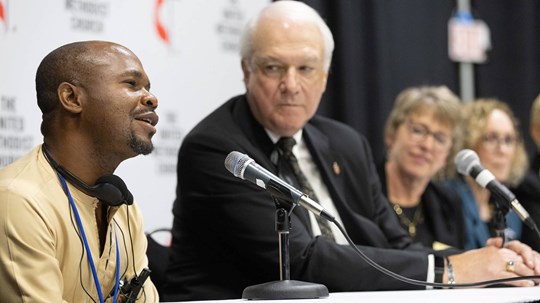
The Southern Baptist Convention (SBC) adopted a new immigration resolution at its annual meeting held earlier this month in Phoenix. The resolution called on the government to secure the border and then provide a path to citizenship for undocumented immigrants. The SBC said this path to citizenship should not be amnesty but should include “appropriate restitutionary measures.” The resolution passed, but not until after a debate that revealed the tensions many evangelicals feel over immigration.
Richard Huff, pastor of Corona de Tucson Baptist Church in Tucson, Arizona, proposed to eliminate the policy section of the resolution. At issue was the path to citizenship, a provision some saw as “amnesty” and a sanctioning of lawbreaking.
Resolution Committee chairman Paul Jimenez said his committee opposed the amendment. He called the original resolution "a realistic and biblical approach to immigration." He said that if the amendment passed the SBC work would be more difficult in areas of the country with more Hispanics.
A slim majority (766-723) voted against the amendment. Instead, additional language was added making clear that “this resolution is not to be construed as support for amnesty for any undocumented immigrant.” The resolution then passed by a show of hands.
One of the supporters of the amendment was Wiley Drake, pastor of First Southern Baptist Church of Buena Park in Buena Park, California. He said he is not against all of the resolution, just the “amnesty clause.”
“This is amnesty any way you phrase it,” Drake said. “Restitution? They don't need restitution. They need to go to work. We win people to Jesus. We get them jobs and we take them back to their country.”
Drake is a former vice president of the SBC who ran unsuccessfully for president of the SBC this year (receiving just 4 percent in a two-person race). He has been controversial in recent years for his leadership in the so-called “birther” movement; Drake called Obama an “evil illegal alien.” Most infamously, Drake prayed for the death of President Obama if he does not “turn to God.” In 2008, he called for prayer to end the lives of leaders of the Americans United for Separation of Church and State. Perhaps as a response, the SBC passed a “civil public discourse” resolution that specifically objected to the “calling for prayers for the deaths of public officials.”
Both the amendment and the final SBC resolution reflect a conundrum facing evangelical churches. Along with other evangelical churches, the SBC has supported immigration reform even though many in their pews hold negative views of immigrants.
A February poll by the Pew Research Center for the People and the Press finds that white evangelicals are more likely to see immigrants as a burden than a strength. Pew found that evangelicals are twice as likely to see immigrants today as “a burden on our country because they take our jobs, housing and health care” than they are to say immigrants “strengthen our country because of their hard work and talents.” These views were similar—but still more negative—than other religious groups.
Hispanic Catholics and those who are not affiliated with any religion were the most positive toward immigrants, with a majority saying immigrants strengthen the country.
Similarly, Pew found that evangelicals were the only religious tradition to have a majority say that the growing number of immigrants “threatens traditional American customs and values.” Around one-third of evangelicals said these immigrants “strengthen American society.”
Evangelicals have about the same level of support for both stronger border enforcement and a pathway to citizenship. Approximately two-thirds of evangelicals support a pathway to citizenship that includes, in the language of the SBC resolution, “appropriate restitutionary measures.” Pew found that 65 percent of evangelicals support “providing a way for illegal immigrants currently in the country to gain legal citizenship they pass background checks, pay fines, and have jobs.” This is the same as other Christian groups. Overall, 72 percent of Americans favor this policy.
At the same time, 78 percent of Americans and 89 percent of evangelicals favor “stronger enforcement of immigration laws and border security.” Nine-in-ten white Christians support greater security. Support among African-Americans and hispanic Christians is lower, but still strong (around 75 percent). Those with no religion also support this (69 percent).
The fight over the SBC immigration resolution highlights this immigration conundrum. There are many evangelicals who hold to negative views of immigrants. Nearly all evangelicals support for greater border controls and law enforcement. Yet, this does not mean that immigrants should be rounded up and deported. Most Americans, including most evangelicals, support a path to citizenship that imposes some “appropriate restitutionary measures.”
Editor's Note: The Pew Research Center for People and the Press (Pew) provided Christianity Today with a religious breakdown of questions from the poll. However, CT is responsible for all analysis and interpretation of the results. Pew identifies evangelicals as white, non-Hispanic Protestants who described themselves as "born-again or evangelical." About 18 percent of Americans are evangelicals by this definition. The margin of error for each religious group is larger than for the sample as a whole. The results are descriptive; religious differences could be due to partisanship, ideology, income, or other factors.
Posted by Sarah Pulliam Bailey at June 29, 2011 10:27AM | Comments (1)
New York will become the sixth state to approve same-sex marriage (the District of Columbia also allows gay marriage). Because of the state's large population, the number of Americans living in states that allow gay marriage will more than double. With New York, 35 million Americans will live in states with gay marriage, one in nine Americans.
The New York Senate approved a new same-sex marriage bill tonight by a vote of 33 to 29. Even though nearly all Republicans voted against the bill, the Republican-controlled Senate passed the bill because of four Republicans who voted with the Democrats. Only two Republican Senators openly backed the bill until just before the vote when Sen. Stephen Saland (Rep.) said he would give the bill the 32nd vote needed for passage. Only one Democrat, Sen. Ruben Diaz, voted against the measure. Only two Republican Senators openly backed the bill prior to the vote.
Additional votes were gained only after a majority in the Senate reached agreement on religious protections in the bill. Shortly before the gay marriage bill vote, the religious exemptions were reportedly passed by a 36-26 vote. The bill passed by the State Assembly included protections for clergy and churches. It did not include explicit protections for faith-based nonprofits. In Illinois, for example, the recent civil unions law has meant that Catholic Social Services could no longer receive state funds for its foster care and adoption services. The nonprofit has a policy against placing children with same-sex couples.
Opponents of the Assembly bill also wanted exemptions for individuals and businesses who objected to gay marriage for religious reasons. These individuals could be in violation of local ordinances. They could also be forced to allow gay couples to use their facilities. For example, without exemptions, critics argued, a business that rents its facilities for weddings could not refuse a couple simply because they were a same-sex couple.
The bill also included language making it impossible for a judge to strike down only the religious exemptions. If the exemptions are ruled to be unconstitutional, the extension of marriage to same-sex couples would be struck down, too.
Even the broadest religious exemptions would not be enough for some opponents of same-sex marriage. Family Research Council's Peter Sprigg said “the principal objection to homosexual 'marriage' has nothing to do with religion.”
“At its heart, marriage is neither a civil institution nor a religious institution. Instead, marriage is a natural institution—rooted in the order of nature itself,” Sprigg said. “The core message of the opposition to homosexual 'marriage' is not just, 'Don’t make us perform same-sex weddings in our church.' Instead, it is: 'Society needs children, and children need a mom and a dad.'”
The new bill still needs to be approved by the Assembly (because of the new religious exemptions) and then be signed by the governor. The Assembly is expected to approve the new language quickly. The signature of Gov. Andrew Cuomo is all but certain. The governor has been an outspoken advocate for same-sex marriage in New York. The measure will go into effect 30 days after he signs it.
The outcome of the bill has been in doubt for weeks. The State Assembly has passed same-sex marriage legislation four times in the past five years. The Senate has never approved it. In 2009, the Senate voted 38-24 against same-sex marriage. After the 2010 election, Republicans gained control but the Senate lost some key opponents to gay marriage. By the end of last week, a handful of senators from both parties announced they would be changing their positions, bringing the number of announced supporters to 31, one shy of the number needed for passage.
GOP Senators debated whether to allow the bill to be considered. Part of the delay was reportedly due to negotiations over more religious exemptions for groups such as adoption agencies. With more protections, Senate Majority Leader Dean Skelos (Republican) decided to let the bill be considered.
Prior to the vote, the New York capitol was filled with protestors for both sides. One side singing hymns and spirituals chanting “God says no.” The other side included a smaller group of Jewish and Christian leaders calling out “God is love.”
Opponents of same-sex marriage delivered 63,000 petitions and held a press conference outside of the Republican conference room. In addition to featuring leaders like National Organization for Marriage President Brian Brown, the press conference included New York Giants receiver David Tyree.
Tyree was the hero of the Giants Super Bowl win in 2007. Tyree told the New York Daily News he “probably would” give up the Super Bowl to stop same-sex marriage.
"Nothing means more to me than that my God would be honored,” Tyree said. “Being the fact that I firmly believe that God created and ordained marriage between a man and a woman, I believe that that's something that should be fought for at all costs.”
Posted by Sarah Pulliam Bailey at June 24, 2011 9:33PM | Comments (49)
This month marks the 44th anniversary of the Loving v. Virginia, the landmark U.S. Supreme Court case that struck down state laws prohibiting interracial marriage. A 1968 Gallup poll found three-quarters of whites disapproved of a whites and blacks marrying. Today, opposition to interracial marriage is low, but it still lingers. Among religious groups, evangelicals remain the most opposed to interracial marriage, according to a poll by the Pew Research Center for the People and the Press (Pew).
Pew's February Political Typology Poll asked people about recent trends in American society. Pew asked if “more people of different races marrying each other” was good or bad society. Overall, only nine percent of Americans said it was bad for society. However, 16 percent of white evangelicals said this, more than twice the opposition found among other Americans (7 percent). The survey found that 27 percent of Americans overall said more interracial marriage was good for society, compared to 17 percent of evangelicals.
Evangelicals may have the most negative view of interracial marriage, but there is also opposition among white mainline Protestants (13 percent) and Catholics (10 percent). Statistically, the percentages in these traditions who saw interracial marriage as bad for society were about the same as for evangelicals.
The views of white Christians stand in stark contrast to two other groups: black Protestants and those with no religion. Only three percent of either group said interracial marriage was bad for society. Eight-in-ten respondents said the trend “doesn't make much difference.” Those who are not religious were more optimistic, with 38 percent saying it was good for society.
Such a poor view of interracial marriage comes despite its near universal acceptance—even celebration—among evangelical leaders even as they acknowledge sensitivity to the issue. For example, in a 2005 sermon, John Piper of Bethlehem Baptist Church in Minneapolis said, “interracial marriage is not only permitted by God but is a positive good in our day. That is, it is not just to be tolerated, but celebrated.” He followed this by noting that the issue remained “extremely controversial since it is opposed by people from all sides.”
Bob Jones University removed its rule against interracial dating in 2000; the university apologized for this and other racist policies in 2005.
Today, the issue of interracial marriage is most likely to be breached during debates over same-sex marriage. Ted Olson and David Boies released a video this month for the American Federation for Equal Rights (AFER). The video features the two lawyers (who argued successfully against California's Proposition 8) discussing Loving v. Virginia as the foundation for the argument for same-sex marriage.
Focus on the Family's Glenn Stanton said the video is emotionally persuasive but makes an invalid comparison between interracial marriage and same-sex marriage.
“Segregation was a profound social evil. Full stop,” Stanton said. “Loving v. Virginia struck down a legal regime, peculiar to certain parts of the nation, that was wholly racist at its core … It was about nothing more than the racial purity of whites and all the ugliness that implies.”
Posted by Sarah Pulliam Bailey at June 24, 2011 10:08AM | Comments (30)
Former Minnesota governor Tim Pawlenty came out on top of a survey from the National Association of Evangelicals (NAE) this month. The NAE recently surveyed its 100-some board members, 45 percent of whom said they would name Pawlenty as the Republican candidate while just 14 percent said the same thing about former Massachusetts governor Mitt Romney. Twenty-two percent were undecided.
The survey asked, “Assuming Barack Obama is the Democratic candidate, if you were to choose a preferred Republican presidential candidate for 2012, who would you name?” Former Arkansas governor Mike Huckabee led the 2007 list when both parties were included. A spokesperson for the NAE said that the survey was an open-ended question where respondents entered a name. The full ranking was not available.
Pawlenty, who attends Wooddale Church led by NAE president Leith Anderson, met with the NAE Board of Directors at in 2008 while he was still governor.
“Pawlenty leads the list of Republican candidates for our evangelical leaders which might be expected since he is so often identified as an evangelical," Anderson said in the statement. "Although, like the rest of the nation, there are still many undecided. With more than a year before the national nominating conventions, a lot can change.”
While the press release stated that none of the board members mentioned religion when choosing another candidate, a recent Pew study suggested that evangelicals overall might have a harder time choosing a Mormon candidate.
CT interviewed Pawlenty earlier this year.
Posted by Sarah Pulliam Bailey at June 23, 2011 10:22AM | Comments (3)
The Alliance Defense Fund (ADF) recently released results from a poll suggesting that a majority of Americans believe in traditional marriage. The poll found 62 percent of Americans believe that “marriage should be defined only as a union between one man and one woman.”
The poll results seem to run counter to other recent polls showing a majority of Americans support same-sex marriage, but like all polling, the results depend on how the question is asked. What makes the ADF poll unique is that it is the first to ask a question that borrows the same language often used in ballot initiatives.
One explanation given for this difference has been to question the poll's sponsorship. The ADF’s lawyers are the key defenders of Proposition 8, which effectively bars same-sex marriage in California. The poll was conducted by Polling Opinion Strategies, a research firm often works with Republican candidates.
The sponsorship may explain why the poll was conducted, but the methodology provided by ADF is in line with standard practice in polling.
In 31 states, voters have approved initiatives that define marriage as being between one man and one woman. While these ballots effectively prohibit same-sex marriage, they are worded in the affirmative (should the state define marriage as the union between one man and one woman?) not the negative (should the state ban same-sex marriage?).
The importance of question wording has been long recognized by pollsters. For example, the Pew Center for the People and the Press (Pew) asked “Do you think it should be legal or illegal for gay and lesbian couples to get married?”A majority (53 percent) said it should be “legal.”
But another Pew survey conducted just weeks earlier found less support for gay marriage when it asked, “Do you strongly favor, favor, oppose, or strongly oppose allowing gays and lesbians to marry legally?”
This seems to be asking the same idea, but it is not. This question is about “allowing” gays and lesbians to marry, not whether those marriages should be “illegal.” This change in the question wording dropped support for same-sex marriage from a majority to 45 percent (versus 46 percent who oppose same-sex marriage). An August 2010 AP-National Constitution Center Poll found nearly six-in-ten Americans think “couples of the same sex be entitled to the same government benefits as married couples of the opposite sex” and oppose having “the government distinguish between them.”
Such subtle differences are not lost on politicians. In 2008, then California Attorney General Jerry Brown changed the official description of Proposition 8. The original petition asked people to support a proposition that “amends the California Constitution to provide that only marriage between a man and a woman is valid or recognized in California.” Brown changed the wording. The wording on the ballot was titled: “Eliminates the Right of Same-Sex Couples to Marry.”
The ADF question does not ask about same-sex marriage. Instead, it asks what people believe marriage should be. The ADF asked each respondent whether he or she agreed with the statement: “I believe marriage should be defined only as a union between one man and one woman.”
A majority (62 percent) said they agree with this statement. One-third said they disagree. This result seems to contradict polls from Gallup, Pew, and other media outlets, which found growing support for same-sex marriage.
Unlike the ADF, these polls do not ask about how to define marriage but what they think about the legal status of same-sex marriage. In May, Gallup asked, “Do you think marriages between same-sex couples should or should not be recognized by the law as valid, with the same rights as traditional marriages?” A slim majority (53 percent) said they should be recognized; 45 percent said they should not.
An April poll by CNN and Opinion Research Corporation found a similar breakdown (51 to 47 percent). Ask the public about same-sex marriage, and a majority oppose denying gays and lesbians the same legal status as heterosexuals. Ask the public whether they think marriage should be defined as the union of one man and one woman, and the public will answer that they believe in traditional marriage.
This seemingly contradictory result fits with polls that ask people if they support same-sex marriage, civil unions, or neither. Polls generally find about a third of the public supporting each of the three options. For example, Fox News polled registered voters in August. It found that 37 percent favored same-sex marriage; 29 percent preferred civil unions but not marriage; and 28 percent did not want any legal recognition of same-sex couples. A Daily Kos poll found that the public is almost equally split between the three options.
On the one hand, this means that two-thirds of Americans favor gay marriage or civil unions. On the other hand, it means that two-thirds want to keep “marriage” as something that includes only one man and one woman, which is similar to what the ADF poll finds.
If forced to choose between allowing same-sex marriage or not, a slim majority chooses to allow it. If the choice includes civil unions, support for same-sex marriage drops to around one-third, as does support for traditional marriage. Ask if marriage should be defined as the union of one man and one woman, a majority of the public will say it should. It may seem contradictory, but that is the nature of public opinion.
Note: For a quick summary of recent polls mentioned in this post, see the PollingReport.com page on same-sex marriage and gay rights.
Posted by Sarah Pulliam Bailey at June 22, 2011 10:33AM | Comments (47)
The New York State Assembly recently approved a bill that would expand marriage to include same-sex couples. The Marriage Equality Act headed to the Senate where it is one vote short of the 32 needed for passage. That vote will need to be a Republican because there is just one Democrat opponent left—Senator Rubén Díaz, one of the most vocal opponents to same-sex marriage in the legislature.
Díaz is a Pentecostal minister and president of the New York Hispanic Clergy Organization. He has participated in rallies against same-sex marriage.
“I am blessed to serve as a Pentecostal minister and I celebrate this!” Díaz said. “As a Christian … I will continue to defend the teachings of the Bible and oppose homosexual marriage. As a Member of the New York State Senate, I will continue to defend the definition of New York's marriage laws to be between a man and a woman.”
Díaz's outspoken position on same-sex marriage has made him the target of gay rights groups. He even became the subject of a gay writing contest: “[Expletive] Ruben Diaz: Gay Erotica Featuring NYC’s Number One Bigot.”
With Díaz voting “no,” proponents are now trying to convince one more Republican to back the bill. Ironically, a similar bill failed in a Democratic-controlled Senate two years ago. This time around, vote switching by a handful of legislators from both parties may mean it will pass a Republican-led Senate. Even if proponents of the bill are able to garner one more Republican supporter, Senate Majority Leader Dean Skelos (R) may not bring it up for a vote. However, many expect a vote today or early next week.
The bill is focus of heavy lobbying on both sides. Supporters of gay marriage include Barbara Pierce Bush (daughter of President George W. Bush) and New York City mayor Michael Bloomberg. The mayor travelled to Albany Thursday to discuss the bill with Republican Senators.
“I still believe if [the senators] do vote their hearts and principles, New York State will become the next state to adopt marriage equality,” Bloomberg told reporters.
Opponents include Archbishop Timothy M. Dolan, the leader of the Catholic church in New York, who compared the effort to redefine marriage in New York to China or North Korea.
“In those countries, government presumes daily to 'redefine' rights, relationships, values, and natural law There, communiqués from the government can dictate the size of families, who lives and who dies, and what the very definition of 'family' and 'marriage' means,” Dolan said. “But, please, not here! Our country’s founding principles speak of rights given by God, not invented by government, and certain noble values – life, home, family, marriage, children, faith – that are protected, not re-defined, by a state presuming omnipotence.”
The bill passed the State Assembly by a vote of 80 to 63. All but a few Republicans voted against the measure. Some of these Democrats represent districts with large religious blocs of voters who tend to vote Democratic in state politics, such as conservative Jews, Catholics, or African-American Protestants.
Dov Hikind, one of the 15 Democrats opposed to the bill, was not shy about invoking God into the debate. The Brooklyn legislator held up a copy of the Hebrew scriptures.
“You want to tell God he doesn’t know what he’s talking about?” Hikind said.
Posted by Sarah Pulliam Bailey at June 17, 2011 10:54AM | Comments (18)
Rep. Michele Bachmann announced her entry to the race tonight's GOP debate in New Hampshire where social issues played prominent role. During the debate, Bachmann was asked if she would seek to overturn the law in states that have legalized gay marriage.
"I don't see that it's the role of a president to go into states and interfere with their state laws,'' said Bachmann, chair of the Tea Party caucus. She later clarified that she supports something like the Defense of Marriage Act.
"John, I do support a constitutional amendment on marriage between a man and a woman, but I would not be going into the states to overturn their state law,'' she said to CNN's John King who moderated the debate.
All of the candidates except for Herman Cain and Texas Rep. Ron Paul said they believe "don't ask, don't tell" policy that bars gays from openly serving in the military should remain in place.
Cain was asked whether Muslims should be asked questions to determine their loyalty to the United States, who responded, "I would ask certain questions. ...[Y]ou have peaceful Muslims and you have militant ones, the ones who are trying to kill us." He said, "I do not believe in Shariah law in American courts."
Former Massachusetts governor Mitt Romney, who is Mormon, said, "No, I think we recognize that people of all faiths are welcome in this country. We treat people with respect regardless of their religious persuasion."
In other recent election news, Cain told the Weekly Standard that he regrets telling TPM that Bachmann's prayer at Ralph Reed's recent gathering sounded like the "the ultimate pander."
As the media sifts through former Alaska governor Sarah Palin's e-mail, reporters uncovered one where Palin imagines a letter from God to her family about the birth of her son Trig, who was born with Down syndrome.
Many are watching to see if Texas Governor Rick Perry enters the race. A Houston Chronicle article suggests that Perry gave about a half a percent of his income to churches and religious organizations. Perry has invited other governors to a prayer event in early August.
Posted by Sarah Pulliam Bailey at June 13, 2011 9:05PM | Comments (8)
It is no secret that some of the strongest backers of Israel are Christian conservatives in America, a trend on full display last week at the Faith and Freedom Conference. Among all the issues mentioned by speakers, few, if any, received the amount of enthusiastic support as calls to strengthen American support for Israel.
President Obama said last month that negotiations between Israel and the Palestinians should begin along the 1967 borders. Presidential candidate Rep. Michele Bachmann (R-Minn.) called this “a shocking display of betrayal of our greatest and friend and ally Israel.”
“America must do what all previous presidents have done since Harry Truman and stand with Israel. I stand with Israel. … [W]e are sending a message to the world that President Obama speaks for a very tiny minority. He may the president of the United States, but he does not speak for us on the issue of Israel,” Bachmann said.
It was the only statement by the Tea Party leader that moved the conference attendees to their feet in applause.
The reception of the audience was similar for other speakers. Calls to repeal “Obamacare,” lower taxes, restrict abortion, and enshrine traditional marriage were well-received. But Israel—that was an issue that consistently received standing ovations.
GOP candidate Tim Pawlenty spoke for nearly 15 minutes on topics ranging from taxes to terrorism, but the crowd did not appear excited until he expressed his support for Israel.
"We need a President of the United States who stands shoulder to shoulder with our great friend Israel and make sure there is no daylight between the United States and Israel,” Pawlenty said, bringing people to their feet.
The support for Israel hinted at Christian Zionism, with speakers saying that Israel was granted their land by God and should exist as a Jewish state.
American Center for Law and Justice chief counsel Jay Sekulow said that it was not enough that the Palestinian Authority recognize Israel. The Palestinian Authority needed to recognize “the right of Israel to exist as a Jewish state.”
“I'm also telling you that I expect a rebuke aimed at the president of the United states coming out the United States Senate, with bipartisan support, saying no return to the '67 borders, no negotiations with Hamas, and no divided Jerusalem," Sekulow said, a rebuke the audience enthusiastically endorsed.
Richard Land, president of the Southern Baptist Convention’s Ethics & Religious Liberty Commission, gave his entire speech on Israel, reading from Genesis where God promised to bless those that bless Israel. Land seemed to imply that Obama's recent statements put America at risk of not being blessed by God, possibly even cursed.
“If we want God to bless America, then we have to bless the Jews,” Land said. “God gave that land to his chosen people forever. That issue is settled by God almighty.”
Land took aim at President Obama, calling him “foolish” and “the worst president of the United States that Israel has ever had.”
Land said he had a message of encouragement to Israel: "Help is on the way,” Land said. "Israel yesterday. Israel today. Israel tomorrow. You are not alone.”
It was a message that may not become the top issue in next year's presidential race, but it is clearly one that is lighting a fire under many in the Christian conservative movement.
Posted by Sarah Pulliam Bailey at June 13, 2011 12:21PM | Comments (23)
People tend describe themselves as either pro-life or pro-choice. But a new poll by the Public Religion Research Institute (PRRI) shows that the average American still holds conflicting views on abortion nearly 40 years after Roe v. Wade. Evangelicals remain much more opposed to abortion than other Americans, but they, too, often do not fit neatly into pro-life or pro-choice camps.
PRRI Research Director Daniel Cox said, “For some time now, Americans have held a stable tension between two views: majorities both say that abortion is morally wrong and say that it should be legal in all or most cases. The binary ‘pro-life’ and ‘pro-choice’ labels don’t reflect this complexity.”
On the poll's simplest, straightforward abortion question, a majority said abortion should be legal. PRRI found only four-in-ten said abortion should be illegal. However, few took a consistently pro-life or pro-choice position. Only 19 percent said abortion should be legal in all circumstances; 14 percent said it should be always be illegal. That leaves nearly two-thirds approving abortion in some cases but not in others. These results a similar to those by the Pew Research Center for the People and the Press. A similar question by Gallup finds fewer in the middle category, but overall the pattern is the same: most Americans approve of abortion in some, but not all, circumstances.
Among religious groups, white evangelicals stand out as being against abortion. Less than one-third (29 percent) said abortion should be legal; two-thirds believe it should be illegal. Support for the legality of abortion is much higher among other Protestants and Catholics.
This, however, is only part of the story. When asked abortion should be available to women in their community, 37 percent of evangelicals agreed. A majority of non-Latino Catholics and black Protestants said abortion should be available. Over 70 percent of Mainline Protestants and those unaffiliated with religion took this view.
Support for the availability of abortion does not mean that abortion is seen as morally neutral. Among all religious groups, a majority of adherents believe that abortion is morally wrong. Among evangelicals, less than one-in-five said abortion is morally acceptable. This finding is consistent with surveys by Gallup over the past decade. In most years, a majority of Americans say that abortion is morally wrong while around 40 percent say it is morally acceptable.
With such conflicting attitudes—abortion is immoral but should be acceptable—many Americans are uneasy being labeled as either pro-life or pro-choice. Most Americans said that “pro-choice” described them somewhat or very well (70 percent). At the same time, nearly the same percentage said the same about being “pro-life” (66 percent). This overlap between those who feel comfortable with pro-choice and pro-life labels exists among all major demographic groups.
Among evangelicals, 80 percent said “pro-life” described them well, but nearly half (48 percent) said the same about being “pro-choice.”
The poll shows that Americans advocate abortion laws that are, at best, contradictory. The poll finds that on the one hand the public supports abortions laws that protect the fetus throughout the entire pregnancy (63%) and encourage women to make more responsible decisions (78%), but on the other hand, they also want laws that preserve a woman's freedom to make her own decisions (70%).
The consistently pro-life and pro-choice people are in the minority. A majority of Americans said women should be allowed to have an abortion if her health was endangered, the victim of a rape, or if there is a chance of the child being born with a serious birth defect. However, support drops if the woman is getting the abortion because she is in poverty or if she does not want to marry the father.
With most Americans ambivalent on abortion, it is not surprising that 40 percent said that abortion is not an important issue (compare that to 3 percent who say the economy is not important). But there remains 29 percent who say it is a “critical” issue. And with these voters likely to hold stronger, and more consistent, views on abortion, the fight between pro-life and pro-choice activists is likely to continue despite the ambivalence felt among most Americans.
Editor's Note: The PRRI poll was conducted between April 22 and May 8. 3,000 adults living in the continental U.S. were surveyed. The poll has a margin of error of +/- 2.0 percent. The margin of error for white evangelicals is +/- 3.5 percent. For complete survey details see the PRRI report.
Posted by Sarah Pulliam Bailey at June 9, 2011 9:43AM | Comments (28)
Mitt Romney formally announced his bid for the Republican nomination for president yesterday in New Hampshire, but a new poll suggests that the former governor of Massachusetts may still face an uphill climb to secure the votes of evangelicals because of his Mormon faith.
The May 25-30 survey from the Pew Research Center for the People and the Press asked people how they would vote for presidential candidates with different traits. The survey found that a third of evangelicals (34 percent) said they would be less likely to vote for someone who is Mormon, compared to Mainline Protestants (19 percent) or Catholics (16 percent).
The findings were similar to Pew's 2007 survey when Romney attempted a previous run. With evangelicals making up a major voting bloc in the GOP primaries, particularly in early states like Iowa and South Carolina, a reluctance to vote for a Mormon candidate could hurt Romney. It could also affect fellow Mormon (albeit with different level of commitment) former Utah Governor Jon Huntsman who may still enter the race.
Overall, 25 percent of voters would be less likely to vote for a Mormon. Liberal Democrats were most opposed to a Mormon candidate (41 percent). Pew found that among the voters who were opposed to a Mormon candidate, about two-third of them said there was “no chance” they would support Romney for president.
Evangelicals were also much more likely to oppose a gay candidate, with nearly two-thirds of them said they would oppose such a candidate. This is over twice the opposition among either Mainline Protestants (30 percent) or Catholics (25 percent).
Unlike opposition to a Mormon candidate, views of a possible homosexual candidate have changed over the past four years. In 2007, nearly half of Americans (46 percent) said they would be a less likely to vote for a homosexual candidate. In this survey, that percentage dropped to just one-third, and all groups showed less opposition to a gay candidate. Evangelicals also dropped (71 to 65 percent), but this was less than the change among other groups. Some of the largest changes in the two surveys came among African Americans (53 to 34 percent), those over 65 years of age (59 to 40 percent), and conservative Republicans (73 to 58 percent).
Of all the traits Pew asked about, the one the public found most negative was atheism. About 60 percent of Americans said they would be less likely to vote for a candidate who “does not believe in God," about the same percentage as in 2007.
Whether these views actually affect how people vote is an open question. On the one hand, some people may be hesitant to offer an answer that could be seen as intolerant, so the poll may be under-reporting biases against candidates. On the other hand, research on intolerance finds that what people say often sounds more intolerant than people actually act when push comes to shove. In their ideal world, voters may not want to support a candidate with certain traits, but a ballot rarely offers ideal choices.
Editor's Note: Pew identifies evangelicals as white, non-Hispanic Protestants who described themselves as "born-again or evangelical." Mainline Protestants are other white, non-Hispanic Protestants. For comparison, reported percentages on “Catholics” includes only white, non-Hispanic Catholics. Around 18 percent of Americans are evangelicals by this definition. The margin of error for each religious group is larger than for the sample as a whole. The results are descriptive; religious differences could be due to partisanship, ideology, income, or other factors.
Posted by Sarah Pulliam Bailey at June 3, 2011 9:30AM | Comments (19)
Yesterday the federal government revoked Indiana's law that would have no longer allowed Medicaid patients from using Planned Parenthood clinics or others that perform elective abortions.
State legislatures in Kansas, North Carolina, Oklahoma, Tennessee, Texas, and Wisconsin are considering similar bans on Medicaid funding, and the Indiana decision will likely affect how these plans proceed.
The state passed HEA 1210 last month, but any change in a state's Medicaid plan must be approved by the Centers for Medicare and Medicaid Services (CMS). CMS administrator Donald Berwick told Indiana that the funding ban was illegal. Berwick said in a letter to Indiana's Office of Medicaid Policy and Planning that states can limit the choices of Medicaid patients except when the choice involves family planning services. Berwick noted that the Indiana Legislative Services Agency stated this when it evaluated the plan in April.
While the federal statute governing the use of Medicaid providers does prohibit limiting the choice of family planning providers, backers of the state law said funding any provider that provides abortion violates the Hyde Amendment, the long-standing policy that prohibits federal funding of abortion procedures. Indiana lawmakers said giving Medicaid funds to groups like Planned Parenthood is funding abortion even if they do not fund the actual procedures.
A coalition of Indiana Republican Congressmen wrote to Health and Human Services secretary Kathleen Sebelius to make this argument. While recognizing the requirements in federal law for family planning choice, the legislators said the ban on Medicaid funding was still legal because it closes a “potential loophole.”
“Planned Parenthood, the single largest abortion provider in the nation, still receives funds for non-abortion services. In reality, by paying for total operational costs, these subsidies free other funds for abortions. Passage of HEA 1210 has effectively closed any potential loophole a committed Hoosiers to the true intent of the Hyde Amendment,” the members said.
“The Obama administration appears to be intent on trying to force Indiana to subsidize the business of abortion in direct contrast to the desires of the state legislature and the people of Indiana,” Indiana Right to Life president Mike Fichter said. “Indiana must refuse to be bullied by the federal government and must challenge this politically-charged determination with full vigor.”
The state, however, is still considering its options, according to the Associated Press. The state has 60 days to ask for a reconsideration of the decision. If the state does not change its laws, it could be subject to penalties.
“It is incredibly gratifying to have the federal government confirm what we’ve been saying all along, that HEA 1210 violates federal law … The message from the [CMS] is clear, you cannot prevent Medicaid patients from choosing their family planning providers,” Planned Parenthood of Indiana president Betty Cockrum said.
When other states have faced similar decisions, they have made changes to stay in good stead with the CMS.
Other parts of the Indiana law are not affected by the CMS decision. The law also requires patients to receive specific information on abortion, view a three dimensional ultrasound of the fetus, and listen to the heartbeat (patients can waive viewing the ultrasound or listening to the heartbeat). Abortions would be banned after 20 weeks. The law defined life as beginning with conception.
The law is being challenged in court by Planned Parenthood and the American Civil Liberties Union, but it is still in effect.
Posted by Sarah Pulliam Bailey at June 2, 2011 2:41PM | Comments (1)
His marital past may be too much for some conservative Republicans.
As evangelicals and other social conservatives gather here this weekend (June 3-4) to take the measure of a number of Republican presidential candidates, Newt Gingrich will be conspicuously absent.
Gingrich’s campaign cited scheduling conflicts in not speaking to Ralph Reed’s Faith & Freedom Coalition, but his absence will nonetheless prompt questions about his ability to woo politically minded religious voters, and leave some voters’ concerns unanswered.
To be sure, the former House speaker has made the rounds in trying to line up early support, especially in Iowa, where religious conservatives are a major force in the state’s first-in-the-nation presidential caucuses.
He’s paid a courtesy call to San Antonio megachurch pastor John Hagee and also stopped by the late Jerry Falwell’s Liberty University and a gathering of Hispanic evangelicals, always trying to reaffirm his commitment to God and country.
Even so, some political observers expect his marital past -- three marriages, two divorces and an admitted affair with the woman who became his current wife -- to be too much for some conservative voters.
"There are some who will look over that because Newt is a political genius," said Tamara Scott, the Iowa director of Concerned Women for America. "There are others who have concerns that this man couldn’t keep his marriage together and how can you run the White House and the country if you can’t keep your own home in order? I’ve heard all of it."
But Gingrich, who has talked openly about his past failings, has a compelling narrative for religiously minded voters who appreciate a good conversion story.
"People are not, by and large, going to be sidetracked by somebody’s past behavior," said Steve Scheffler, president of the Iowa Faith and Freedom Coalition. "We’re all sinners and people make mistakes."
Indeed, Iowa pastor Jeff Mullen, who has hosted Gingrich at his church in Waukee, cited ancient Israel’s King David, who was a murderer and an adulterer and yet is described in the Bible as a "man after God’s own heart."
"I personally don’t think (Gingrich) needs to ask my forgiveness for anything," Mullen said.
Gingrich’s nascent campaign is already off to a rocky start. After savaging the House GOP plan to overhaul Medicare, and racking up a bill at Tiffany & Co. of up to $500,000, Gingrich’s "Positive Intensity Score" now trails all other GOP candidates, according to Gallup’s most recent analysis.
His political baggage isn’t new: a March poll by the Pew Research Center found Gingrich was the first choice of 11 percent of white evangelicals, lower than Sarah Palin and Mitt Romney and significantly lower than Mike Huckabee, who has since withdrawn from the race.
As he attempts to both launch and repair his bid for the White House, Gingrich has held get-to-know-you meetings with evangelical activists. California pastor Jim Garlow, who became chairman of Gingrich’s "Renewing American Leadership" nonprofit, left his session with a better impression.
"I found him to be very transparent," said Garlow, pastor of Skyline Wesleyan Church in La Mesa, Calif., of his discussion of Gingrich’s "moral and marital failures" in a private meeting. "There was no defensiveness at all."
But some evangelical leaders say Gingrich still has work to do.
"Men are much more willing to cut him some slack than women are," said Southern Baptist ethicist Richard Land, who said he’s asked hundreds of Southern Baptists what they think of Gingrich and his past. "I find that women don’t trust him and it doesn’t help that he’s married to the `other woman."‘
Gingrich, who was a Southern Baptist until he joined the Roman Catholic Church in 2009, is married to his third wife, Callista, a lifelong Catholic who sings in the choir at the Basilica of the National Shrine of the Immaculate Conception in Washington.
Land, for one, thinks Gingrich needs to give an honest address about his past failings, similar to John F. Kennedy’s Houston speech about his Catholic beliefs, or Mitt Romney’s 2007 defense of his Mormonism.
"Don’t try to explain it," Land said he’s advised Gingrich, who he said would think about it. "Just confess it and ask for forgiveness."
Reed, who will host this weekend’s Washington gathering as he attempts to revive his old Christian Coalition kingmaker role, predicted evangelicals will consider Gingrich as long as he speaks about his past mistakes and his current faith in God.
"I think there’s a misconception that evangelicals engage in identity voting," Reed said, citing as evidence divorced Ronald Reagan’s win over evangelical Jimmy Carter.
Gingrich spokesman Rick Tyler said the candidate has not shied away from the topic, discussing it "courageously and honestly" whenever asked.
In a March interview on Pat Robertson’s Christian Broadcasting Network, Gingrich spoke frankly about his marital past.
"I was doing things that were wrong and yet I was doing them. I found that I felt compelled to seek God’s forgiveness. … I do believe in a forgiving God."
During the 2008 campaign season, he confessed on James Dobson’s "Focus on the Family" program that he was having an affair while calling for President’s Bill Clinton’s impeachment in the Monica Lewinsky sex scandal.
Even so, Tyler acknowledged that some evangelicals may not be able to consider Gingrich.
"Newt has made peace with God over his failings and people can determine for themselves if it’s a disqualifier or not," Tyler said. "The people that I’m talking to are more concerned about finding someone who could beat Obama because he is so antithetical to their values, as opposed to picking someone who is perfect."
Posted by Ted Olsen at June 1, 2011 4:38PM | Comments (16)
It's becoming a key issue for groups that once played down fiscal issues.
The House of Representatives is expected to vote—and vote down—a bill that would raise the federal debt limit. The debt limit (or "debt ceiling") is the maximum amount the federal government can borrow. The current limit is $14.3 trillion. The U.S. hit that limit last week, and if Congress does not raise the limit by August, the government will not be able to pay all of its obligations.
In previous years, many social conservatives would have viewed the debt limit as a technical, fiscal issue. Yet, many whose agenda typically revolve around issues of life, marriage, and religious liberty are now mobilizing around the debt ceiling.
The Family Research Council made the issue the focus of its weekly radio show and asked people to urge their members of Congress to vote down efforts to raise the debt limit without an agreement on spending reductions.
In a legislative alert, the FRC said, "The current fight is not against a looming debt limit but against the status quo of Washington’s out-of-control behavior with the public purse." The organization called for a Balanced Budget Amendment to the U.S. Constitution and "a serious statutory spending cap." According to the FRC, such measures are required "to keep future generations from suffering for the sins of their forbearers."
The Southern Baptist Ethics & Religious Liberty Commission (ERLC) echoed the FRC’s policy proposal. The ERLC’s Doug Carlson said the ERLC believes a "step in the right direction" would be the "cut, cap, and balance" proposal offered by Rep. Jim Jordan (R-OH). His proposal, which is backed by 75 other House members,
* cuts spending in order to cut the annual deficit in half
* caps federal spending to 18 percent of the Gross Domestic Product (GDP), and
* sends a balanced budget amendment to the states for ratification.
To make the 18 percent of GDP federal spending cap, over $800 billion dollars would need to be cut. This is about as much as the U.S. currently spends on both Medicare and Medicaid. To cut the deficit in half, around $300 billion would need to be taken out of the budget. This is equivalent to taking out all money spent on unemployment compensation plus all the spending for the wars in Afghanistan and Iraq.
Stuart Shepard of Focus on the Family’s Citizenlink may go even further. In his weekly online video, he said, "For everybody the in Washington, here’s something we’ve learned in flyover country: before you pay what you owe, you have to spend less than what you get." Depending on how this is calculated, this could mean between $600 billion and $1 trillion.
While the FRC, ERLC, and Citizenlink focus on spending cuts, Chuck Colson of Breakpoint said the both sides need to be willing to compromise in order to fix the debt. He said Democrats need to be willing to reform entitlements and Republicans must consider tax increases.
"Neither’s side math adds up" Colson said. "It’s time for us to ask the questions we’ve assiduously avoided. What do we want from government? And how do we pay for it?"
For leaders of the National Association of Evangelicals, Sojourners, Evangelicals for Social Action, and other faith-based interest groups that belong to the "Circle of Protection" coalition, the answer to this question includes protecting programs that aid the poor.
"Budgets are moral documents, and how we reduce future deficits are historic and defining moral choices. As Christian leaders, we urge Congress and the administration to give moral priority to programs that protect the life and dignity of poor and vulnerable people in these difficult times, our broken economy, and our wounded world," said a letter issued by Circle of Protection.
Posted by Ted Olsen at June 1, 2011 1:23PM | Comments (5)