The first family listened to a sermon on how Christianity has consequences.
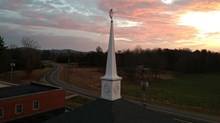
President Obama attended St. John's Church with his family in D.C. yesterday, an Episcopal church close to the White House.
An administration official told CT that the Obamas have not settled on a new permanent church. Obama attended the same church on Easter Sunday and Inauguration Day, but it's unclear whether there was a particular reason they visited St. John's yesterday.
The Associated Press caught video of Obama and his wife Michelle talking with the Rev. Luis León before leaving the church with Joshua Dubois, the director of the Office of Faith-Based and Neighborhood Partnerships:
Mike Angell, a seminarian of the church, posted a rough version of the sermon he gave on his blog:
We do not walk alone. Take a moment and look around this sanctuary. None of us walks this way alone. Christianity has consequences, and none of us can face those consequences alone. There is a danger to read the story of the rich man individualistically. We can make it a story about a man who has to individually choose whether or not he will follow Jesus. When Jesus invited the rich man to follow him, he invited him to join a community, a community boldly living life together in a new way. These followers of the way were later called Christians. Jesus walks beside us, and we walk beside our sisters and brothers, the body of Christ. Christianity has consequences, and none of us can face them alone. So I am excited to be here with you at St. John’s for the next couple of years. I am excited to walk with you and to boldly face, together, the consequences of our Christianity.
Here's the AP writes that several presidents have visited St. John's in the past because of its location and because it's familiar to the Secret Service.
A pew nine rows back from the altar carries a small brass plaque designating it as "The President's Pew." Former President George W. Bush often attended services, and church history claims that every president since James Madison, the nation's fourth chief executive, has visited.
The first service in the landmark church was held in 1816 and many former presidents have worshipped there.
Posted by Sarah Pulliam Bailey at October 12, 2009 | Comments (4)
President Obama was awarded the Nobel Peace Prize on Friday for his “extraordinary efforts to strengthen international diplomacy and cooperation between peoples,” especially his efforts to eliminate nuclear weapons.
The surprise move was praised by National Association of Evangelical President Leith Anderson and megachurch pastor Joel Hunter.
Leith Anderson
“I first heard the call for a world free of nuclear weapons from President Ronald Reagan when he addressed the National Association of Evangelicals over twenty-five years ago. The Nobel prize for President Obama acknowledges and perpetuates the Reagan vision.”
Joel Hunter, pastor of Northland—A Church Distributed
“The ambition to free future generations from the fear of indiscriminate destruction is a truly nonpartisan ambition that resonates with our deepest moral convictions. President Obama is to be congratulated for setting a course so that the generation that had school drills to hide under our desks in case of nuclear attack should be the source of a permanent recess from fear for our grandchildren.”
Tyler Wigg-Stevenson, founding director of the Two Futures Project
“There is much to be done and the road to a world free of nuclear weapons is daunting and long. But this Nobel Prize highlights the importance of setting that goal to guide our steps in the short term as we seek to shape a more secure world. To prevent nuclear terrorism, we must make progress toward the complete abolition of nuclear weapons. A new generation needs to deal once and for all with the legacy of the Cold War.” The Two Futures Project, a confessional Christian movement for the abolition of nuclear weapons, is sponsoring a track on preventing nuclear terrorism at today’s NAE-sponsored Evangelical Leaders Forum.
If people do criticize the prize, they might risk being aligned with terrorists by the Democratic National Committee.
"The Republican Party has thrown in its lot with the terrorists - the Taliban and Hamas this morning - in criticizing the President for receiving the Nobel Peace prize," DNC communications director Brad Woodhouse told Politico. "Republicans cheered when America failed to land the Olympics and now they are criticizing the President of the United States for receiving the Nobel Peace prize - an award he did not seek but that is nonetheless an honor in which every American can take great pride - unless of course you are the Republican Party."
What do you think? Does Obama deserve the prize?
Update: Cathy Ruse writes on Family Research Council's blog "President Obama Wins Nobel Peace Prize for…funding abortions overseas?"
"Mother Teresa called abortion the greatest destroyer of peace. But according to the Nobel committee, forcing taxpayers to fund it gets you a peace prize."
Posted by Sarah Pulliam Bailey at October 9, 2009 | Comments (43)
President Obama pitched government-funded health care as a “a core ethical and moral obligation” in a conference call open to the public tonight, saying that some people are "bearing false witness."
"This notion that we are somehow setting up death panels that would decide on whether elderly people get to live or die. That is just an extraordinary lie," he said. "You’ve heard that this is all going to mean government funding of abortion. Not true."
Obama also said his opponents have claimed that elderly Americans that a new health insurance system could jeopardize Medicare.
"Many of you have older members of your congregations. They’re all now scared to death that someone is talking about cutting Medicare benefits," he said. "That is again simply not true."
Faith in Public Life estimated that 140,000 people participated in the call.
"These are all fabrications that have been put out there in order to discourage people from meeting what I consider to be a core ethical and moral obligation," Obama said. "And that is that we look out for one another. That I am my brother’s keeper and my sister’s keeper."
Sojourners President Jim Wallis, Florida megachurch pastor Joel Hunter, and Director of the Domestic Policy Council Melody Barnes also spoke.
Earlier today, Family Research Council launched a new TV ad in five states that claims Obama’s health care plan will lead to publicly funded abortions.
President of FRC Tony Perkins released a statement responding to Obama's call.
"This evening, President Obama stated that abortion funding in health care reform is a 'distraction,'" he said. "If that is the case - then why not end this so-called 'distraction' and amend the bill to explicitly prohibit abortion funding and coverage with his health care plan?"
Posted by Sarah Pulliam Bailey at August 19, 2009 | Comments (96)
National Institutes of Health chief Francis Collins resigned from the BioLogos Foundation, the foundation he started in May as a way to reconcile faith and science, USA Today reports.
"I want to reassure everyone I am here to lead the NIH as best I can, as a scientist," Collins said, noting concerns.
The author of The Language of God: 'A Scientist Presents Evidence for Belief has been outspoken about his faith in the past.
''The NIH director needs to focus on science,'' Collins told the Associated Press on Monday. ''I have no religious agenda for the NIH.''
The AP reports that Collins resigned from the Web site the day before assuming his new job, but was proud of its work.
"I do think the current battle that's going on in our culture between extreme voices is not a productive one," he said. "The chance to play some kind of useful role in that conversation by pointing out the potential harmony was something that seemed to be making some inroads."
Update: Family Research Council's David Prentice responds to Collins, who supports using embryos for research and helped Obama craft his policy for the NIH. "Saying that one is a devout evangelical Christian while promoting embryo and cloning experiments, is a bit akin to claiming to be a devout Druid while promoting clear-cutting of forests," Prentice writes.
Posted by Sarah Pulliam Bailey at August 19, 2009 | Comments (12)
President Obama will address health care concerns during a public call-in with religious leaders tomorrow at 5 p.m. Eastern, as reported last week.
The press release states that a "high-level administration official" will answer questions, but a Faith in Public Life spokeswoman declined to give more details pending confirmation.
The call will be open to the public, streamed live, and include various religious leaders, including Florida megachurch pastor Joel Hunter, Kansas megachurch pastor Adam Hamilton, and Sojourners President Jim Wallis.
To listen to “40 Minutes for Health Reform,” log on to www.faithforhealth.org at 5 p.m. Eastern or call 347-996-5501.
Posted by Sarah Pulliam Bailey at August 18, 2009 | Comments (9)
The Department of Justice defended the Defense of Marriage Act again while claiming the law discriminates against gays, according to the Associated Press. "This administration does not support DOMA as a matter of policy, believes that it is discriminatory, and supports its repeal," government attorneys wrote. The DOJ asked the court to dismiss a lawsuit brought on by a gay couple who married in California last year.
"The administration believes the Defense of Marriage Act is discriminatory and should be repealed," said Justice Department spokeswoman Tracy Schmaler, because it prevents equal rights and benefits.
The Justice Department, she added, is obligated "to defend federal statutes when they are challenged in court. The Justice Department cannot pick and choose which federal laws it will defend based on any one administration's policy preferences."
The law prohibits federal recognition of same-sex marriage, permitting states to refuse to recognize same-sex marriages performed in other states. The White House issued the following statement by Obama.
"This brief makes clear, however, that my Administration believes that the Act is discriminatory and should be repealed by Congress. I have long held that DOMA prevents LGBT couples from being granted equal rights and benefits. While we work with Congress to repeal DOMA, my Administration will continue to examine and implement measures that will help extend rights and benefits to LGBT couples under existing law."
Posted by Sarah Pulliam Bailey at August 17, 2009 | Comments (177)
The Senate on Friday confirmed Francis Collins, a geneticist known for his role in decoding the human genome and dedication to bridging the gap between religion and science, as director of the National Institutes of Health (NIH).
Department of Health and Human Services Secretary Kathleen Sebelius announced Friday that Collins was unanimously confirmed by the Senate.
"Dr. Collins will be an outstanding leader," Sebelius said in a statement. "Today is an exciting day for NIH and for science in this country."
Collins, an evangelical Christian, authored the best-selling book The Language of God: A Scientist Presents Evidence for Belief, and established the BioLogos Foundation to promote harmony between Christian faith and scientific discovery.
Posted by Sarah Pulliam Bailey at August 10, 2009 | Comments (1)
President Obama has accepted an invitation to speak during a public call-in about health care reform on August 19. The call will be open to the public, streamed live, and include a coalition of religious groups ranging from Sojourners to Faith in Public Life to the National Baptist Convention. More details will be released this afternoon.
The coalition released the “40 Days for Health Reform” initiative this morning, including a national TV ad featuring Christians arguing for healthcare reform, prayer events, meetings with members of Congress, and a nationwide health care sermon weekend on August 28-30.
Posted by Sarah Pulliam Bailey at August 10, 2009 | Comments (19)
President Obama said the public should become less focused on whether abortion would be covered under federal healthcare in an interview with Katie Couric last night.
KATIE COURIC: Do you favor a government option that would cover abortions?PRESIDENT OBAMA: You know-- the-- the-- the-- what I think is important, at this stage, is not trying to micromanage what benefits are covered. Because I think we're still trying to get a framework. And my main focus is making sure that people have the options of high quality care at the lowest possible price.
As you know, I'm pro choice. But I think we also have a tradition-- of, in this town, historically, of not financing abortions as part of-- you know, government funded health care. And, you know, my-- you know, rather than wade into that issue at this point-- I think that it's appropriate for us to figure out how to just deliver on the cost savings, and not get distracted by the abortion debate at this station.
(h/t Kathryn Jean Lopez)
Obama's hope that it won't remain a distraction might not happen. Dan Gilgoff has a piece on how the abortion question might turn off more moderate evangelicals.
"I wouldn't call it a litmus test, but this is a prototype moment for the possibility of finding common ground," says the Rev. Joel Hunter, a prominent evangelical who is on Obama's faith advisory council. "If there is a doubt in the pro-life community about public funding of abortion, that will sink the healthcare
bill.""Moderate, pro-life evangelicals like me will be very unhappy if healthcare reform ends up becoming a vehicle for government subsidizing, or mandatory coverage, of abortion," adds David Gushee, a Christian ethics professor at Mercer University who has consulted with the Obama White House on other issues.
Politico's Ben Smith is also doing some coverage.
Posted by Sarah Pulliam Bailey at July 22, 2009 | Comments (6)
President Obama met with with Mormon president Thomas S. Monson today, a meeting that was prompted by Senate Majority Leader Harry Reid (D-Nev.), who is Mormon. Monson presented Obama with a breakdown of his family history.
"I enjoyed my meeting with President Monson and Elder Oaks. I'm grateful for the genealogical records that they brought with them and am looking forward to reading through the materials with my daughters," Obama said in a statement. "It's something our family will treasure for years to come."
The Salt Lake Tribune gives some background for the visit. Two church leaders attended Obama's inauguration and attended the a prayer service at the National Cathedral the next day. Former President George W. Bush stopped in Utah twice during his last term to talk with church officials.
Update: Here's the press release from the Church of Jesus Christ of Latter-day Saints.
Posted by Sarah Pulliam Bailey at July 20, 2009 | Comments (13)
President Obama chose Regina Benjamin as surgeon general earlier this week, earning initial praise for rebuilding her clinic after it was destroyed by Hurricane Katrina and than destroyed by a fire a year later. She has also done missionary work in Honduras was awarded a medal by Pope Benedict XVI in 2006.
But McClatchy reports that Benjamin "supports the president's position on reproductive health issues." White House spokesman Reid Cherlin said, "Like him she believes that this is an issue where it is important to try and seek common ground and come together to try and reduce the number of unintended pregnancies. As a physician, she is deeply committed to the philosophy of putting her patients' needs first when it comes to providing care."
Life News reports that in 1996, she spoke in favor of the American Medical Association's governing body vote to "urge medical schools to expand their curriculum" to teach "more about abortion."
A 2007 interview with the Catholic Digest suggests that her Catholic faith influences her medical practice.
“Church was always a very important part of my life,†Benjamin said. “I believe I am carrying on the healing ministry of Christ. I feel obligated to help continue his works. I think it’s important to make a difference in everything you do, even if it’s small.â€
Benjamin joins Secretary of Health and Human Services Kathleen Sebelius as pro-choice, Catholic officials who will handle health-related issues.
Meanwhile, confirmation hearings continue for Sonia Sotomayor, and Wall Street Journal columnist William McGurn wonders why her Catholic faith is not discussed more.
If the indifference to Ms. Sotomayor's Catholicism were truly a sign of a new respect for the "no religious test" provisions of the Constitution, that would be something to celebrate. But in the unlikely case that this "wise Latina" ever comes to see the legal wisdom of overturning Roe and returning abortion to the democratic process, we'll be reading a very different story.
Sotomayor has sidestepped questions that asked about her personal views on abortion, saying that Roe V. Wade is settled and "I will follow the law." She also said that Obama did not ask her opinion on abortion before he nominated her.
Posted by Sarah Pulliam Bailey at July 16, 2009 | Comments (3)
Christian groups took notice when President Obama chose evangelical scientist Francis Collins as the new head of the National Institutes on Health, despite some questions about his support for embryonic stem-cell research.
Michael Gerson writes for the Washington Post that his appointment signals that evangelicalism is growing up.
Collins's appointment says something good about the maturity of modern evangelicalism, which is starting to abandon some of its least productive debates with modernity. Criticisms of evolution, rooted in 19th-century controversies, have done little more than set up religious young people for entirely unnecessary crises of faith as they encounter scientific knowledge. In the running conflict of modern biology and evangelicalism, Collins is a peacemaker.
Gerson also writes that it signals maturity for President Obama. "In the process, Obama has affirmed something important: that anti-supernaturalism is not a litmus test at the highest levels of science," he writes.
If you want a few chuckles, take a look at this 2006 video where Stephen Colbert heckles Collins a little bit about science and faith.
| The Colbert Report | Mon - Thurs 11:30pm / 10:30c | |||
| Francis Collins | ||||
| ||||
Colbert asks, "Are you going to be the only Christian in hell?"
Posted by Sarah Pulliam Bailey at July 15, 2009 | Comments (9)
President Obama and Pope Benedict XVI will meet for the first time face-to-face on Friday during Obama's trip to Italy for the G8 summit.
The meeting will likely be characterized as a clash of the pro-life and pro-choice agendas. As early as November of last year, Time magazine predicted this meeting and asked: "Will the Pope and Obama Clash Over Abortion?" Abortion and other topics related to bioethics are expected to be raised at the meeting. Time's latest story reports:
To paint the Obama-meets-Benedict dossier in broad strokes, says one senior Vatican diplomat, "it's basically the reverse of Bush." In other words, the Pope tends to appreciate the new President's less aggressive approach to foreign affairs, while he disagrees on ethical matters such as abortion rights and stem-cell research - whereas President George W. Bush was seen by the Vatican as one of the few like-minded Western leaders on social issues, but whose invasion of Iraq was strongly opposed by the Vatican.
In preparation for the meeting, Obama reached out to the Catholic community in the U.S. at a roundtable with mostly-Catholic news service reporters on July 2. At the meeting, Obama emphasized his respect for the Catholic Church and referenced his personal experience with the social work of Cardinal Joseph Bernardin of Chicago, an early supporter of the Catholic Campaign for Human Development.
Obama said:
Cardinal Bernardin was strongly pro-life …never shrank from speaking about that issue, but was very consistent in talking about a seamless garment and a range of issues that were part and parcel of what he considered to pro-life, that meant he was concerned about poverty, he was concerned with how children were treated, he was concerned about the death penalty, he was concerned about foreign policy.
Dan Gilgoff at U.S. News noted that although most of Obama's responses were "trademark Obama" in their diplomacy, a few of his comments - particularly related to abortion and the administration's ongoing review of conscience clause rules for health workers - were surprising. Obama says:
I don't know any circumstance in which abortion is a happy circumstance or decision … and to the extent that we can help women avoid being confronted with a circumstance in which that's even a consideration, I think that's a good thing.
Read more about conscience clause rules at the Her.meneutics blog here and here.
Posted by Sarah Pulliam Bailey at July 8, 2009 | Comments (0)
Time magazine reports that President Obama has told his aides that his primary place of worship will be Evergreen Chapel, the nondenominational church at Camp David.
The White House has not made an official statement yet.
Update: White House Deputy Press Secretary Jen Psaki said by e-mail: "The President and First Family continue to look for a church home. They have enjoyed worshipping at Camp David and several other congregations over the months, and will choose a church at the time that is best for their family."
Amy Sullivan and Elizabeth Dias reported that a number of factors drove the decision - financial, political, personal, and being able to worship without being on display. At St. John's, worshippers snapped photos of Obama with their camera phones.
Carey Cash, who attended Southwestern Baptist Theological Seminary in Fort Worth and served as a chaplain in the Iraq War, preaches at the chapel.
If the White House had custom-ordered a pastor to be the polar opposite of Jeremiah Wright, they could not have come as close as Cash. (As it is, the White House had no hand in selecting Cash. The Navy rotates chaplains through Camp David every three years; Cash began his tour this past January.) The 38-year-old Memphis native is a graduate of the Citadel and the great-nephew of Johnny Cash. He served a tour as chaplain with a Marine battalion in Iraq and baptized nearly 60 Marines during that time. Cash earned his theology degree from Southwestern Baptist Theological Seminary in Fort Worth - and, yes, that means Obama's new pastor is a Southern Baptist.
Time reports that Obama will still looking for someone he can pray with and turn to for spiritual guidance. An earlier New York Times article reported that Obama's spiritual advisers have included Otis Moss, T. D. Jakes, Kirbyjon Caldwell, Jim Wallis, and Joel Hunter.
Posted by Sarah Pulliam Bailey at June 29, 2009 | Comments (168)
The Atlantic's Marc Ambinder has sifted through the National Journal profiles of 366 top officials in the Obama administration. Here's an interesting tidbit:
The percentage of white Christians among top officials whose religious affiliation is known dropped from 71 percent during Bush's second term to 46 percent in the Obama administration.
Posted by Sarah Pulliam Bailey at June 22, 2009 | Comments (12)
President Obama told an audience at the National Hispanic Prayer Breakfast that the country must be guided by the principle "love thy neighbor as thy self" as it seeks immigration reform.
"We must also clarify the status of millions who are here illegally, many who have put down roots," the President said. ""For those who wish to become citizens, we should require them to pay a penalty and pay taxes, learn English, go to the back of the line, behind those who played by the rules. ...We must give life to that fundamental belief that I am my brother's keeper, that I am my sister's keeper."
The president started his speech with his usual reminder that America is a nation of Christians, Muslims, Jews, Hindus and non-believers and spoke about the importance of prayer.
"But prayer is more than a last resort," he said. "Prayer helps us search for meaning in our own lives, and it helps us find the vision and the strength to see the world that we want to build."
Here's a portion of the speech as provided by the White House:
At a time when there's no shortage of challenges to occupy our time, it's even more important to step back, and to give thanks, and to seek guidance from each other -- but most importantly, from God. That's what we've come here to do.
We can begin by giving thanks for the legacy that allows us to come together. For it was the genius of America's Founders to protect the freedom of all religion, and those who practice no religion at all. So as we join in prayer, we remember that this is a nation of Christians and Muslims and Jews and Hindus and non-believers. It is this freedom that allows faith to flourish within our borders. It is this freedom that makes our nation stronger.
For those of us who draw on faith as a guiding force in our lives, prayer has many purposes. For many, it is a source of support when times are hard. President Lincoln, who Reverend Cortes mentioned, once said, "I have been driven many times upon my knees by the overwhelming conviction that I had nowhere else to go." And while the challenges that I've faced pale in comparison to Lincoln's, I know that more than once I've been filled with the same conviction over the last five months.
But prayer is more than a last resort. Prayer helps us search for meaning in our own lives, and it helps us find the vision and the strength to see the world that we want to build. And that's what I'd like to talk about for just a few minutes today.
As I look out at this audience, I'm reminded of the power of faith in America -- faith in God, and a faith in the promise of this great country. Each of us come from many different places. We trace our roots back to different nations, and we represent a broad spectrum of personal and political beliefs. But all of us pray to God. All of us share a determination to build a better future for our children and grandchildren. And that must be a starting point for common ground, and for the America that we want to build.
Like some of you, I am the son of a parent who came to these shores in search of a better future. And while I may be the first African American President, there is nothing unique or unusual about the opportunities that this country gave to me. Instead, like generations of Americans, I could count on the basic promise that no matter what you look like, or where you come from, America will let you go as far as your dreams and your hard work will carry you.
And that promise is at the heart of the American story. It's a story shared by many of you -- by clergy and members of Congress; by business leaders and community organizers. It's the story of every young child who has the opportunity to go farther in life than their parents were able to go. It's the story of a young girl who could rise from a public housing project to be nominated for the highest court in the land. (Applause.) And I am confident that it's a story that will someday be told by the first Hispanic President of the United States of America. (Applause.)
But we know there is much more work to be done to extend the promise of a better life to all our children and grandchildren. In all that we do, we must be guided by that simple command that binds all great religions together: Love thy neighbor as thyself.
In the 21st century, we've learned that this truth is central not just to our own lives, but to our success as a nation. If our children cannot get the world-class education they need to succeed, then America will not be able to compete with other countries. If our families cannot afford health care, then the costs go up for all of us -- individuals, businesses, and government. If folks down the street can't pay their mortgage and folks across town can't find a job, then that pain is going to trickle into other parts of our economy.
And that's why we've come together on behalf of the future that we want to build -- one where all of our children go to the best schools, all our people can go to work and make a living, all our families can afford health care; and prosperity is extended to everybody. Together, we must build a future where the promise of America is kept for a new generation.
We also know that keeping this promise means upholding America's tradition as a nation of laws and a nation of immigrants. Those things aren't contradictory; they're complementary. That's why I'm committed to passing comprehensive immigration reform as President of the United States. (Applause.)
The American people -- the American people believe in immigration, but they also believe that we can't tolerate a situation where people come to the United States in violation of the law, nor can we tolerate employers who exploit undocumented workers in order to drive down wages. That's why we're taking steps to strengthen border security, and we must build on those efforts. We must also clarify the status of millions who are here illegally, many who have put down roots. For those who wish to become citizens, we should require them to pay a penalty and pay taxes, learn English, go to the back of the line behind those who played by the rules. That is the fair, practical, and promising way forward, and that's what I'm committed to passing as President of the United States. (Applause.)
We must never forget that time and again, the promise of America has been renewed by immigrants who make their story part of the American story. We see it in every state of our country. We see it in our families and in our neighborhoods. As President, I've been honored to see it demonstrated by the men and women who wear the uniform of the United States.
Last month, I had the honor of welcoming a group of our service members as citizens for the very first time. In that crowd, there were faces from every corner of the world. And one man from Nicaragua -- Jeonathan Zapata -- had waited his whole life to serve our country even though he was not yet a citizen. "By serving in the military," he said, "I can also give back to the United States." He's done so in Afghanistan, and he even helped man the 400,000th aircraft landing aboard the USS Kitty Hawk.
And Jeonathan's story is not unique either. He's part of a proud legacy of service. For generations, Hispanic Americans have served with great commitment and valor, and there are now nearly 150,000 Hispanic Americans serving under our flag. And today we are proud -- (applause) -- today we are proud to welcome several of them who are wounded warriors recovering at Walter Reed. Please join me in honoring their service, and in keeping them and all of our troops in our thoughts and prayers -- please. (Applause.)
These troops have dedicated their lives to serving their fellow Americans. Their example -- like those of all of our men and women in uniform -- should challenge us to ask what we can do to better serve our communities and our country, because the greatest responsibility that we have as citizens is to one another.
That's the spirit we need to build; that's the America that we seek. And to do so, we must look past our divisions to serve the hopes and dreams that we hold in common. We must give life to that fundamental belief that I am my brother's keeper, that I am my sister's keeper.
Scripture tells us, "The word is very near to you. It is in your mouth and in your heart so you may obey it." Today, let us pray for the strength to find the word in our hearts, and for the vision to see the America that we can build together as one nation, and as one people.
Posted by Sarah Pulliam Bailey at June 19, 2009 | Comments (3)
Analysts and leading evangelicals are reacting pretty strongly to specific concerns about President Obama's "speech to the Muslim world" in Cairo on Thursday, including his definition of democracy, persecution by Muslims, support of Israel, and use of religion to support his goals.
National Review Online asked religious freedom activist Nina Shea, "Is there an 'Arab world' approach to religious freedom?"
She responded:
None of the Arab countries is ranked as "free" in the Center for Religious Freedom survey, though the degree of repression varies. Iran, Iraq, and Saudi Arabia are the worst, while Jordan, Morocco, Lebanon, and Oman are relatively better. All restrict minorities in varying degrees, and virtually all officially sponsor anti-Semitism. And all are intolerant of and punish apostates, heretics, blasphemers, and those who "insult" Islam. This has resulted in repressing converts from and critics of Islam as well as writers, scholars, artists, journalists, democracy activists, reformers, women's rights proponents, and others who exercise the right to free speech. This has contributed to the political, intellectual, and economic stagnation of this part of the world, as observed in the U.N.'s Arab Development Report.
Freedom House issued a statement applauding Obama's commitment to democracy. However, American Values President Gary Bauer, writing for Human Events, thought that Obama's stance for universal values was too broad:
Somewhere lost in all of the hype over Obama's outreach to the world is a sense that he stands most proudly as the American President. It's time for the president's soaring rhetoric to be applied in support of this great nation and its Judeo-Christian heritage.
Bauer also criticized Obama for neglecting to mention persecution by Muslims. Prior to the speech, Bauer had hoped that Obama would address the persecution of Christians in many Muslim countries. Bauer noted Obama singled out Saudi Arabia as a good example of "interfaith dialogue" even though last March the State Department placed the country on its list of severe violators of religious freedom. Bauer was disappointed that Obama worked harder to "ingratiate himself to Muslim leaders" than to criticize their faults:
[T]he president could have said so much more. The suppression of basic human rights is a fact of life throughout much of the Islamic world, and Muslim nations make up a large percentage of the State Department's list of the world's most severe violators of religious freedom. That list includes Saudi Arabia, and its dictator, King Abdullah, whose "counsel" Obama sought earlier this week in a trip to Riyadh.
Some in mainline Protestant circles found much to like in the Obama speech.
Reverand Mark S. Hanson, presiding bishop of the Evangelical Lutheran Church in America (ELCA), specifically praised Obama's use of the phrase "interfaith dialogue." The ECLA press release noted "the president's acknowledgment of the difficulty Palestinians - including Palestinian Christians - face because of the Israeli occupation. He said Obama challenged those who deny the Holocaust and called for Hamas to recognize Israel."
At Israel's Jerusalem Post, David Horovitz analyzed Obama's speech, and the applause he garnered, as a hopeful sign for Obama's goal for "a new beginning," but was less encouraged by Obama's repetition of his goal for peace through a two-state solution between Israel and Palestine.
Watching from here, his even-handed attribution of blame for the failure of peace efforts to date was jarring indeed. "For more than 60 years," the president declared, the Palestinian people "have endured the pain of dislocation. Many wait in refugee camps in the West Bank, Gaza and neighboring lands for a life of peace and security that they have never been able to lead."
To which most Israelis, having now witnessed even Ehud Olmert's ultra-generous two-state terms being derisively brushed aside by Mahmoud Abbas, would retort: "And whose fault is that?"
Horovitz also expressed concern regarding the president's "strikingly brief" discussion of Iran. In the speech, Obama repeated the stance he indicated on Tuesday to The Washington Post that Iran has "legitimate" use for nuclear power, so long as it's meant for energy not weapons. The issue is of particular concern for Israelis - who consider Iran's quest for nuclear power an heightened threat to their survival - and Gary Bauer has frequently raised the alarm in the conservative community regarding both Iran's and North Korea's intentions, saying that "it will take more than eloquent words to compel America's enemies to behave." The Christian Science Monitor has questioned whether Obama's hands-off stance toward North Korea's nuclear ambition could embolden Iran.
Finally, Obama's use of quotes from the Quran, along with his frequent references over the past week - and in the speech itself - to his personal experience with the Muslim faith, has also attracted attention. From the CatholicPRWire, columnist Chris Benguhe observed that compared to the way Obama "unequivocally supported Islam and the Muslim faith" in his speech in Cairo, his support of Christianity at Notre Dame last month was less apparent. Benguhe appreciated that the president acknowledged the importance of religious freedom, and added:
But now I wish our president would show the same respect and consideration for the religious convictions and sensitivities of us Christians here at home in his own country, and I really wish he would acknowledge how important Christianity is to this nation.
Posted by Tim Morgan at June 5, 2009 | Comments (10)
On the campus of Cairo University today, President Obama delivered a speech mainly addressed to the 1 billion plus followers of Islam around the world.
Cairo is recognized as the intellectual HQ of global Islam, so selection of Cairo as the venue for this speech was the easy part. I've read thru the transcript of the address and here are two stand-out ideas that I impressed me:
First idea: The US President bears a particular duty to resolve differences between the West and Islam.
Obama said:
We meet at a time of great tension between the United States and Muslims around the world -- tension rooted in historical forces that go beyond any current policy debate. The relationship between Islam and the West includes centuries of coexistence and cooperation, but also conflict and religious wars. More recently, tension has been fed by colonialism that denied rights and opportunities to many Muslims, and a Cold War in which Muslim-majority countries were too often treated as proxies without regard to their own aspirations. Moreover, the sweeping change brought by modernity and globalization led many Muslims to view the West as hostile to the traditions of Islam.
This is such an unusual formation to depict the core matter as tension between the Superpower United States and "Muslims around the world." Many non-Muslims will not agree with this conceptual framework.
Second idea: World peace hangs in the balance and peace-minded Christians, Muslims, and Jews should deploy "Golden Rule"-based ethics.
Here's the quote:
But we should choose the right path, not just the easy path. There's one rule that lies at the heart of every religion -- that we do unto others as we would have them do unto us. (Applause.) This truth transcends nations and peoples -- a belief that isn't new; that isn't black or white or brown; that isn't Christian or Muslim or Jew. It's a belief that pulsed in the cradle of civilization, and that still beats in the hearts of billions around the world. It's a faith in other people, and it's what brought me here today.
Once again, Obama draws on his core commitments to pragmatic approaches to address complex political situations. His call to "a new beginning" will seem so very naive to Middle East experts, but many have also under-estimated Obama. So don't count him out yet.
We all know that President Obama can deliver a potent speech and also has incredible political skills. Now that we have the speech out of the way, let's see how willing Team Obama is in tackling the impossible, such as:
1. Middle East Terrorism
2. The Status of Jerusalem
3. Iran and its nuclear program
4. Iraqi refugees (especially Christians)
5. Egypt's soon-to-arrive political transition
And that's just 5 of this region's many problems.
Posted by Tim Morgan at June 4, 2009 | Comments (8)
President Obama will choose U.S. Circuit Judge Sonia Sotomayor for the Supreme Court today, according to an AP report.
Sotomayor (SUHN'-ya soh-toh-my-YOR') will take retiring Justice David Souter's place if she is approved by the Senate. She would be the first Hispanic and third woman to serve on the Supreme Court.
According to the New York Times Caucus blog, Obama's short list included Federal Appeals Judge Diane P. Wood of Chicago, Homeland Security Secretary Janet Napolitano and Solicitor General Elena Kagan.
Obama will make the announcement at 10:15 Eastern. You can watch live on the White House website. Check back here for updates.
Posted by Sarah Pulliam Bailey at May 26, 2009 | Comments (1)

President Obama has pledged to make the war in Afghanistan a top foreign policy priority. He has maintained strong relations with Afghan President Hamid Karzai (inset photo) and spoke out in favor of winning the conflict there.
But the military strategy, just like the Bush administration, has come to dominate the American response from keeping the Karzai regime in power to fighting the Taliban.
From an evangelical point of view, the Obama administration goals do not seamlessly match up with gospel priorities. The situation is complicated significantly by the number of evangelicals in the Armed Services in Afghanistan and many of them are commited to spreading the gospel.
Note this recent article from Al Jazeera English language service:
US soldiers have been encouraged to spread the message of their Christian faith among Afghanistan's predominantly Muslim population, video footage obtained by Al Jazeera appears to show.
Military chaplains stationed in the US air base at Bagram were also filmed with bibles printed in the country's main Pashto and Dari languages.
In one recorded sermon, Lieutenant-Colonel Gary Hensley, the chief of the US military chaplains in Afghanistan, is seen telling soldiers that as followers of Jesus Christ, they all have a responsibility "to be witnesses for him".
"The special forces guys - they hunt men basically. We do the same things as Christians, we hunt people for Jesus. We do, we hunt them down," he says.
"Get the hound of heaven after them, so we get them into the kingdom. That's what we do, that's our business."
Here is the You Tube/Al Jazeera segment:
This entanglement of fervent faith and lethal military might sure looks like a potentially dangerous combination to me. What do you think?
This kind of effort touches on a wide collection of missiological issues. Certainly, Christians worldwide endorse the place of military chaplains and the universal right of people to spread their faith.
However, the US military mission gets intermingled with the freedom of religious expression and outreach. On the receiving end in Afghanistan, I imagine this is pretty confusing for Muslims.
Posted by Tim Morgan at May 19, 2009 | Comments (29)
President Obama addressed abortion for the first time since his election during his speech to Notre Dame graduates today.
"So let's work together to reduce the number of women seeking abortions by reducing unintended pregnancies, and making adoption more available, and providing care and support for women who do carry their child to term," Obama said to applause.
"I do not suggest that the debate surrounding abortion can or should go away," Obama said. "No matter how much we may want to fudge it ? indeed, while we know that the views of most Americans on the subject are complex and even contradictory ? the fact is that at some level, the views of the two camps are irreconcilable." He called for a respectful debate with "open hearts, open minds, fair-minded words."
Obama re-told his conversion story of how he worked as a community organizer with church members. "I found myself drawn ? not just to work with the church, but to be in the church," he said. "It was through this service that I was brought to Christ." Obama also noted his African American race and the 55th anniversary of the day that the Supreme Court handed down the decision in Brown v. Board of Education.
Here are some clips edited by the Associated Press:
Here's a video from Politico where a person in the audience starts to heckle Obama:
The full text of Obama's prepared remarks continue after the jump.
Thank you, Father Jenkins for that generous introduction. You are doing an outstanding job as president of this fine institution, and your continued and courageous commitment to honest, thoughtful dialogue is an inspiration to us all.
Good afternoon Father Hesburgh, Notre Dame trustees, faculty, family, friends, and the class of 2009. I am honored to be here today, and grateful to all of you for allowing me to be part of your graduation.
I want to thank you for this honorary degree. I know it has not been without controversy. I don't know if you're aware of this, but these honorary degrees are apparently pretty hard to come by. So far I'm only 1 for 2 as President. Father Hesburgh is 150 for 150. I guess that's better. Father Ted, after the ceremony, maybe you can give me some pointers on how to boost my average.
I also want to congratulate the class of 2009 for all your accomplishments. And since this is Notre Dame, I mean both in the classroom and in the competitive arena. We all know about this university's proud and storied football team, but I also hear that Notre Dame holds the largest outdoor 5-on-5 basketball tournament in the world ? Bookstore Basketball.
Now this excites me. I want to congratulate the winners of this year's tournament, a team by the name of "Hallelujah Holla Back." Well done. Though I have to say, I am personally disappointed that the "Barack O'Ballers" didn't pull it out. Next year, if you need a 6'2" forward with a decent jumper, you know where I live.
Every one of you should be proud of what you have achieved at this institution. One hundred and sixty three classes of Notre Dame graduates have sat where you are today. Some were here during years that simply rolled into the next without much notice or fanfare ? periods of relative peace and prosperity that required little by way of sacrifice or struggle.
You, however, are not getting off that easy. Your class has come of age at a moment of great consequence for our nation and the world ? a rare inflection point in history where the size and scope of the challenges before us require that we remake our world to renew its promise; that we align our deepest values and commitments to the demands of a new age. It is a privilege and a responsibility afforded to few generations ? and a task that you are now called to fulfill.
This is the generation that must find a path back to prosperity and decide how we respond to a global economy that left millions behind even before this crisis hit ? an economy where greed and short-term thinking were too often rewarded at the expense of fairness, and diligence, and an honest day's work.
We must decide how to save God's creation from a changing climate that threatens to destroy it. We must seek peace at a time when there are those who will stop at nothing to do us harm, and when weapons in the hands of a few can destroy the many. And we must find a way to reconcile our ever-shrinking world with its ever-growing diversity ? diversity of thought, of culture, and of belief.
In short, we must find a way to live together as one human family.
It is this last challenge that I'd like to talk about today. For the major threats we face in the 21st century ? whether it's global recession or violent extremism; the spread of nuclear weapons or pandemic disease ? do not discriminate. They do not recognize borders. They do not see color. They do not target specific ethnic groups.
Moreover, no one person, or religion, or nation can meet these challenges alone. Our very survival has never required greater cooperation and understanding among all people from all places than at this moment in history.
Unfortunately, finding that common ground ? recognizing that our fates are tied up, as Dr. King said, in a "single garment of destiny" ? is not easy. Part of the problem, of course, lies in the imperfections of man ? our selfishness, our pride, our stubbornness, our acquisitiveness, our insecurities, our egos; all the cruelties large and small that those of us in the Christian tradition understand to be rooted in original sin. We too often seek advantage over others. We cling to outworn prejudice and fear those who are unfamiliar. Too many of us view life only through the lens of immediate self-interest and crass materialism; in which the world is necessarily a zero-sum game. The strong too often dominate the weak, and too many of those with wealth and with power find all manner of justification for their own privilege in the face of poverty and injustice. And so, for all our technology and scientific advances, we see around the globe violence and want and strife that would seem sadly familiar to those in ancient times.
We know these things; and hopefully one of the benefits of the wonderful education you have received is that you have had time to consider these wrongs in the world, and grown determined, each in your own way, to right them. And yet, one of the vexing things for those of us interested in promoting greater understanding and cooperation among people is the discovery that even bringing together persons of good will, men and women of principle and purpose, can be difficult.
The soldier and the lawyer may both love this country with equal passion, and yet reach very different conclusions on the specific steps needed to protect us from harm. The gay activist and the evangelical pastor may both deplore the ravages of HIV/AIDS, but find themselves unable to bridge the cultural divide that might unite their efforts. Those who speak out against stem cell research may be rooted in admirable conviction about the sacredness of life, but so are the parents of a child with juvenile diabetes who are convinced that their son's or daughter's hardships can be relieved.
The question, then, is how do we work through these conflicts? Is it possible for us to join hands in common effort? As citizens of a vibrant and varied democracy, how do we engage in vigorous debate? How does each of us remain firm in our principles, and fight for what we consider right, without demonizing those with just as strongly held convictions on the other side?
Nowhere do these questions come up more powerfully than on the issue of abortion.
As I considered the controversy surrounding my visit here, I was reminded of an encounter I had during my Senate campaign, one that I describe in a book I wrote called The Audacity of Hope. A few days after I won the Democratic nomination, I received an email from a doctor who told me that while he voted for me in the primary, he had a serious concern that might prevent him from voting for me in the general election. He described himself as a Christian who was strongly pro-life, but that's not what was preventing him from voting for me.
What bothered the doctor was an entry that my campaign staff had posted on my website ? an entry that said I would fight "right-wing ideologues who want to take away a woman's right to choose." The doctor said that he had assumed I was a reasonable person, but that if I truly believed that every pro-life individual was simply an ideologue who wanted to inflict suffering on women, then I was not very reasonable. He wrote, "I do not ask at this point that you oppose abortion, only that you speak about this issue in fair-minded words."
Fair-minded words.
After I read the doctor's letter, I wrote back to him and thanked him. I didn't change my position, but I did tell my staff to change the words on my website. And I said a prayer that night that I might extend the same presumption of good faith to others that the doctor had extended to me. Because when we do that ? when we open our hearts and our minds to those who may not think like we do or believe what we do ? that's when we discover at least the possibility of common ground.
That's when we begin to say, "Maybe we won't agree on abortion, but we can still agree that this is a heart-wrenching decision for any woman to make, with both moral and spiritual dimensions.
So let's work together to reduce the number of women seeking abortions by reducing unintended pregnancies, and making adoption more available, and providing care and support for women who do carry their child to term. Let's honor the conscience of those who disagree with abortion, and draft a sensible conscience clause, and make sure that all of our health care policies are grounded in clear ethics and sound science, as well as respect for the equality of women."
Understand ? I do not suggest that the debate surrounding abortion can or should go away. No matter how much we may want to fudge it ? indeed, while we know that the views of most Americans on the subject are complex and even contradictory ? the fact is that at some level, the views of the two camps are irreconcilable. Each side will continue to make its case to the public with passion and conviction. But surely we can do so without reducing those with differing views to caricature.
Open hearts. Open minds. Fair-minded words.
It's a way of life that has always been the Notre Dame tradition. Father Hesburgh has long spoken of this institution as both a lighthouse and a crossroads. The lighthouse that stands apart, shining with the wisdom of the Catholic tradition, while the crossroads is where "?differences of culture and religion and conviction can co-exist with friendship, civility, hospitality, and especially love." And I want to join him and Father Jenkins in saying how inspired I am by the maturity and responsibility with which this class has approached the debate surrounding today's ceremony.
This tradition of cooperation and understanding is one that I learned in my own life many years ago ? also with the help of the Catholic Church.
I was not raised in a particularly religious household, but my mother instilled in me a sense of service and empathy that eventually led me to become a community organizer after I graduated college. A group of Catholic churches in Chicago helped fund an organization known as the Developing Communities Project, and we worked to lift up South Side neighborhoods that had been devastated when the local steel plant closed.
It was quite an eclectic crew. Catholic and Protestant churches. Jewish and African-American organizers. Working-class black and white and Hispanic residents. All of us with different experiences. All of us with different beliefs. But all of us learned to work side by side because all of us saw in these neighborhoods other human beings who needed our help ? to find jobs and improve schools. We were bound together in the service of others.
And something else happened during the time I spent in those neighborhoods. Perhaps because the church folks I worked with were so welcoming and understanding; perhaps because they invited me to their services and sang with me from their hymnals; perhaps because I witnessed all of the good works their faith inspired them to perform, I found myself drawn ? not just to work with the church, but to be in the church. It was through this service that I was brought to Christ.
At the time, Cardinal Joseph Bernardin was the Archbishop of Chicago. For those of you too young to have known him, he was a kind and good and wise man. A saintly man. I can still remember him speaking at one of the first organizing meetings I attended on the South Side. He stood as both a lighthouse and a crossroads ? unafraid to speak his mind on moral issues ranging from poverty, AIDS, and abortion to the death penalty and nuclear war. And yet, he was congenial and gentle in his persuasion, always trying to bring people together; always trying to find common ground. Just before he died, a reporter asked Cardinal Bernardin about this approach to his ministry. And he said, "You can't really get on with preaching the Gospel until you've touched minds and hearts."
My heart and mind were touched by the words and deeds of the men and women I worked alongside with in Chicago. And I'd like to think that we touched the hearts and minds of the neighborhood families whose lives we helped change. For this, I believe, is our highest calling.
You are about to enter the next phase of your life at a time of great uncertainty. You will be called upon to help restore a free market that is also fair to all who are willing to work; to seek new sources of energy that can save our planet; to give future generations the same chance that you had to receive an extraordinary education. And whether as a person drawn to public service, or someone who simply insists on being an active citizen, you will be exposed to more opinions and ideas broadcast through more means of communications than have ever existed before. You will hear talking heads scream on cable, read blogs that claim definitive knowledge, and watch politicians pretend to know what they're talking about. Occasionally, you may also have the great fortune of seeing important issues debated by well-intentioned, brilliant minds. In fact, I suspect that many of you will be among those bright stars.
In this world of competing claims about what is right and what is true, have confidence in the values with which you've been raised and educated. Be unafraid to speak your mind when those values are at stake. Hold firm to your faith and allow it to guide you on your journey. Stand as a lighthouse.
But remember too that the ultimate irony of faith is that it necessarily admits doubt. It is the belief in things not seen. It is beyond our capacity as human beings to know with certainty what God has planned for us or what He asks of us, and those of us who believe must trust that His wisdom is greater than our own.
This doubt should not push us away from our faith. But it should humble us. It should temper our passions, and cause us to be wary of self-righteousness. It should compel us to remain open, and curious, and eager to continue the moral and spiritual debate that began for so many of you within the walls of Notre Dame. And within our vast democracy, this doubt should remind us to persuade through reason, through an appeal whenever we can to universal rather than parochial principles, and most of all through an abiding example of good works, charity, kindness, and service that moves hearts and minds.
For if there is one law that we can be most certain of, it is the law that binds people of all faiths and no faith together. It is no coincidence that it exists in Christianity and Judaism; in Islam and Hinduism; in Buddhism and humanism. It is, of course, the Golden Rule ? the call to treat one another as we wish to be treated. The call to love. To serve. To do what we can to make a difference in the lives of those with whom we share the same brief moment on this Earth.
So many of you at Notre Dame ? by the last count, upwards of 80% -- have lived this law of love through the service you've performed at schools and hospitals; international relief agencies and local charities. That is incredibly impressive, and a powerful testament to this institution. Now you must carry the tradition forward. Make it a way of life. Because when you serve, it doesn't just improve your community, it makes you a part of your community. It breaks down walls. It fosters cooperation. And when that happens ? when people set aside their differences to work in common effort toward a common good; when they struggle together, and sacrifice together, and learn from one another ? all things are possible.
After all, I stand here today, as President and as an African-American, on the 55th anniversary of the day that the Supreme Court handed down the decision in Brown v. the Board of Education. Brown was of course the first major step in dismantling the "separate but equal" doctrine, but it would take a number of years and a nationwide movement to fully realize the dream of civil rights for all of God's children. There were freedom rides and lunch counters and Billy clubs, and there was also a Civil Rights Commission appointed by President Eisenhower. It was the twelve resolutions recommended by this commission that would ultimately become law in the Civil Rights Act of 1964.
There were six members of the commission. It included five whites and one African-American; Democrats and Republicans; two Southern governors, the dean of a Southern law school, a Midwestern university president, and your own Father Ted Hesburgh, President of Notre Dame. They worked for two years, and at times, President Eisenhower had to intervene personally since no hotel or restaurant in the South would serve the black and white members of the commission together. Finally, when they reached an impasse in Louisiana, Father Ted flew them all to Notre Dame's retreat in Land O'Lakes, Wisconsin, where they eventually overcame their differences and hammered out a final deal.
Years later, President Eisenhower asked Father Ted how on Earth he was able to broker an agreement between men of such different backgrounds and beliefs. And Father Ted simply said that during their first dinner in Wisconsin, they discovered that they were all fishermen. And so he quickly readied a boat for a twilight trip out on the lake. They fished, and they talked, and they changed the course of history.
I will not pretend that the challenges we face will be easy, or that the answers will come quickly, or that all our differences and divisions will fade happily away. Life is not that simple. It never has been.
But as you leave here today, remember the lessons of Cardinal Bernardin, of Father Hesburgh, of movements for change both large and small. Remember that each of us, endowed with the dignity possessed by all children of God, has the grace to recognize ourselves in one another; to understand that we all seek the same love of family and the same fulfillment of a life well-lived. Remember that in the end, we are all fishermen.
If nothing else, that knowledge should give us faith that through our collective labor, and God's providence, and our willingness to shoulder each other's burdens, America will continue on its precious journey towards that more perfect union. Congratulations on your graduation, may God Bless you, and may God Bless the United States of America.
Posted by Sarah Pulliam Bailey at May 17, 2009 | Comments (37)

More news about the fiscal 2010 Federal Budget is trickling out this week. Less than expected funding for treatment and prevention of HIV/AIDS, malaria, and TB is not what many public health professionals were hoping for.
In fact, some are saying President Obama has broken a campaign promise he made last year to increase by $1 billion the total amount allocated to fighting HIV/AIDS, TB, and malaria.
The Center for Global Health Policy said:
Leading disease experts said President Barack Obama's 2010 budget proposal for global health falls far short of what is needed to combat the deadly twin epidemics of HIV/AIDS and tuberculosis. Details on global health spending were released by the White House today, and a preliminary analysis indicates the President is proposing only $165 million in additional funding for bilateral AIDS as well as the US contribution to the Global Fund. "This proposal is even worse than we had feared. With this spending request, Obama has broken his campaign promise to provide $1 billion a year in new money for global AIDS, and he has overlooked the growing threat of tuberculosis," said the Center for Global Health Policy's Director, Christine Lubinski. While malaria receives a significant boost, Obama's call for a meager increase in the President's Emergency Plan for AIDS Relief (PEPFAR) budget is no match for the scope of the AIDS crisis, which killed 2 million people in 2007, nearly 5,500 a day. Obama's detailed budget blueprint comes as developing countries are struggling to preserve their fragile health systems. In several countries, drug shortages and treatment program cutbacks now threaten the lives of millions of HIV/AIDS and TB patients. This unfolding health crisis could quickly spread, as people who stop treatment become far more infectious. Treatment disruption can also lead to drug-resistance, an extremely expensive and potentially deadly development.
Meanwhile, the President has named his top person on HIV/AIDS. He is a career physician with a long-standing focus on HIV: Dr. Eric Goosby (photo above).
Click here for his bio.
Generally, the secular media has been supportive of this Clinton era appointee. POZ magazine notes:
"Dr. Goosby has always been an advocate for evidence-based prevention policy, a perspective that is much needed in our global response to the epidemic," said Kevin Robert Frost, CEO of The Foundation for AIDS Research (amfAR). "We must do more to implement evidence-based policies such as harm reduction and age-appropriate sex education, and Dr. Goosby has a keen understanding of what needs to be done." The Global AIDS Alliance also applauded Goosby's selection, but it is urging him to fulfill a campaign pledge to double U.S. foreign assistance from $25 billion to at least $50 billion by 2012. "The president's [Fiscal Year 2010] budget request is well below what is required to keep that promise," the group said in a statement, adding that Goosby "has a unique opportunity to hold the Obama administration accountable for its campaign promises to increase funding for prevention and treatment of HIV/AIDS overseas."
If you follow the global HIV/AIDS story, you know that HIV is spreading much more quickly than we can spend money to fight it effectively. It is also clear that in developed nations, such as the US and key Euro-zone nations, HIV is making a comeback. Call it the Third Wave of this pandemic if you wish.
Fighting HIV globally is a money/resources game right now.
If you don't spend the money now, you will spend it later after people are infected; then, they will need drugs every day for the rest of their lives to survive. Every year, more children are getting HIV; at the moment, there are more than 2 million kids who have the virus, according to UNAIDS estimates.
I suppose this sounds harsh, but:
I know some in public health who are now wondering why we are willing to spend trillions of tax dollars to save Citibank, AIG, GM, Chrysler, yet not fully fund the global fight against HIV.
Unless adequate money is spent each and every year, HIV will continue to take more lives year after year for the imaginable future.
HIV and AIDS look like they are going to get worse during the next four years.
Click here for the full statement from the Center for Global Health Policy.
Posted by Tim Morgan at May 7, 2009 | Comments (5)
The Obama administration says it will issue a proclamation marking the National Day of Prayer on Thursday, but appears to be moving away from the White House ceremonies hosted by former President George W. Bush.
"President Obama is a committed Christian and believes that we should be engaging Americans of faith in efforts to renew our country," a White House official said.
"He is following the tradition of Presidents Reagan, George H.W. Bush and others by signing a proclamation honoring the National Day of Prayer, while continuing to work with communities of faith to improve our country."
During Bush's eight years in office, prominent evangelicals, including National Day of Prayer Task Force chairman Shirley Dobson, and her husband, Focus on the Family founder James Dobson, gathered each year for an East Room ceremony on the first Thursday in May.
"We are disappointed in the lack of participation by the Obama administration," Shirley Dobson said in a statement issued by the task force on Monday. "At this time in our country's history, we would hope our president would recognize more fully the importance of prayer."
This year, task force organizers went ahead with their own plans and scheduled their traditional morning ceremonies on Capitol Hill for the morning, the same time of day when past White House events had been held. They asked for a White House representative to attend but had not received a response as of Monday.
At his press briefing on Friday, White House Press Secretary Robert Gibbs said the president's upcoming plans included signing a proclamation to recognize the prayer day.
The National Day of Prayer was signed into law in 1952 by President Truman. President Reagan amended the law in 1988 to state that the observances would be held the first Thursday in May.
Posted by Sarah Pulliam Bailey at May 4, 2009 | Comments (38)
As President Obama marked his first 100 days in office yesterday, a new Gallup poll shows that 41 percent of weekly church attenders supported Obama before the election, but the number has jumped to 57 percent.
Dan Gilgoff offers a round-up of what's happened in the last 100 days, but most of Obama's focus has been on the economy and more recently on the swine flu.
The Southern Baptist Convention's Richard Land has worked with presidential administrations going back to Ronald Reagan's, but he can't remember any that has convened an advisory council composedised mostly of religious leaders, as President Obama has done. The council gives religion "an institutionally higher profile than under President Bush," says the conservative Land, who directs public policy for the nation's largest evangelical denomination. "No president that I've dealt with has had anything like it."
During his press conference last night, Obama was asked whether he hopes Congress sends him the Freedom of Choice Act soon, which Obama said was not not highest legislative priority.
QUESTION: Thank you, Mr. President. In a couple of weeks, you're going to be giving the commencement at Notre Dame. And, as you know, this has caused a lot of controversy among Catholics who are opposed to your position on abortion.
As a candidate, you vowed that one of the very things you wanted to do was sign the Freedom of Choice Act, which, as you know, would eliminate federal, state and local restrictions on abortion. And at one point in the campaign when asked about abortion and life, you said that it was above -- quote, "above my pay grade."
Now that you've been president for 100 days, obviously, your pay grade is a little higher than when you were a senator.
Do you still hope that Congress quickly sends you the Freedom of Choice Act so you can sign it?
OBAMA: You know, the -- my view on -- on abortion, I think, has been very consistent. I think abortion is a moral issue and an ethical issue.
I think that those who are pro-choice make a mistake when they -- if they suggest -- and I don't want to create straw men here, but I think there are some who suggest that this is simply an issue about women's freedom and that there's no other considerations. I think, look, this is an issue that people have to wrestle with and families and individual women have to wrestle with.
The reason I'm pro-choice is because I don't think women take that -- that position casually. I think that they struggle with these decisions each and every day. And I think they are in a better position to make these decisions ultimately than members of Congress or a president of the United States, in consultation with their families, with their doctors, with their doctors, with their clergy.
So -- so that has been my consistent position. The other thing that I said consistently during the campaign is I would like to reduce the number of unwanted pregnancies that result in women feeling compelled to get an abortion, or at least considering getting an abortion, particularly if we can reduce the number of teen pregnancies, which has started to spike up again.
And so I've got a task force within the Domestic Policy Council in the West Wing of the White House that is working with groups both in the pro-choice camp and in the pro-life camp, to see if we can arrive at some consensus on that.
Now, the Freedom of Choice Act is not highest legislative priority. I believe that women should have the right to choose. But I think that the most important thing we can do to tamp down some of the anger surrounding this issue is to focus on those areas that we can agree on. And that's -- that's where I'm going to focus.
Posted by Sarah Pulliam Bailey at April 30, 2009 | Comments (7)
Artist Michael D'Antuono was planning to unveil "The Truth" - a portrait of President Obama wearing a crown of thorns and holding his hands in crucifix form - tomorrow in New York's Union Square to commemorate Obama's 100th day in office, but decided to cancel after receiving thousands of angry e-mails about the portrait's religious overtones.
The portrait, which shows Obama lifting a dark veil to reveal (or hide) the presidential seal, was not meant to offend Christians or make light of their beliefs, D'Antuono told Mark Hemingway of National Review Online. He explains:
The idea of the piece, or the reaction that I'd hoped for, was to highlight our nation's deep partisan divide and how our interpretation of the truth is really prejudiced by our political perspective and I think that to a large degree we are being manipulated by the media. I miss the old day when we just have the facts. Now we have pundits and spin and strategists.
I just thought that through that painting people would see different things. The right and the left would have different interpretations of it based on their political lens. But I have to admit I was very surprised that instead of that I got thousands of email[s] complaining on the religious front. And that was not my intent at all. I wanted to create a dialog politically but not religiously. I didn't mean to make fun of anybody's religion; maybe I did so naively but I didn't mean it that way. In the bible Jesus is The Truth and comparing Obama that way isn't something I meant to do at all.
Apparently, I've upset a lot of people. And I've decided that's not what I wanted to do and I'm not going to display it in the park on Wednesday ... art is meant to be somewhat provocative but the religious element went way farther than I had anticipated.
Whether D'Antuono is sincerely aiming for deep conversation or mere provocation is unclear; his own website describes the painting this way: "More than a presidential portrait, 'The Truth' is a politically, religiously and socially-charged statement on our nation's current political climate and deep partisan divide that is sure to create a dialogue."
He told Hemingway that the portrait may still appear in a gallery showing.
Posted by Katelyn Beaty at April 28, 2009 | Comments (11)
Citing the University of Notre Dame's decision to host President Obama at its May 17 commencement ceremony, former U.S. ambassador to the Vatican Mary Ann Glendon has declined to accept the school's prestigious Laetare Medal and to speak opposite Obama at commencement. In a letter sent this morning to Notre Dame president John Jenkins, Glendon, a pro-life Harvard Law School professor, writes:
"A commencement . . . is supposed to be a joyous day for the graduates and their families. It is not the right place, nor is a brief acceptance speech the right vehicle, for engagement with the very serious problems raised by Notre Dame's decision - in disregard of the settled position of the U.S. bishops - to honor a prominent and uncompromising opponent of the Church's position on issues involving fundamental principles of justice."
The "settled position" Glendon mentions is the U.S. Conference of Catholic Bishops' 2004 request that Catholic institutions "not honor those who act in defiance of our fundamental moral principles" and that such persons "should not be given awards, honors or platforms which would suggest support for their actions." Glendon also expresses concern that Notre Dame's decision could set off a "ripple effect" among U.S. Catholic universities.
President Jenkins released a brief response Monday: "We are, of course, disappointed that Professor Glendon has made this decision. It is our intention to award the Laetare Medal to another deserving recipient, and we will make that announcement as soon as possible."
Glendon's entire letter is below. See Francis Beckwith's response to Notre Dame's decision here, and Richard Mouw's and David Dockery's responses here.
April 27, 2009
The Rev. John I. Jenkins, C.S.C.
President
University of Notre DameDear Father Jenkins,
When you informed me in December 2008 that I had been selected to receive Notre Dame's Laetare Medal, I was profoundly moved. I treasure the memory of receiving an honorary degree from Notre Dame in 1996, and I have always felt honored that the commencement speech I gave that year was included in the anthology of Notre Dame's most memorable commencement speeches. So I immediately began working on an acceptance speech that I hoped would be worthy of the occasion, of the honor of the medal, and of your students and faculty.
Last month, when you called to tell me that the commencement speech was to be given by President Obama, I mentioned to you that I would have to rewrite my speech. Over the ensuing weeks, the task that once seemed so delightful has been complicated by a number of factors.
First, as a longtime consultant to the U.S. Conference of Catholic Bishops, I could not help but be dismayed by the news that Notre Dame also planned to award the president an honorary degree. This, as you must know, was in disregard of the U.S. bishops' express request of 2004 that Catholic institutions "should not honor those who act in defiance of our fundamental moral principles" and that such persons "should not be given awards, honors or platforms which would suggest support for their actions." That request, which in no way seeks to control or interfere with an institution's freedom to invite and engage in serious debate with whomever it wishes, seems to me so reasonable that I am at a loss to understand why a Catholic university should disrespect it.
Then I learned that "talking points" issued by Notre Dame in response to widespread criticism of its decision included two statements implying that my acceptance speech would somehow balance the event:
? "President Obama won't be doing all the talking. Mary Ann Glendon, the former U.S. ambassador to the Vatican, will be speaking as the recipient of the Laetare Medal."
? "We think having the president come to Notre Dame, see our graduates, meet our leaders, and hear a talk from Mary Ann Glendon is a good thing for the president and for the causes we care about."
A commencement, however, is supposed to be a joyous day for the graduates and their families. It is not the right place, nor is a brief acceptance speech the right vehicle, for engagement with the very serious problems raised by Notre Dame's decision - in disregard of the settled position of the U.S. bishops - to honor a prominent and uncompromising opponent of the Church's position on issues involving fundamental principles of justice.
Finally, with recent news reports that other Catholic schools are similarly choosing to disregard the bishops' guidelines, I am concerned that Notre Dame's example could have an unfortunate ripple effect.
It is with great sadness, therefore, that I have concluded that I cannot accept the Laetare Medal or participate in the May 17 graduation ceremony.
In order to avoid the inevitable speculation about the reasons for my decision, I will release this letter to the press, but I do not plan to make any further comment on the matter at this time.
Yours Very Truly,
Mary Ann Glendon
Mary Ann Glendon is Learned Hand Professor of Law at Harvard Law School. A member of the editorial and advisory board of First Things, she served as the U.S. Ambassador to the Vatican from 2007 to 2009.
Posted by Katelyn Beaty at April 27, 2009 | Comments (7)
The President and his wife gave $172,050 - about 6.5 percent of his gross income - to charities.
President Obama and his wife gave $172,050 - about 6.5 percent of his gross income - to charities in 2008, ABC News' Jake Tapper and Karen Travers report. The Obamas gave $8,050 - or .3 percent of their gross income - to churches and faith-based charities, which represented nine of the 37 charities, according to his tax return.
Here's a breakdown of some of the faith-based charity donations from Dan Gilgoff:
* $500 to Apostolic Church of God
* $200 to Brookland Baptist Church
* $500 to Brown AME Church
* $1,000 to Catholic Relief Services
* $150 to Crusade of Mercy
* $100 to First Lutheran Church
* $5,000 to New Orleans Area Habitat for Humanity
* $500 to St. Leo's Residence for Veterans
* $100 to St Luke's United Methodist Church
Vice President Joe Biden reported an income of $269,256 last year -- after taxes that comes to $183,315, according to ABC News. The VP's office says: "The charitable donations claimed by the Bidens on their tax returns are not the sum of their annual contributions to charity. They donate to their church, and they contribute to their favorite causes with their time, as well as their checkbooks."
The list of Obama's donations comes after the jump.
The biggest donations were $25,000 contributions to CARE and the United Negro College Fund, but other charities included AIDS Alliance for Children Youth & Families, American Red Cross, Apostolic Church of God, Book Worm Angels, Boys and Girls Club, Bread for the City, Brookland Baptist, Brown A.M.E. Church, Catholic Relief Services, Central Illinois Food Bank, Chicago Coalition for the Homeless, Citizens United for Research in Epilepsy, the president's alma mater Columbia University, Crusade of Mercy, Direct Relief International, First Lutheran Church, Greater Chicago Food Depository, Haiti Foundation of Hope, Illinois Coalition Against Sexual Assault, Illinois Head Start Association, Illinois Reading Council, Juvenile Diabetes Research Foundation, Martin Luther King National Memorial Project, Midtown Educational Foundation, Mujeres Latinas En Accion, National Coalition for Homeless Veterans, National Congress of Black Women, National MS Society, New Orleans Areas Habitat for Humanity, Ovarian Cancer National Alliance, Rochelle Lee/Boundless Readers, St. Leo's Residence for Veterans, St. Luke's united Methodist Church, The Christopher House, United Negro College Fund and United Way of Galveston.
Posted by Sarah Pulliam Bailey at April 16, 2009 | Comments (25)
Conservative Christian groups blasted a new report from the Department of Homeland Security on "rightwing extremism," calling it an example of "guilt by association" for linking anti-abortion activists with hate groups.
The 10-page "assessment" from the department stresses that the report is not based on specific threats.
"The HDS/Office of Intelligence and Analysis ... has no specific information that domestic rightwing terrorists are currently planning acts of violence," the April 7 report says, "but rightwing extremists may be gaining new recruits by playing on their fears about several emergent issues."
The report draws parallels between the "current national climate" with the 1990s, when there was evidence of "white supremacists' longstanding exploitation of social issues such as abortion, interracial crimes, and same-sex marriage."
It cites the economic downturn and the election of the nation's first African-American president as potential "drivers" for recruitment by rightwing groups.
Janice Shaw Crouse, director of Concerned Women for America's Beverly LaHaye Institute, called the report alarmist.
"It is the worst sort of extremism for a government agency to stir up fear against those groups who hold biblical views on social issues," Crouse said. "It is even worse to link those views with `interracial crimes.' What unconscionable guilt by association!"
In a statement released Wednesday, Homeland Security Secretary Janet Napolitano said the assessment is one of a series that is sent to law enforcement agencies across the country. The department also issued a Jan. 26 assessment on "leftwing extremists" that focused on potential cyber attacks.
"We don't have the luxury of focusing our efforts on one group; we must protect the country from terrorism whether foreign or homegrown, and regardless of the ideology that motivates its violence," she said. "We are on the lookout for criminal and terrorist activity but we do not -- nor will we ever -- monitor ideology or political beliefs."
Tony Perkins, president of the Family Research Council, called it "a shockingly biased new report," and Jay Sekulow, chief counsel of the American Center for Law and Justice, said it unfairly characterized those with anti-abortion views.
"This is an outrageous characterization that raises serious questions about the leadership and direction of the agency charged with protecting Americans in the ongoing battle against terrorism," said Sekulow.
Posted by Sarah Pulliam Bailey at April 15, 2009 | Comments (18)
Adding more fuel to the fire, President Obama's health secretary nominee Kathleen Sebelius received nearly three times as much money from an abortion doctor than she disclosed, according to the Associated Press.
Sebelius has already angered conservatives for her pro abortion stances. She told the Senate Finance Committee that she took money from from George Tiller, a late-term abortion provider, who was acquitted last month of charges that he performed 19 illegal late-term abortions in 2003.
She told the committee that she received $12,450 between 1994 and 2001 from Tiller. But Erica Werner at the AP reports that Tiller gave at least $23,000 more from 2000 to 2002 to a political action committee while Sebelius was state insurance commissioner so she could raise money for Democrats.
The Finance Committee was expected to vote this month on forwarding Sebelius' nomination to the full Senate. There was no immediate indication from committee Republicans that her omission on the Tiller contributions would upset that timing.
The anti-abortion group Operation Rescue, which is opposing Sebelius' nomination, circulated the campaign finance documents showing the discrepancy in what Sebelius told senators. The records were reviewed Monday by the AP and their accuracy was verified by the Kansas Governmental Ethics Commission.
Senators raised the issue of abortion only in written questions submitted to Sebelius after her hearing. Last week, Sebelius told the Senate that she does not anticipate issuing new abortion regulations if she is approved.
"I am personally opposed to abortion, and my faith teaches me that all life is sacred," she said. "I have tried to reduce unwanted pregnancies and thus curtail the need for abortion."
(h/t Mark Hemingway)
Posted by Sarah Pulliam Bailey at April 13, 2009 | Comments (1)
While aides scour the nation's capital for a new spiritual home for the first family, the Obamas spent Easter Sunday at an historic Episcopal church across the street from the White House.
It took the presidential motorcade less than two minutes to drive from 1600 Pennsylvania Ave. to St. John's of Lafayette Square, a small, yellow Episcopal church with an impressive presidential pedigree.
Every U.S. president since James Madison has attended a worship service at St. John's, according to the church, which reserves a pew -- No. 54 -- whenever the chief executive attends. Former President George W. Bush, a Methodist, made St. John's his unofficial D.C. church home; John Quincy Adams, James Monroe and Franklin Delano Roosevelt also worshipped there, said Gary S. Smith, a historian at Grove City College in Pittsburgh.
Obama himself attended St. John's, sometimes called the "church of the presidents," for a pre-inaugural prayer service on Jan. 20; several days earlier, he visited Nineteenth Street Baptist Church, one of the city's oldest black churches.
Joshua DuBois, head of the White House Office of Faith-based and Neighborhood Partnerships, said the Obamas have "not made a decision yet on which church they will formally join in Washington, but they were honored to worship with the parishioners at St. John's Episcopal Church and at Nineteenth Street Baptist Church earlier this year."
Decked out in Easter attire, all four Obamas -- the president, first lady Michelle, and daughters Sasha and Malia -- received Communion and heard the Rev. Luis Leon preach about the tension between faith and doubt.
"Don't be alarmed if you don't have 100 percent faith," said Leon, St. John's rector since 1995. "Do not be alarmed if you don't understand everything. It takes time to be a believer."
It has also taken time -- nearly three months and counting – for the Obamas to find a new spiritual home. They left Trinity United Church of Christ in Chicago, where they worshipped for nearly 20 years, last year after the broadcasting of controversial sermons by his former pastor, the Rev. Jeremiah Wright, nearly sunk Obama's campaign.
Smith, author of "Faith and the Presidency: From George Washington to George W. Bush," said St. John's provides safe harbor for a president with former pastor problems.
"It's a very safe choice for Easter, given its historic relationship with American presidents. ... If you've been burned, you want to be cautious."
But Smith and others say the Episcopal congregation, which is predominantly white, will probably not become the home church of the nation's first black president.
Obama writes movingly of his experience in the black church in his memoir "Dreams from My Father," and a White House aide told the newspaper Politico last week that there is "something compelling to him about the African American worship tradition. ... He has made his perspective pretty clear."
Presidential aides have scouted about a dozen churches in this city looking for a good fit. But it's a challenge to find a congregation that not only meets the first family's spiritual needs but also can accommodate a popular president and his considerable security detail, according to the White House.
Nearly any choice Obama makes will have political ramifications -- including choosing no church at all, says Smith. Religious conservatives, a constituency Obama has gone out of his way to court, are already disappointed with the president for opening funding for international family planning and embryonic stem cell research, as well as possibly rescinding the so-called conscience protections for healthcare workers.
"If you don't attend church it just adds another layer on there," said Smith.
Posted by Sarah Pulliam Bailey at April 13, 2009 | Comments (1)
Daniel Henninger says the Muslim world must be prepared to give it as well as receive it.
Daniel Henninger of the Wall Street Journal writes, "In short, the "respect" Mr. Obama promised to give Islam is going only in one direction. And he knows that." Henninger says the Muslim world can show its good will by treating Christians better. Here's a telling quote of the kinds of issues that he's talking about:
In Iraq, the situation for small religious minorities has become dire. Reports emerge regularly of mortal danger there for groups that date to antiquity -- Chaldean-Assyrians, the Yazidis and Sabean Mandaeans, who revere John the Baptist. Last fall the Chaldean-Assyrian archbishop of Mosul was kidnapped and murdered. Some Iraqi Christians believe the new government won't protect them, and talk of moving into a "homeland" enclave in Nineveh. Penn State Prof. Philip Jenkins, author of "The Lost History of Christianity," calls the Iraq situation "a classic example of a church that is killed over time."
Here's a link to my interview with Jenkins on this very subject.
Posted by Stan Guthrie at April 9, 2009 | Comments (3)
Barack Hussein Obama is back. His full name, that is.
As he fought rumors that he is a Muslim during the campaign, supporters of Obama rarely used his full name while conservative pundits frequently used his full name.
But Obama brought back his midde name Hussein during trips to France this week, according to Jonathan Martin at Politico
On Friday, at a town hall meeting in Strasbourg, France, he made an extemporaneous comment that would have been unthinkable on a campaign where female supporters wearing headscarves were once removed from a camera shot behind the candidate.
"I think that it is important for Europe to understand that even though I'm now president and George Bush is no longer president, al-Qaida is still a threat, and that we cannot pretend somehow that because Barack Hussein Obama got elected as president, suddenly everything is going to be OK," he told the audience.
Martin also writes that Turkish Prime Minister Recep Tayyip Erdogan, seeming to recognize the signal that using Obama's middle name sends, calling him "the distinguished president of the United States, Barack Hussein Obama."
Posted by Sarah Pulliam Bailey at April 8, 2009 | Comments (14)
The headline on President Obama's speech to the Turkish parliament is his statement that the U.S. is not at war with Islam, but for connoisseurs of religious politics, the real interest lies in this remark:
Freedom of religion and expression lead to a strong and vibrant civil society that only strengthens the state, which is why steps like reopening the Halki Seminary will send such an important signal inside Turkey and beyond. An enduring commitment to the rule of law is the only way to achieve the security that comes from justice for all people. Robust minority rights let societies benefit from the full measure of contributions from all citizens.
Since its opening on the site of an ancient monastery on an island in the Sea of Marmara in 1844, the Halki Seminary was the main school of theology for the Greek Patriarchate of Constantinople. Then, in 1971, the Turks closed the place, on the grounds that they didn't want religious institutions of higher learning to exist independent of the Turkish state. Oh, and the idea that this should become a center for education of world Orthodoxy didn't sit well with them either.
For years, the position of the American government has been that Halki Seminary should be reopened. Both houses of Congress passed resolutions to that effect in 1998, and the following year President Clinton actually visited the island and urged the same. It's now on the table in Turkey's negotiations to become part of the EU. So in one sense, Obama wasn't doing anything out of the ordinary. But just yesterday, he made waves in Europe by urging Turkey's admission to the EU--a position he reiterated in Ankara. ("Let me be clear: the United States strongly supports Turkey's bid to become a member of the European Union.") The Turks have real reason now to make a move.
Meanwhile, by speaking up strongly for Halki to the Turkish parliamentarians, Obama earned some cred with the Greeks in America--whose religious suzerain is the patriarch of Constantinople, Bartholomew. They had been annoyed that Obama met with him at his hotel rather than making a visit to the Phanar, where Bartholomew hangs his mitre. Win-win for the president as things stand, big win-win if Halki is permitted to reopen.
(Originally posted at Spiritual Politics.)
Posted by Sarah Pulliam Bailey at April 6, 2009 | Comments (0)
Ten percent of Americans still believe that President Barack Obama is a Muslim, the same percentage of those who believed the rumor during the campaign. As a group, evangelicals (19 percent) are the most likely to believe he's a Muslim, according to a new poll from the Pew Center for People and the Press.
Just 38 percent of white evangelicals and 46 percent of Republicans identify Obama as a Christian. During the campaign, Obama made frequent references to his Christian faith and fought smear campaigns that said he was a Muslim. But since he took office, Obama has made very few references to his faith.
In his decision to overturn former President Bush's policy on stem cell research, he said, "As a person of faith, I believe we are called to care for each other and work to ease human suffering."
He spoke more about his faith at the National Prayer Breakfast, when he announced the launch of his version of the faith-based initiatives.
I didn’t become a Christian until many years later, when I moved to the South Side of Chicago after college. It happened not because of indoctrination or a sudden revelation, but because I spent month after month working with church folks who simply wanted to help neighbors who were down on their luck – no matter what they looked like, or where they came from, or who they prayed to. It was on those streets, in those neighborhoods, that I first heard God’s spirit beckon me. It was there that I felt called to a higher purpose – His purpose.
Posted by Sarah Pulliam Bailey at April 2, 2009 | Comments (18)
President Obama's planned commencement speech at the University of Notre Dame continues to spark controversy, as the local Catholic bishop said he will boycott the event because some Obama policies contradict church teaching.
Bishop John D'Arcy of the Diocese of Fort Wayne-South Bend (Ind.) said Tuesday that "as a Catholic university, Notre Dame must ask itself, if by this decision it has chosen prestige over truth."
"President Obama has recently reaffirmed, and has now placed in public policy, his long-stated unwillingness to hold human life as sacred," D'Arcy said, "and has brought the American government, for the first time in history, into supporting direct destruction of innocent human life."
The young Obama administration has upset Catholic leaders by opening federal funding to international family planning groups and embryonic stem cell research, as well as proposing to rescind conscience protection rules for health care workers that were instituted by the Bush administration.
The Cardinal Newman Society, a watchdog for Catholic orthodoxy on college campuses, has launched an online petition to stop Obama from speaking at Notre Dame that has reportedly gathered more than 100,000 signatures.
There are 67 million Catholics in the U.S.
"We fully expected some criticism and have received it, though nothing more than we anticipated," Dennis K. Brown, a spokesman for Notre Dame told Catholic News Service. "I can't foresee us rescinding the invitation."
Posted by Sarah Pulliam Bailey at March 25, 2009 | Comments (14)
"He can't be here tonight, because he's busy getting ready for Easter," Vice President Joe Biden joked about President Obama at Saturday night's Gridiron dinner. "He thinks it's about him."
(h/t Dan Gilgoff)
Posted by Sarah Pulliam Bailey at March 23, 2009 | Comments (0)
A national grass-roots network that came together after the 9/11 terrorist attacks for the sole purpose of praying for the president has lost more than 25,000 members since Barack Obama's election last November.
But in that same time, more than 41,000 have signed up.
For John Lind, president of the Scottsdale, Ariz.-based Presidential Prayer Team, those figures indicate that the ministry that aimed to be nonpartisan when it began in 2001 has lived up to its mission.
"The only ... president we've been under has been (George W.) Bush, so you've got to be realistic and say, `Wow, this could be a substantial dip in our database,' but it wasn't," he said in an interview. "I think it's a positive. It's almost two-to-one new member to unsubscribed."
That doesn't mean it's been a smooth transition for all of the nearly half-million members who receive weekly e-mail updates guiding them in how to pray for the president. Some have sent the ministry messages saying that it has been "very difficult" to move from praying for Bush to praying for Obama.
"I did not want to pray for Obama because I didn't vote for him, but then I realized that I had to pray for him, and it has literally changed my life to pray for him," wrote a woman who only signed her name as "Betty."
"God really changes our hearts if we allow him to do so. So, thank you for your part in getting us all together."
Other team members, like Barbara Brown from Foresthill, Calif., said they realized that they needed to put prayer ahead of politics after Election Day.
Brown was quoted in a recent profile on the ministry's Web site: "I still have to remind some of my Democrat friends that no, President Obama did not inherit all of our nation's problems from President Bush's administration, and I have to remind some of my Republican friends that even though we did not vote for President Obama, he is now our president and he deserves our respect, honor and prayers as commanded by God."
Lind said since the ministry went online in 2001 it has had 1.7 million people take part in its initiatives, which include praying for not only the president and his administration but military members and grandparents.
The site featured several "40 Days to Pray the Vote" projects leading up to the election and "77 Days of Prayer" between Election Day and Inauguration Day. The latest initiative is "Praying Through the 1st 100 Days" of the Obama presidency; more than 31,500 people have signed up for a daily e-mail that provides them with a verse of Scripture and a short prayer at the start of each day.
"It just kind of jump-starts their day," said Lind.
Officials of the ministry say they don't have specific information about the party or church affiliation of their members, but they believe most have traditionally been evangelical Christians.
Peggy Gustave, who directs member services, estimates that about 95 percent are Christian. She is aware of some Jewish members and at least one Baha'i member. On a recent day, she said she received 1,500 e-mail messages.
"I think with some people, they kind of want to be encouraged to pray for this president, even if they see that some of his agenda may not follow their bent," she said. "We refer them back to our mission Scripture, ... which says to pray for those in authority over us. Period."
Lind offered similar encouragement when he recorded his latest message for "Presidential Club" members who donate $25 or more a month to the ministry, saying the prayer efforts for the Obama administration are necessary.
"He and his administration are facing ... enormous things on their plate," Lind said he told them. "We can't let our guard down."
In that message, Lind also mentioned that he and six board members prayed with Bush in person during a 26-minute visit to the Oval Office on his last full day as president.
He called the meeting "just a terrific time."
Bush spokesman Rob Saliterman confirmed that team members met with the former president on Jan. 19.
Lind said team officials hope to have the same opportunity with Obama.
"We've tried to kind of let the dust settle a little bit," he said. "We want an appointment with President Obama."
Posted by Sarah Pulliam Bailey at March 3, 2009 | Comments (4)
The Obama's may be settling on a puppy choice, but last I checked, President Obama has not found a church to call home. He's attended some private services, but a new article in Slate concludes that his church hopping habits may not be a bad thing.
Even if the American mania for shopping extends to our spiritual lives, church shopping still doesn't get much respect. But while it may be frequently derided as an example of rampant spiritual consumerism, shopping around can be one of the good things about the way religion is practiced in America.
Andrew Santella provides a nice round-up of the church shopping phenomenom, but I'm guessing his conclusion would horrify some church leaders. "In that sense, church shopping transfers a bit of power from the pulpit to the pews. And keeping a check on the power of church leaders is never a bad idea."
About 40 percent of Americans attend a religious service at least once a week while 58 percent of evangelicals do the same, according to the Pew Forum on Religion & Public Life. On the other hand, 61 percent of Americans say they are a member of a congregation, and 74 percent of evangelicals say the same.
Santella concludes, "So, the president shouldn't feel any need to rush into committing to a new church. When you have so many options, it pays to shop around."
Last year, president of Fuller Theological Seminary Richard Mouw wrote a more theological piece for CT examining why church shopping isn't the worth thing in the world.
Evangelicals probably care more about Obama's church attendance than they do his new puppy--so vote about that on today's on href="http://www.christianitytoday.com/ct/features/poll.html">CT's poll.
Posted by Sarah Pulliam Bailey at February 27, 2009 | Comments (55)
I was recently telling a Democratic friend about Obama's abortion balancing act. One day he repeals the Mexico City "gag rule" delighting pro-choice activists. The next week he seems intent on making it up to pro-life voters, announcing that one priority of a new faith-based council will be reducing the need for abortion.
My friend interrupted and said, "why should we care about appeasing the pro-lifers? We won."
The first reason, I said, is because Obama promised.
But then I thought about the word "we." Obviously my friend was making a realpolitick assumption that his side, the Obama coalition, was almost entirely pro-choice. But is that really true?
No. Pro-lifers made up a meaningful percentage of Obama's winning coalition. Professor John Green of University of Akron, czar of all religion-and-politics polling, reports that based on not-yet-released survey conducted in December, about a quarter of Obama's vote came from pro-lifers, defined as people "wanting serious restrictions on abortion, but not necessarily a full ban on abortions." What's more, Green will report, about one third of young voters who went for Obama are pro-life.
These findings comport with Beliefnet's own less scientific user survey.
Now obviously, pro-choicers made up an even bigger portion of his coalition. But pro-lifers comprised a surprisingly big minority.
As a point of reference, this would mean that pro-lifers made up a bigger percentage of Obama's vote than....union members, white Catholics, Jews, gays, Latinos or 18-21 year olds.
As a good Democrat, you'd never think of being so cavalier with those groups, why would you blow off the pro-lifers?
The strong showing comes in part because Obama improved with Latinos, evangelicals, Catholics, and regular church-goers. Obama doesn't have to act on abortion right away -- most of Obama's religious voters care more about the economy than abortion -- but he also shouldn't think that he can abandon his abortion reduction promises without political consequences.
(Originally posted at Steve Waldman's blog at Beliefnet.)
Posted by Sarah Pulliam Bailey at February 12, 2009 | Comments (22)
President Obama signed an executive order establishing the new White House Office of Faith-Based and Neighborhood Partnerships.
As expected, Obama named Joshua DuBois as the head of the office. The order says the office will look to "reduce the need for abortion." The office's top priority will be making community groups an important part of economic recovery and reducing poverty. The office will also encourage responsible fatherhood and work with the National Security Council to allow interfaith dialogue around the world.
Evangelicals on an advisory council include Richard Stearns, President of World Vision, Frank S. Page, President emeritus of the Southern Baptist Convention, Joel C. Hunter, Pastor of Northland, a Church Distributed, and Jim Wallis, President of Sojourners.
The full press release is below:
Washington (February 5, 2009) ? President Barack Obama today signed an executive order establishing the new White House Office of Faith-Based and Neighborhood Partnerships. The White House Office of Faith-Based and Neighborhood Partnerships will work on behalf of Americans committed to improving their communities, no matter their religious or political beliefs.
"Over the past few days and weeks, there has been much talk about what our government's role should be during this period of economic emergency. That is as it should be ? because there is much that government can and must do to help people in need," said President Obama. "But no matter how much money we invest or how sensibly we design our policies, the change that Americans are looking for will not come from government alone. There is a force for good greater than government. It is an expression of faith, this yearning to give back, this hungering for a purpose larger than our own, that reveals itself not simply in places of worship, but in senior centers and shelters, schools and hospitals, and any place an American decides."
The White House Office for Faith-Based and Neighborhood Partnerships will be a resource for nonprofits and community organizations, both secular and faith based, looking for ways to make a bigger impact in their communities, learn their obligations under the law, cut through red tape, and make the most of what the federal government has to offer.
President Obama appointed Joshua DuBois, a former associate pastor and advisor to the President in his U.S. Senate office and campaign Director of Religious Affairs, to lead this office. "Joshua understands the issues at stake, knows the people involved, and will be able to bring everyone together ? from both the secular and faith-based communities, from academia and politics ? around our common goals," said President Obama.
The Office of Faith Based and Neighborhood Partnerships will focus on four key priorities, to be carried out by working closely with the President's Cabinet Secretaries and each of the eleven agency offices for faith-based and neighborhood partnerships:
The Office's top priority will be making community groups an integral part of our economic recovery and poverty a burden fewer have to bear when recovery is complete.
It will be one voice among several in the administration that will look at how we support women and children, address teenage pregnancy, and reduce the need for abortion.
The Office will strive to support fathers who stand by their families, which involves working to get young men off the streets and into well-paying jobs, and encouraging responsible fatherhood.
Finally, beyond American shores this Office will work with the National Security Council to foster interfaith dialogue with leaders and scholars around the world.
As the priorities of this Office are carried out, it will be done in a way that upholds the Constitution ? by ensuring that both existing programs and new proposals are consistent with American laws and values. The separation of church and state is a principle President Obama supports firmly ? not only because it protects our democracy, but also because it protects the plurality of America's religious and civic life. The Executive Order President Obama will sign today strengthens this by adding a new mechanism for the Executive Director of the Office to work through the White House Counsel to seek the advice of the Attorney General on difficult legal and constitutional issues.
The Office of Faith Based and Neighborhood Partnerships will include a new President's Advisory Council on Faith-Based and Neighborhood Partnerships, composed of religious and secular leaders and scholars from different backgrounds. There will be 25 members of the Council, appointed to 1-year terms.
Members of the Council include:
Judith N. Vredenburgh, President and Chief Executive Officer, Big Brothers / Big Sisters of America
Philadelphia, PA
Rabbi David N. Saperstein, Director & Counsel, Religious Action Center of Reform Judaism, and noted church/state expert
Washington, DC
Dr. Frank S. Page, President emeritus, Southern Baptist Convention
Taylors, SC
Father Larry J. Snyder, President, Catholic Charities USA
Alexandria, VA
Rev. Otis Moss, Jr., Pastor emeritus, Olivet Institutional Baptist Church
Cleveland, OH
Eboo S. Patel, Founder & Executive Director, Interfaith Youth Corps
Chicago, IL
Fred Davie, President, Public / Private Ventures, a secular non-profit intermediary
New York, NY
Dr. William J. Shaw, President, National Baptist Convention, USA
Philadelphia, PA
Melissa Rogers, Director, Wake Forest School of Divinity Center for Religion and Public Affairs and expert on church/state issues
Winston-Salem, NC
Pastor Joel C. Hunter, Senior Pastor, Northland, a Church Distributed
Lakeland, FL
Dr. Arturo Chavez, Ph.D., President & CEO, Mexican American Cultural Center
San Antonio, TX
Rev. Jim Wallis, President & Executive Director, Sojourners
Washington, DC
Bishop Vashti M. McKenzie, Presiding Bishop, 13th Episcopal District, African Methodist Episcopal Church
Knoxville, TN
Diane Baillargeon, President & CEO, Seedco, a secular national operating intermediary
New York, NY
Richard Stearns, President, World Vision
Bellevue, WA
Posted by Sarah Pulliam Bailey at February 5, 2009 | Comments (14)
The Obama administration will delay a decision on whether religious groups who hire based on the religious background of job applicant can receive federal funding, the Associated Press reports.
The decision will impact whether evangelical groups like World Vision can receive money from the new White House Office of Faith-based and Neighborhood Partnerships.
President Obama will order a legal review of hiring practices for faith-based groups currently participating in White House faith-based initiatives, the AP reports.
The Wall Street Journal reports that Obama will expand the mission to include abortion reduction and outreach to the Muslim world. Hiring issues should be decided on a case-by-case basis, Joshua DuBois, the 26-year-old former campaign advise told Laura Meckler.
"The president found one of the problems with the previous initiative was that tough questions were decided without appropriate consideration and data," DuBois told the WSJ. President Obama, he said, "doesn't have an interest in rushing questions that are so complex."
Instead, the president will sign an executive order making clear that the director of the new office should seek guidance from the Department of Justice on specific legal issues regarding "how to respect the Constitution" and nondiscrimination laws, Mr. DuBois said.
Dan Gilgoff at U.S. News & World Report writes that Obama's decision mirrors a central recommendation from a report released last December by the Brookings Institution, which recommended that the administration commission a study on the issue.
The study would focus on such questions as: When they are permitted by law or policy to do so, how many religious organizations actually do discriminate in employment matters on the basis of religion in federally-funded programs and activities? To what extent do they do so? Does such discrimination affect a small number of positions, or a larger share? Do religious providers view nondiscrimination obligations to be a hindrance or a help to their work? What does state and local law say on these matters, or what has been common practice? How easy is it for religious providers to segregate government funds from private funds for the payment of employees' salaries? Under various kinds of policies, how many federally-funded jobs would be off-limits to potential employees who did not share the organization's faith commitments?
Posted by Sarah Pulliam Bailey at February 5, 2009 | Comments (2)
WASHINGTON -- President Obama referenced his plan to allow federal funding to faith-based organizations at the National Prayer Breakfast this morning.
In his the first religiously-themed speech of his presidency, Obama addressed a large gathering of Republicans and Democrats and other leaders at the Washington Hilton hotel. He Obama emphasized in his speech that his plan for the faith-based initiatives will not favor any religious group over another or religious groups over secular groups.
It will simply be to work on behalf of those organizations that want to work on behalf of our communities, and to do so without blurring the line that our founders wisely drew between church and state. This work is important, because whether it's a secular group advising families facing foreclosure or faith-based groups providing job-training to those who need work, few are closer to what's happening on our streets and in our neighborhoods than these organizations. People trust them. Communities rely on them. And we will help them.
Obama also spoke about the common themes found in religions. "No matter what we choose to believe, let us remember that there is no religion whose central tenet is hate," Obama said. "There is no God who condones taking the life of an innocent human being. This much we know."
He also spoke about his father's conversion from atheism to Islam, his mother's resistance to organized religion, and his own path to Christianity.
I didn't become a Christian until many years later, when I moved to the South Side of Chicago after college. It happened not because of indoctrination or a sudden revelation, but because I spent month after month working with church folks who simply wanted to help neighbors who were down on their luck ? no matter what they looked like, or where they came from, or who they prayed to. It was on those streets, in those neighborhoods, that I first heard God's spirit beckon me. It was there that I felt called to a higher purpose ? His purpose.
Here's a short portion of his speech.
C-SPAN has a full video and below are his prepared remarks:
Good morning. I want to thank the Co-Chairs of this breakfast, Representatives Heath Shuler and Vernon Ehlers. I'd also like to thank Tony Blair for coming today, as well
as our Vice President, Joe Biden, members of my Cabinet, members of Congress, clergy, friends, and dignitaries from across the world.
Michelle and I are honored to join you in prayer this morning. I know this breakfast has a long history in Washington, and faith has always been a guiding force in our family's life, so we feel very much at home and look forward to keeping this tradition alive during our time here.
It's a tradition that I'm told actually began many years ago in the city of Seattle. It was the height of the Great Depression, and most people found themselves out of work.
Many fell into poverty. Some lost everything.
The leaders of the community did all that they could for those who were suffering in their midst. And then they decided to do something more: they prayed. It didn't
matter what party or religious affiliation to which they belonged. They simply gathered one morning as brothers and sisters to share a meal and talk with God.
These breakfasts soon sprouted up throughout Seattle, and quickly spread to cities and towns across America, eventually making their way to Washington. A short time
after President Eisenhower asked a group of Senators if he could join their prayer breakfast, it became a national event. And today, as I see presidents and dignitaries here from every corner of the globe, it strikes me that this is one of the rare occasions that still brings much of the world together in a moment of peace and goodwill.
I raise this history because far too often, we have seen faith wielded as a tool to divide us from one another ? as an excuse for prejudice and intolerance. Wars have been
waged. Innocents have been slaughtered. For centuries, entire religions have been persecuted, all in the name of perceived righteousness.
There is no doubt that the very nature of faith means that some of our beliefs will never be the same. We read from different texts. We follow different edicts. We subscribe to different accounts of how we came to be here and where we're going next ? and some subscribe to no faith at all.
But no matter what we choose to believe, let us remember that there is no religion whose central tenet is hate. There is no God who condones taking the life of an innocent human being. This much we know.
We know too that whatever our differences, there is one law that binds all great religions together. Jesus told us to "love thy neighbor as thyself." The Torah commands, "That which is hateful to you, do not do to your fellow." In Islam, there is a hadith that reads "None of you truly believes until he wishes for his brother what he wishes for himself." And the same is true for Buddhists and Hindus; for followers of Confucius and for humanists. It is, of course, the Golden Rule ? the call to love one another; to understand one another; to treat with dignity and respect those with whom we share a brief moment on this Earth.
It is an ancient rule; a simple rule; but also one of the most challenging. For it asks each of us to take some measure of responsibility for the well-being of people we
may not know or worship with or agree with on every issue. Sometimes, it asks us to reconcile with bitter enemies or resolve ancient hatreds. And that requires a living,
breathing, active faith. It requires us not only to believe, but to do ? to give something of ourselves for the benefit of others and the betterment of our world.
In this way, the particular faith that motivates each of us can promote a greater good for all of us. Instead of driving us apart, our varied beliefs can bring us together to feed the hungry and comfort the afflicted; to make peace where there is strife and rebuild what has broken; to lift up those who have fallen on hard times. This is not only our call as people of faith, but our duty as citizens of America, and it will be the purpose of the White House Office of Faith-Based and Neighborhood Partnerships that
I'm announcing later today.
The goal of this office will not be to favor one religious group over another ? or even religious groups over secular groups. It will simply be to work on behalf of those
organizations that want to work on behalf of our communities, and to do so without blurring the line that our founders wisely drew between church and state. This
work is important, because whether it's a secular group advising families facing foreclosure or faith-based groups providing job-training to those who need work, few are closer to what's happening on our streets and in our neighborhoods than these organizations. People trust them. Communities rely on them. And we will help them.
We will also reach out to leaders and scholars around the world to foster a more productive and peaceful dialogue on faith. I don't expect divisions to disappear overnight, nor do I believe that long-held views and conflicts will suddenly vanish. But I do believe that if we can talk to one another openly and honestly, then perhaps old rifts will start to mend and new partnerships will begin to emerge. In a world that grows smaller by the day, perhaps we can begin to crowd out the destructive forces of
zealotry and make room for the healing power of understanding.
This is my hope. This is my prayer.
I believe this good is possible because my faith teaches me that all is possible, but I also believe because of what I have seen and what I have lived.
I was not raised in a particularly religious household. I had a father who was born a Muslim but became an atheist, grandparents who were non-practicing Methodists and Baptists, and a mother who was skeptical of organized religion, even as she was the kindest, most spiritual person I've ever known. She was the one who taught me as a child to love, and to understand, and to do unto others as I would want done.
I didn't become a Christian until many years later, when I moved to the South Side of Chicago after college. It happened not because of indoctrination or a sudden revelation, but because I spent month after month working with church folks who simply wanted to help neighbors who were down on their luck ? no matter what they looked like, or where they came from, or who they prayed to. It was on those streets, in those neighborhoods, that I first heard God's spirit beckon me. It was there that I felt called to a higher purpose ? His purpose.
In different ways and different forms, it is that spirit and sense of purpose that drew friends and neighbors to that first prayer breakfast in Seattle all those years ago, during another trying time for our nation. It is what led friends and neighbors from so many faiths and nations here today. We come to break bread and give thanks and seek guidance, but also to rededicate ourselves to the mission of love and service that lies at the heart of all humanity. As St. Augustine once said, "Pray as though everything depended on God. Work as though everything depended on you."
So let us pray together on this February morning, but let us also work together in all the days and months ahead. For it is only through common struggle and common effort, as brothers and sisters, that we fulfill our highest purpose as beloved children of God. I ask you to join me in that effort, and I also ask that you pray for me, for my family, and for the continued perfection of our union. Thank you.
Posted by Sarah Pulliam Bailey at February 5, 2009 | Comments (11)
Unless my cell phone is not allowed for some reason, I'll be twittering during the National Prayer Breakfast in Washington this morning. A spokesman for the breakfast declined to say who the keynote speaker will be, but Roll Call is reporting that Tony Blair will address the crowd. Barack Obama is expected to attend before he announces details about the faith-based initiatives.
Update: Here were my tweets during the prayer breakfast. My phone's predictive text spelled Sen. Kirsten Gillibrand's name wrong, but it's corrected below.
Joe Biden just arrived at the National Prayer Breakfast in Washington.
The chief of the Eastern Band of Cherokee Indians offered the Lord's Prayer in Cherokee and English.
Barack and Michelle Obama have arrived and Casting Crowns will sing.
Rep. Jo Ann Emerson from Mo. read from Gen. 33:1-12.
Senators Amy Klobuchar of Minn. and Johnny Isakson talk about Senate prayer breakfast. Amy saved the grits from being taken off the menu.
The new senator from NY Kirsten Gillibrand (corrected) read from Matt. 5:14-16 and spoke briefly about God's light and love for the world.
Reps Ike Skelton and Todd Akin offer prayers for nation and world leaders. Tony Blair will speak now.
Blair said religion is under attack from inside and out. He said "Only God can forgive completely in the knowledge of our sin."
Blair spoke about the common good in every religion. Said when courage fails faith can lift one up.
Obama insists that he and Blair prepared separately but also spoke about common value in religion: love your neighbor as yourself.
Obama referenced his plan to unveil plans for the faith-based initiatives. Said it would not favor no particular faith.
Obama spoke about his becoming a Christian after spending time with church members who helped neighbors. "I heard Gods spirit beckon me."
Posted by Sarah Pulliam Bailey at February 5, 2009 | Comments (8)
The Obama administration will announce a diverse advisory council and details about the new White House Office for Faith-Based and Neighborhood Partnerships on Thursday, according to the Associated Press.
AP reporter Eric Gorski's source says that representation from the gay, lesbian, bisexual and transgender community is also anticipated.
Here's on the list so far, according to the source:
-The Rev. Joel Hunter, an Orlando, Fla.-area evangelical megachurch pastor who was consulted by the Obama campaign and prayed privately with Obama over the phone the night he was elected.
-Bishop Vashti McKenzie, the first female bishop in the African Methodist Episcopal Church.
-The Rev. Frank Page of Taylors, S.C., the most recent past president of the conservative Southern Baptist Convention, the nation's largest Protestant denomination.
-Rabbi David Saperstein, director of the Washington-based Religious Action Center of Reform Judaism, a public policy arm of Judaism's liberal Reform branch.
-Judith Vredenburgh, president and chief executive officer of Big Brothers and Big Sisters of America.
The new office will be announced the same day Obama is expected to appear at the annual National Prayer Breakfast in Washington.
Posted by Sarah Pulliam Bailey at February 3, 2009 | Comments (4)
The economic stimulus bill includes a provision for funding $100 million for grants to faith-based organizations, Howard M. Friedman notes on Religion Clause.
According to page 141 of bill, half of the amount would become available October 1, 2009. Friedman also notes that a proposed amendment by Rep. Susan Davis of California would increase the total appropriation to $500 million.
Posted by Sarah Pulliam Bailey at January 28, 2009 | Comments (10)
President Barack Obama has told congressional Democrats to drop a proposal to spend money on family planning from the proposed $825 billion plan to stimulate the economy, a White House aide told McClatchy.
Obama is likely to offer that concession when he meets Tuesday with congressional Republicans, who've complained bitterly that the proposal is liberal pork that has nothing to do with stimulating the economy or creating jobs.
(Originally posted at Steve Waldman's blog at Beliefnet.)
Posted by Sarah Pulliam Bailey at January 27, 2009 | Comments (3)
President Obama chose an Arabic network for his first television interview, saying that his administration will offer friendship to the Muslim world but will hunt down terrorists that kill innocent civilians. Politico has the full transcript.
In an interview with the Al-Arabiya satellite television network, Obama emphasized his Muslim background and relatives, telling Muslims "that the Americans are not your enemy. We sometimes make mistakes. We have not been perfect."
"And what we need to understand is, is that there are extremist organizations -- whether Muslim or any other faith in the past -- that will use faith as a justification for violence," Obama told the network. "We cannot paint with a broad brush a faith as a consequence of the violence that is done in that faith's name."
Paul Schemm of the Associated Press reports on the reaction from those in the Arab world, saying that they have been more cautious about the new president than other parts of the world. Obama said that he would address the Muslim world from a Muslim capital in the first 100 days of his administration, but no location has been announced.
"America is a country of Muslims, Jews, Christians, non-believers -- regardless of your faith, people all have certain common hopes and common dreams," Obama said on the network. Several people noted Obama's inclusion of non-believers in the religion lineup in his inaugural address as well.
Posted by Sarah Pulliam Bailey at January 27, 2009 | Comments (3)
President Obama signed an executive order called the "Mexico City policy," which reverses a ban on funding international groups that provide abortions.
Ronald Reagan first implemented the policy that prohibited the U.S. from funding programs that offer abortion overseas. Bill Clinton reversed the policy in 1993 while George W. Bush restored it in 2001.
The Associated Press writes, "Obama signed it quietly, without coverage by the media, late on Friday afternoon, a contrast to the midday signings with fanfare of executive orders on other subjects earlier in the week."
Abortion opponents are sending their outraged press releases while progressives are essentially saying "at least he didn't do it yesterday."
Charmaine Yoest, President & CEO of AUL Action: "What a terrible way to begin a new administration: with an abortion business bailout that will exploit women in developing countries for political ends. We should not export the tragedy of abortion to other nations, and we certainly shouldn't do so via the hard-earned dollars of American taxpayers."
Jim Wallis of Sojourners: "I am encouraged that President Obama’s first action on abortion was to release a statement supporting a common ground approach to reducing abortion, even as he also reiterated his policy of supporting legal choice. Even more significant was his decision not to issue an executive order rescinding the 'Mexico City policy' on the day of the anniversary of the Roe decision and the annual March for Life."
Obama has spoken several times on the desire to reduce unintended pregnancy, but he reiterated his support for Roe v. Wade yesterday on the Supreme Court decision's anniversary.
Posted by Sarah Pulliam Bailey at January 23, 2009 | Comments (24)
Barack Obama has made a point of telling anyone who will listen how important faith is to him. The president-elect speaks the language of faith fluently, for the most part, and he has made a special effort to reach out to evangelicals. But a report in his hometown Chicago Tribune notes that Obama has scarcely appeared at Sunday worship since his famous falling out with Rev. Jeremiah Wright. According to the Trib, "he has not attended a public church service since before being elected, a departure from the actions of his two immediate predecessors."
Noting that he doesn't want to make a commitment to a church before moving to the nation's capital, and worrying about his possibly disruptive presence with other worshipers, Obama says he relies on pastor friends and his own private prayer in the interim.
Yet the president-elect says he will find a church once the move is complete. "We frankly haven't thought about it yet," Obama told the Tribune, "because right now we're just trying to make sure that we don't lose anything in the move, including our children."
Another Obama predecessor cited concerns that he would be a disruption as a factor in his own spotty church attendance as president. His name was Ronald Reagan.
Posted by Stan Guthrie at December 29, 2008 | Comments (27)
Dan Gilgoff, formerly of Beliefnet, briefly interviewed Clark Evans, the Library of Congress's head of reference services, rare books, and special collections division about the Bible Barack Obama will use at the inauguration.
Before the election, we cross-posted several posts from Gilgoff when he was politics editor at Beliefnet. He has moved to a new role at U.S. New & World Report and has an excellent new politics & religion blog.
In the interview, Evans tells Gilgoff that the Bible has an inscription.
On the back flyleaf, you find the seal of the Supreme Court and a record of the event written out by William Thomas Carroll. What jumps out at you is that the Supreme Court justice at the time [who administered the oath to Lincoln] was Robert Taney, who had written the majority opinion in the Dred Scott decision of 1857 that permitted slavery to spread into the territories. There was a palpable tension between the justice and the president.
Posted by Sarah Pulliam Bailey at December 23, 2008 | Comments (0)
Evangelist Franklin Graham knows a thing or two about getting flack for praying at an inauguration. He took heat after praying in Jesus's name at President Bush's inauguration in 2001. I just spoke with Franklin Graham, who gave his take on Obama's decision to ask megachurch pastor Rick Warren to give the invocation at his inauguration. We have also compiled our coverage of Warren over the years in a special section.
Here are some highlights from the interview:
[Obama] is including evangelicals at his inauguration, but I don't know if he'll include them in his administration. Time will tell. But Rick Warren will have Obama's ear on important issues.
Does Warren's acceptance of the invitation give an implicit nod to Obama's administration?
For anybody to be upset at Rick Warren for offering a prayer to almighty God, asking God to give wisdom and guidance to the Obama administration, is ludicrous.
Should Rick Warren pray in the name of Jesus at the inaugural?
I would hope he does because he's a minister of the gospel. There's no other way to pray. A Muslim should not be offended. [Warren] has no other way to pray than in the name of Christ. No one should be offended, because Rick Warren should be who Rick Warren is, and that's a minister of Jesus Christ.
I know you said a month ago that your father would not be serving as a spiritual adviser to Barack Obama.
He's 90 years old. He's just happy to get up in the morning.
Do you have any advice for Rick Warren?
My advice to Rick is to stay true to your convictions, and don't back up one step. I don't think he will. When you have the far left and the gay advocates mad at you, you must be doing something right.
Posted by Sarah Pulliam Bailey at December 23, 2008 | Comments (18)
Barack Obama will be sworn into office using President Abraham Lincoln's Bible, the first time it has been used since its original use in 1861.
Perhaps the news will snuff out the false rumors that Obama would choose the Koran. Or maybe it will distract people from the Rick Warren pick for a few minutes.
The press release from the transition team about the Bible is after the jump.
"Washington, D.C. - On January 20th, President-elect Barack Obama will take the oath of office using the same Bible upon which President Lincoln was sworn in at his first inauguration. The Bible is currently part of the collections of the Library of Congress. Though there is no constitutional requirement for the use of a Bible during the swearing-in, Presidents have traditionally used Bibles for the ceremony, choosing a volume with personal or historical significance. President-elect Obama will be the first President sworn in using the Lincoln Bible since its initial use in 1861.
'President-elect Obama is deeply honored that the Library of Congress has made the Lincoln Bible available for use during his swearing-in,' said Presidential Inaugural Committee Executive Director Emmett Beliveau. 'The President-elect is committed to holding an Inauguration that celebrates America's unity, and the use of this historic Bible will provide a powerful connection to our common past and common heritage.' "
More from the transition's release:
"The Lincoln Bible will be available for a press viewing between 11:00 AM and Noon today in the Members' Room on the first floor of the Library of Congress' Thomas Jefferson Building at 10 First St. S.E. in Washington, D.C. Video and still cameras are permitted. Media should allow 10-15 minutes to clear security at the First Street entrance to the Jefferson Building. Clark Evans, who heads the Reference Services Section of the Rare Book and Special Collections Division of the Library of Congress, will also be available at that time to answer questions about the Lincoln Bible and the Library. High-resolution photographs of the Bible are also available upon request. RSVP is not required. Please contact the PIC Communications Office with questions.
The Bible was originally purchased by William Thomas Carroll, Clerk of the Supreme Court, for use during Lincoln's swearing-in ceremony on March 4, 1861. The Lincoln family Bible, which is also in the Library of Congress's collection, was unavailable for the ceremony because it was packed away with the First Family's belongings, still en route from Springfield, IL, to their new home at the White House.
The Bible itself is bound in burgundy velvet with a gold-washed white metal rim around the three outside edges of both covers. All its edges are heavily gilded. In the center of the top cover is a shield of gold wash over white metal with the words 'Holy Bible' chased into it. The book is 15 cm long, 10 cm wide, and 4.5 cm deep when closed. The 1,280-page Bible was published in 1853 by the Oxford University Press.
Annotated in the back of the volume, along with the Seal of the Supreme Court, is the following: 'I, William Thomas Carroll, clerk of the said court do hereby certify that the preceding copy of the Holy Bible is that upon which the Honble. R. B. Taney, Chief Justice of the said Court, administered to His Excellency, Abraham Lincoln, the oath of office as President of the United States ...'
The Lincoln Inaugural Bible will be on display at the Library of Congress February 12th to May 9th, 2009, as part of an exhibition titled "With Malice Toward None: The Abraham Lincoln Bicentennial Exhibition." The exhibit will then travel to five other American cities. The Library is planning several other events and programming in commemoration of the bicentennial of the birth of the nation's 16th president, who was born on February 12th, 1809.
On March 4, 2009, the 147th anniversary of Lincoln's first inauguration, the Library of Congress will also be convening an all-day symposium with several renowned Lincoln scholars."
Posted by Sarah Pulliam Bailey at December 23, 2008 | Comments (13)
President-elect Barack Obama urged Illinois Gov. Rod Blagojevich to resign from office, Obama's spokesman said in a statement today.
"The president-elect agrees with Lt. Governor Quinn and many others that under the current circumstances it is difficult for the Governor to effectively do his job and serve the people of Illinois," spokesman Robert Gibbs said.
Reader Brad Flora sent me this link from the Windy City about how members of the Eastern Orthodox church aren't excited to be linked to Blagojevich. Here's a portion from Kate Shellnutt:
Today, though, Serbian Americans - and even more broadly, members of the Eastern Orthodox church - aren't pleased to see the non-stop news reports about the country's only Serbian Orthodox governor.
Blagojevich now lives in Ravenswood Manor, but he said during an interview for his run for governor that he currently doesn't attend a single church regularly. Still, as the son of Serbian immigrants to Chicago, he remains an icon for the Serbian-American population and remains active in their religious community.
Posted by Sarah Pulliam Bailey at December 10, 2008 | Comments (3)
A mini debate has exploded on several blogs over whether President-elect Barack Obama can call himself a Christian.
If you're just catching up, first read this 2004 interview with Obama, but here are the relevant sections.
FALSANI: Who's Jesus to you? (Obama laughs nervously)
OBAMA: Right. Jesus is an historical figure for me, and he's also a bridge between God and man, in the Christian faith, and one that I think is powerful precisely because he serves as that means of us reaching something higher. And he's also a wonderful teacher. I think it's important for all of us, of whatever faith, to have teachers in the flesh and also teachers in history.
On Sin
FALSANI: What is sin?
OBAMA: Being out of alignment with my values.
FALSANI: What happens if you have sin in your life?
OBAMA: I think it's the same thing as the question about heaven. In the same way that if I'm true to myself and my faith that that is its own reward, when I'm not true to it, it's its own punishment.
On Hell
Obama: ?There's the belief, certainly in some quarters, that people haven't embraced Jesus Christ as their personal savior that they're going to hell.
FALSANI: You don't believe that?
OBAMA: I find it hard to believe that my God would consign four-fifths of the world to hell.
I can't imagine that my God would allow some little Hindu kid in India who never interacts with the Christian faith to somehow burn for all eternity. That's just not part of my religious makeup.
On Heaven
FALSANI: Do you believe in heaven?
OBAMA: Do I believe in the harps and clouds and wings?
FALSANI: A place spiritually you go to after you die?
OBAMA: What I believe in is that if I live my life as well as I can, that I will be rewarded. I don't presume to have knowledge of what happens after I die. But I feel very strongly that whether the reward is in the here and now or in the hereafter, the aligning myself to my faith and my values is a good thing.
Here are just some of the bloggers weighing in.
1. Obama is not a orthodox Christian. He may call himself a "Christian" in the same way that some Unitarians use the term to refer to themselves. But his beliefs do not seem to be in line with the historic definition.
2. In the 20 years that Obama attended Trinity, did he never hear a clear exposition of the Gospel? Did the Rev. Jeremiah Wright never once preach on the need for a saving faith in Christ? If not, then that is more scandalous than any of the anti-American remarks Wright made from the pulpit.
3. Although I already pray for Obama (as the Bible commands me to do) I now realize that I also need to pray for his eternal soul and not just that he be an effective leader of our nation. I also pray that he will find a spiritual leader who will help lead him to a true knowledge of Christ.
Unless Obama was being incredibly and uncharacteristically inarticulate, this is heterodox. You cannot be a Christian in any meaningful sense and deny the divinity of Jesus Christ. You just can't.
So when people say "I am a Christian" I accept them at their word, just as I hope that they accept me at my word when I make the same claim.
But the conversation doesn't have to end there, does it? It seems to me that, having taken President-elect Obama at his word when he claims the Christian faith, we can then go on to discuss what he thinks Christianity is, who he thinks who Jesus is, what obligations he believes a Christian takes on by virtue of being a Christian, and so on. And as that conversation proceeds we might say to him that we think his understanding of Christianity sadly limited, or the place of Christ in his theology to be insufficient and wrong-headed, or whatever.
Rod and Carter are correct that by any formal, credal standard of traditional Christianity in any confession, Obama is heterodox. It is important to distinguish this from the more loaded question of whether or not he is a Christian. It is relatively easy to demonstrate heterodoxy, but more difficult to show non-Christianity, and this is as it should be.
Now it's true that if he had been asked about Christ's nature, Bush - or Ronald Reagan, to take another conservative President with an idiosyncratic religious sensibility - might have given a more Nicaean answer than Obama did in the interview in question. But then again maybe not! (And God only knows what John McCain, the most pagan Presidential contender we've had in some time, might have said.)
The Incarnation is just such a bridge and a mystery. I guess I find a modern Christianity that is not attuned to that mystery, not willing to reimagine and undergo God in ways that may not always merely repeat orthodoxy to be ... well, moribund as a faith. I don't think Obama's engagement with it to be unChristian, merely modern.
So I'll end with this: It seems that there is one sine qua non for Christianity, and it was articulated by St. Paul in Romans 10:9,
That if you confess with your mouth, "Jesus is Lord," and believe in your heart that God raised him from the dead, you will be saved.
And it is abundantly clear that Barack Obama has, on many occasions, affirmed that Jesus is Lord.
I have nothing to offer, except to offer our readers a place to comment (on theology, not Obama's politics).
Posted by Sarah Pulliam Bailey at November 18, 2008 | Comments (85)
As Barack Obama scopes out his family's new home, most of the buzz seems to be focused on his daughters' education.
But Amy Sullivan at Time wants to know where Obama plans to go to church. Sullivan cleverly interviews a few who offer their advice.
On the short list? People's Congregational Church, Metropolitan Memorial United Methodist Church, Metropolitan A.M.E. Church, Church of the Epiphany, Washington Community Fellowship, and Memorial Chapel at Fort Myer.
Is there an obvious choice? What do you think?
Posted by Sarah Pulliam Bailey at November 17, 2008 | Comments (13)
The situation in east Africa is already evolving into a major test of the world's resolve to prevent another genocide from developing.
This time, it's eastern DR Congo. This region of the world has proven to be a safe haven for militias of all kinds, including groups responsible in part for the 1994 genocide in Rwanda.
This area of eastern Africa has been the setting for some of the world's worst humanitarian disasters. Think Darfur, genocide in Rwanda, Burundi, the LRA killings in northern Uganda, deadly political reprisals in Kenya.
It has traumatized by HIV, malaria, TB, the list of horrors goes on and on.
Vice President-elect Joe Biden was right: Obama is going to face a major foreign policy test. But the timing is all wrong. The test starts right now, professor Obama. The US and the international community are already looking to Obama for guidance about what to do.
All of Washington is in transition mode. But time marches on. This week, I spoke by phone at length with an very high level foreign policy official under the Bush administration. He is very active in this part of Africa, working for peace implementation.
For global evangelicals, he had some important words, which I will partially quote, where he specifically addressed evangelical advocacy:
The more people who follow what is going on ... the better. The more they’re kicking up dust in the press and with their elected representatives the better. Because my view, Tim, is there are lots of things the United States of America has to deal with, a lot of things at home as this economic meltdown shows, and also a lot of challenges beyond our shores. And the first priority of this President and the President-elect is our national security and protecting vital interests.
One can argue these issues of moral necessity are less compelling. What’s made America great are the values and the faith upon which we were founded. Therefore, those values and that faith have to animate our foreign policy. But they get crowded off the stage by the immediate.
If it’s mischief by Russia in Georgia, if it’s Ahmadinejad in Iran trying to get nuclear weapons, the list goes on ... Our humanity and, frankly, the American ideal compel us to deal with difficult issues especially when it grows to the point where you have massive ethnic cleansing and genocide.
So my view is the more people that are raising Cain the better. And the more they do to try to get members of the House and Senate to raise Cain the better, I think 99 percent of Americans fundamentally want the same thing even if we disagree on the best way to get there.
We just need to keep some of the Americans engaged and recognize that we have a moral obligation to act.
For starters:
White House comment line: 1-202-456-1111
President George W. Bush: president@whitehouse.gov
Vice President Richard Cheney: vice.president@whitehouse.gov
To my knowledge, the Obama transition team does not have a comment line set up as yet.
If you have ideas for advocacy and action, email me or post them below:
Posted by Tim Morgan at November 14, 2008 | Comments (4)
That provocative title leads the latest podcast discussion between Collin Hansen, a Christianity Today editor at large, and Stan Guthrie, CT's managing editor of special projects.
Collin points to some Bible verses on how Christians should respond (hint, he doesn't encourage people to declare "Armageddon"). But he does say the election has serious consequences and was "very painful" for people fighting against abortion.
Last week, Ted Olsen, CT's managing editor of news & online journalism, gave a helpful overview of the election results.
You can subscribe to the RSS feed, iTunes feed, or search for "Christianity Today" on the iTunes store.
Posted by Sarah Pulliam Bailey at November 11, 2008 | Comments (0)
Joel Hunter wasn't the only religious leader on Barack Obama's list of people to call. Obama also sought out controversial gay bishop Gene Robinson three times during his campaign, Ruth Gledhill of the The Times in London reports.
"The first words out of [Obama's] mouth were: ?Well you're certainly causing a lot of trouble,' My response to him was: ?Well that makes two of us.'" "He said that Mr Obama had indicated his support for equal civil rights for gay and lesbian people and described the election as a "religious experience."
Robinson is the openly gay bishop whose consecration led several Episcopalian conservatives to split from the church.
In other non-political but important religion news, a third diocese split from the church today. The Diocese of Fort Worth, will vote next week on whether to do the same.
Posted by Sarah Pulliam Bailey at November 8, 2008 | Comments (26)
In the fall of 1976, I was in the sixth grade in Shreveport, Louisiana, at Claiborne Elementary, a school that had an all-white student population just three years before. By the mid-1970s, the enrollment was half-black.
In that fall’s presidential election, President Ford was running against Jimmy Carter. Our teacher, Mr. Stewart, asked his sixth-graders to write what we thought should be the qualifications to be president of the United States. I wrote something and waited for everybody else to finish.
Sitting at the desk next to me was a black kid. I happened to glance at his paper. He wrote that the president of the United States should be white.
Blacks and whites didn't mix at my school or in my neighborhood except in fighting and insulting each other. Claiborne Elementary wasn’t Shreveport’s only angry place. Shreveport was in the throes of busing and desegregation, and the animosity spilled into the city’s churches. In a large white Baptist congregation not far from my neighborhood, one Sunday morning deacons escorted from the sanctuary some black Christians who had come to worship.
But even as an 11-year-old white girl in this Deep South environment steeped in racism, this black boy’s answer deeply troubled me. Why did he believe the country’s president had to be white?
On November 4, 2008, the world saw that the president doesn't have to be. (In now predominantly black Shreveport, change had come one year before the 2008 general election. On November 7, 2007, my Caddo Parish Magnet High School classmate Cedric Glover became the city’s first black mayor.)
Maybe you're like a lot of white evangelicals who didn't vote for President-elect Obama. That's fine because Senator McCain is still going to be a force to contend with in the US Senate.
But for me, this election has begun to heal some memories and, for all of us, it changes the possibilities.
Posted by Tim Morgan at November 5, 2008 | Comments (20)
Evangelicals will have to learn to work with Barack Obama's administration, no matter how ecstatic or how disappointed they may be. Here's the story.
By the way, if you're just tuning in, we have tons of posts for you to read. Joel Hunter prayed with Obama, Jim Wallis, Richard Cizik, and Richard Land react, and Ted Olsen made an amazing map of how the evangelical vote broke down. Check this link for election day coverage.
Posted by Sarah Pulliam Bailey at November 5, 2008 | Comments (9)
Jim Wallis, founder of Sojourners, plans to hold president-elect Barack Obama accountable for his commitment to reduce the number of unintended pregnancies. I spoke with Wallis last night, and here's his take on the evangelical vote, working with an Obama administration, and abortion.
"The important evangelical vote this time is the black church. Black churches are evangelical. They're voting overwhelmingly for Barack Obama. The most important evangelical vote is the black evangelical vote, not the white evangelical vote. When we talk about the evangelical vote, you've gotta talk about evangelicals of color.
"There are a lot of evangelicals who are willing to engage with an Obama presidency on global poverty, the environment, Darfur, on trafficking, on war and peace in Iraq. The life issue has been defined very narrowly. I voted the way black evangelicals vote for a very long time. It's wonderful to see black evangelicals leading the way this time. The abortion rate does not go down. I think we have a serious chance for an abortion reduction, and I think we have a serious chance with an Obama administration.
"Barack Obama will be held accountable on a serious commitment to abortion reduction. He called for that, his campaign platform said that, and he should be held accountable to that. He needs prayer and accountability, support and pushing, both at the same time."
Posted by Sarah Pulliam Bailey at November 5, 2008 | Comments (23)
Kevin Eckstrom pulled together reaction from various religious leaders on the Religion News Service Blog.
Here's Billy Graham:
"President-elect Obama faces many challenges, and I urge everyone to join me in pledging our support and prayers and he begins the difficult task ahead."
Posted by Sarah Pulliam Bailey at November 5, 2008 | Comments (44)
Evangelical pastor Joel Hunter prayed with president-elect Barack Obama on the phone before Obama gave his acceptance speech last night. (The full interview has been posted here)
Hunter declined to go into details, but said he prayed with Obama and Otis Moss, pastor of Olivet church in Cleveland.
"It was a very sweet time. It was just a very meaningful time that you could tell meant a lot to him. Sen. Obama has done a great job with keeping us in consistent conversation and it really is a good signal that he wants us to be a part of the conversation."
After Hunter prayed at the Democratic National Convention, he declined to give media interviews until after the election. I spoke with him this morning, and he said, "Between the convention and the election, it’s just raw politics, so any moral points you try to make are taken as partisan. That’s why I go quiet."
Hunter is hopeful that evangelicals will have a voice in the Obama administration.
"I think we’re going to be invited into many conversations. He is a consensus-oriented type of leader. We need to be able to respond to those invitations to those given. Part of our role is to speak truth to power. That certainly is part of our role. The most effective way of doing that is not to be so narrow and combative. It’s to be part of the conversation. It’s not to back down on any moral convictions that we have. By the same token, we’ve got to understand that we can be much more effective in getting our point across and realizing our goals if that prophetic language comes with a degree of understanding and respect."
Hunter pastors a church in Florida, where a gay-marriage ban passed last night.
"The moral agenda is not going to change. The outcome is a firm statement, at least from the folks in Florida, that we want to protect marriage as between a man and a woman. By the same token, we have to be careful that we can still treat with respect and some sympathy those who want to build a legal relationship."
Posted by Sarah Pulliam Bailey at November 5, 2008 | Comments (28)
The president of Southern Baptist Theological Seminary's discusses how the election of an African-American as president "transcends politics and touches the heart of the American people":
That victory is a hallmark moment in history for all Americans -- not just for those who voted for Sen. Obama. As a nation, we will never think of ourselves the same way again. Americans rich and poor, black and white, old and young, will look to an African-American man and know him as President of the United States. The President. The only President. The elected President. Our President.
On other social issues, Mohler says, conservative Christians "face awesome battles ahead":
On issue after issue, we face a longer, harder, and more protracted struggle than ever before. ... This is no time for surrender or the abandonment of our core principles. We face a much harder struggle ahead, but we have no right to abandon the struggle."
Posted by Ted Olsen at November 5, 2008 | Comments (5)
Richard Land said yesterday that if Barack Obama were elected, it will not be with new evangelical votes. Early polls suggest Land may be correct, with evangelicals falling around 72-26 percent for John McCain. Earlier this evening, I spoke with Land, who is the president of the Southern Baptist Convention's Ethics & Religious Liberty Commission.
My first reaction is that there’s something really good about our country and something we ought to celebrate that an African American has been elected president. John McCain was running against an economic tsunami. The economy took up all the oxygen in the room.
The marriage amendment in Florida is passing by the required 60 percent. That’s good news. It’s very likely that the marriage amendment is going to pass in all three states, which is good news for defenders of traditional marriage.
Evangelicals did their part. The exit polling is showing that there’s no drop-off among evangelicals. The 2006 elections showed us that evangelicals can’t win elections by themselves. If indeed the three marriage initiatives win, it will show that the values voters were not the ones who lost this election.
If evangelicals are sad about the election, I’m going to say, 'Do you have faith in God? Is your faith in God or in government?'
Obama voted as an extreme liberal. He campaigned as a centrist. We’ll have to see how he governs. We’ll find that out in the next few months.
Posted by Sarah Pulliam Bailey at November 4, 2008 | Comments (2)
Though the economy clearly was the defining issue of the election, Obama forged a new coalition by luring millions of religious voters who had avoided Democrats in recent years.
In short:
He narrowed the God Gap. Bush beat Kerry among weekly church-goers by 61%-39%. McCain is beating Obama 54%-44% Most of that gain appears to have come from Protestants rather than Catholics
He won Catholics back. Early exit polls indicate he won 54% of the Catholic vote compared to 45% for John McCain. George W. Bush won the Catholic vote 52%-46%. Most of those gains came from Catholics who don't attend mass weekly.
He also improved among white Catholics, according to the early exit polls. Bush got 56%-43% As of now, McCain lead by just 51%-49% This was despite an aggressive push by more than 50 Bishops to encourage Catholics to focus on abortion as the central issue.
Real improvements among Evangelicals. Evangelicals and Born Again Christians made up a greater portion of the electorate this year than last election but that didn't all accrue to McCain's benefit, as predict. Obama improved slightly on a national level, getting 25% compared to Kerry's 21%
But far more important, he made significant progress in the pivotal rustbelt states that won him the election. For instance, evangelicals flooded the polls in Ohio and Obama significantly improved on Kerry's showing.
Some gains among Mainline Protestants -- Though shifting toward the center in recent years, mainline Protestants -- once a core of the Republican party -- - still went for the Republicans in 2004. The exit polls didn't ask specifically about mainline Protestants but it appears Obama improved slightly with this group.
Big gains among lightly religious. Though secular voters already voted Democratic, they did so by an even bigger margin this year. Even more important, a quarter of the electorate says they go to worship services but only a few times a year. Kerry won that group with 54%-45%. Obama won 61%-38%
That's what happened. Here's HOW he did it:
"We worship an awesome God in the blue states," Barack Obama declared during his 2004 Democratic convention keynote. Thunderous applause greeted that line, in part because Democrats felt frustrated that they'd been unfairly cast as a secular or even anti-religion party, and by the political dominance of religious conservatives.
Tonight, Obama forged a New Democratic Faith Coalition (click here for detail). To a large degree, he was able to make such progress with these groups because of the economy. Some pro-life voters went with Obama in spite of his positions on 'values issues,' not because of them.
But Obama nonetheless helped ease their way to his side through a canny set of tactics and strategies unlike anything we've seen from Democrats in years.
Emphasizing His Personal Faith
No Democrat since Jimmy Carter has spoken as openly, and as often, about his personal faith. In his Call to Renewal speech in 2006, Obama chastised some Democrats 'who dismiss religion in the public square as inherently irrational or intolerant, insisting on a caricature of religious Americans that paints them as fanatical, or thinking that the very word "Christian" describes one's political opponents, not people of faith.'
Indeed, some of his comments would have been mocked by the left had they come out of a Republican mouth. Obama's campaign distributed literature during the primaries that described ""That day Obama felt a beckoning of the spirit and accepted Jesus Christ into his life." One panel on the brochure, "Called to Bring Change," declares, "We do what we do because God is with us." Another described his belief in "the power of prayer," and another, labeled, "Called to Christ," stated, "Kneeling beneath that cross on the South Side, I felt I heard God's spirit beckoning me. I submitted myself to His will, and dedicated myself to discovering His truth and carrying out His works."
This had two purposes: one was reaching out to religious voters. The other was to show him as a mainstream, culturally conservative person. Obama might not be able to bowl, but he sure could pray.
The Rise of the Religious Left
Obama's religious outreach efforts were orders of magnitude greater than John Kerry's. The campaign's religious outreach arm has initiated 950 "American values" house parties. Initially, the campaign had hoped for a significant turnout of moderate evangelicals, especially among the young. That apparently happened in a few key states such as Ohio and Indiana.
Just as significant, the efforts paid dividends among Mainline Protestants, a heretofore Republican-leaning group that apparently went for Obama. Senator Obama's frequent discussions of his personal faith seemed targeted at evangelicals but may have given comfort as well to traditional mainliners. "Obama planting seeds in the evangelical garden has borne fruit in the mainline garden," says Mara Vanderslice, founder of a progressive religious group Matthew25 and religious outreach director for John Kerry's 2004 campaign.
Just as important, a bevy of 'religious left' groups sprouted up since 2004 which ran ads and organized grass roots activity in battleground states. Among the newcomers on the scene: Catholics United, Catholics in Alliance for the Common Good, Faith in Public Life, Network of Spiritual Aggressives, and Red Letter Christians.
Abortion Reduction
As the campaign went on it became clear that many moderate evangelicals and Catholics agreed with Obama on the economy and the Iraq war but couldn't get past his consistently pro-choice views. As conservatives hammered Obama on his opposition to the born alive bill, he could see moderate evangelicals and possibly Catholics slipping away. At the urging of progressive pro-life activists, the campaign began talking about an 'abortion reduction' agenda -- helping reduce unintended pregnancies through education and birth control, and providing financial assistance to pregnant mothers to make it easier for them to carry a baby to term. They included language in the Democratic platform suggesting as such and Obama touted the idea in a few comments during debates. Dial-ometers soared when, during the third debate, he emphasized common ground on abortion and 'sacred sex.'
As the election approached, pro-life progressive ran radio and TV ads pushing the idea that one could be pro-life and pro-obama.
The Vice Presidential Pick
McCain's selection of Sarah Palin created an opportunity for Obama. She revved up the evangelical base (possible by end of the night we'll be saying the 'traditionally Republican core of the evangelical base - or some other qualifier) but created greater concerns among mainline protestants, a group that had leaned Republican.
Meanwhile, Obama's selection of Joe Biden was meant to improve his chances with white Catholics -- not because Biden is a theological conservative but because he's a cultural Catholic. Over and over, Biden tied the ticket's economic messages to Catholic language-- emphasizing, for instance, 'the dignity of work.' This particularly seemed to help in the Catholic areas of Pennsylvania, where they know Biden well.
(Originally posted at Steve Waldman's blog at Beliefnet.)
Posted by Ted Olsen at November 4, 2008 | Comments (67)
TV networks have called the 2008 race for Barack Obama, who becomes the first African American to win the presidency.
Update: The New York Times has also called the race.
Posted by Sarah Pulliam Bailey at November 4, 2008 | Comments (0)
This is truly a historic day for all of us, whatever the outcome.
This morning at my local polling place the line was much longer than usual. I live in a well-heeled, strongly Republican suburb of Chicago. So while Barack Obama is the "local candidate," I don't expect him to carry DuPage County, which I call home.
To my knowledge Barack Obama has asked no one to vote for him based on his race, yet there is no denying that this is a key issue for some of his supporters. For example, a poll I saw the other day said 97 percent of African Americans plan to vote for the Illinois senator. This figure of support is hard for me to fathom, given that many African-American voters care about "family values" issues, and Obama's liberal legislative record - particularly his staunch support for abortion rights and his ambiguity on gay unions - seems to run counter to those values.
For me, experience, judgment, and agenda should easily trump race for voters. As Martin Luther King Jr. said four decades ago, we ought to be judged on the content of our character, not the color of our skin.
As the line I stood in this morning slowly snaked around to the voting booths set up next to the gym wall in one of our local churches, I noticed an African-American woman a few places ahead of me slowly, carefully marking her ballot. She wore a faded blue headband that had seen many seasons. She had on a pair of black athletic shoes, jeans, and a nondescript shirt. Her vote, if the polls are to be believed, was almost certainly going to go for Obama. The woman was definitely not a typical wealthy DuPage County resident, but here she was, her vote counting as much as anyone else's.
As I waited behind this woman I tried to imagine what this day must mean for her. She looked to be around 60 and so could likely remember the days in our country when discrimination against minorities was much more rampant than it is today. How proud she must have felt on the day when an African-American man was running for president of the United States.
As someone who has dealt with disability my entire life, I remember the pride and joy I felt when Sarah Palin gave her acceptance speech in Minneapolis, highlighting her support for special-needs children. Perhaps this feeling faintly echoes the excitement felt by African Americans and others at Obama's candidacy. As I replaced this woman in the voting booth I felt pride in how far my country has come.
In God's providence I missed living through the days of slavery, Jim Crow, race riots, and other horrors. America indeed still has a lot of problems within and challenges without. But perhaps Obama's candidacy (and, if God wills, his victory) will enable us to turn the page on these sad chapters of our history and begin to more perfectly live up to our best ideals. This is truly a historic day for all of us, whatever the outcome.
God, bless this woman. And bless America, too.
Posted by Stan Guthrie at November 4, 2008 | Comments (2)
Sen. Barack Obama's ailing grandmother died of cancer, his campaign announced today. He left the campaign trail two weeks ago to visit her in Hawaii.
From The Washington Post, here's a statement from Obama and his sister Maya Soetoro-Ng:
"It is with great sadness that we announce that our grandmother, Madelyn Dunham, has died peacefully after a battle with cancer. She was the cornerstone of our family, and a woman of extraordinary accomplishment, strength, and humility. She was the person who encouraged and allowed us to take chances. She was proud of her grandchildren and great-grandchildren and left this world with the knowledge that her impact on all of us was meaningful and enduring. Our debt to her is beyond measure.
"Our family wants to thank all of those who sent flowers, cards, well-wishes, and prayers during this difficult time. It brought our grandmother and us great comfort. Our grandmother was a private woman, and we will respect her wish for a small private ceremony to be held at a later date. In lieu of flowers, we ask that you make a donation to any worthy organization in search of a cure for cancer."
Dunham took care of Obama during his teen years, and the candidate has often spoken of how his grandmother was an integral figure in his life.
"She's the one who put off buying a new car or a new dress for herself so that I could have a better life," he said in his acceptance speech at the Democratic National Convention. "She poured everything she had into me. And although she can no longer travel, I know that she's watching tonight, and that tonight is her night as well."
Posted by Sarah Pulliam Bailey at November 3, 2008 | Comments (11)
Should he win, Obama will need to early on figure out how to get out of a political straight jacket of his own making: on abortion. His challenge will not be traversing the political parties but two Democratic constituencies who both worked hard for him and want very different things.
For the last few months, pro-life progressives have pushed hard the idea that Obama would help reduce the number of abortions through common ground efforts to help women avoid pregnancy or carry babies to term.
One group ran ads in battleground states explaining that Democrats could reduce abortion more than Republicans. Another argued against banning abortion as imprtactical and said abortions could be reduced if policies provided medical and financial care that would help women "choose life."
Pro-life progressives have publically assured voters that Obama would be committed to reducing the number of abortions.
On the other hand, Obama said early in the campaign that his first act as president would be to sign the Freedom of Choice Act, a fairly radical bill that would wipe out state abortion restrictions. Pro-choice groups have worked hard for Obama, too, and take that commitment seriously.
How will he bridge that gulf?
(Originally posted at Steve Waldman's blog at Beliefnet.)
Posted by Sarah Pulliam Bailey at November 3, 2008 | Comments (9)
What if Wright played a bigger role in the campaign? That's what Politico wants to know today.
John McCain refused to bring the Rev. Jeremiah Wright up in ads, even at the frustration of some in his own party. Wright was Barack Obama's long-time pastor until controversial videos were posted on YouTube. Obama resigned his membership in May and broke ties with his pastor.
The Pennsylvania GOP has created this ad, not with McCain's approval.
The Boston Globe's Michael Paulson found an interesting entry in the ecumenical newsletter Vital Theology. Vincent E. Bacote, an associate professor of theology at Wheaton College:
"Jeremiah’s Wright’s theology is a progressive gospel which has a tight focus on the context of the African-American community. While not excluding others, it emphasizes the flourishing of African Americans in a context that has been hostile for most of U.S. history. In light of Wright’s background theologically and the church’s identity denominationally, this should surprise no one. The rhetoric in the video clips reflects, on the one hand, prophetic preaching that is also found in more conservative circles where America is given a warning because of certain sins (like abortion). On the other hand, whether hyperbolic or not, some of the words may mask rather than reveal Wright’s theology, because some hearers may attend more to controversy than God’s liberating activity."
The Chicago Tribune's Manya Brachear visited Obama's former church and writes that the congregation is ready for it to be Wednesday. Ah yes, ready for Wednesday.
Posted by Sarah Pulliam Bailey at November 3, 2008 | Comments (9)
Another effigy of Barack Obama was found this morning at the University of Kentucky, just a few weeks after one was found at George Fox University.
Earlier this week, an effigy of Sarah Palin with a noose around its neck that was hung at a home in West Hollywood, California as part of a Halloween display.
Update: Another effigy of Obama was reported in Southern Indiana Wednesday night.
Posted by Sarah Pulliam Bailey at October 29, 2008 | Comments (5)
The Associated Press just posted this alert:
The ATF says it has broken up a plot to assassinate Democratic presidential candidate Barack Obama and shoot or decapitate 102 black people in a Tennessee murder spree. In court records unsealed Monday, agents said they disrupted plans to rob a gun store and target an unnamed but predominantly African-American high school by two neo-Nazi skinheads.
Posted by Sarah Pulliam Bailey at October 27, 2008 | Comments (11)
Focus on the Family Action posted a pretend letter in which a writer signed "A Christian from 2012" looks back on a Barack Obama administration in 2012, including terrorists attacks on four U.S. cities.
The letter proposes these scenarios:
-The Supreme Court would lean liberal
-Churches that refuse to perform same-sex marriages would lose their tax-exempt status
-"under God" in the Pledge would be declared unconstitutional
-Doctors and nurses who won't perform abortions will no longer be able to deliver babies
-Pornography would be openly displayed on newsstands
-Inner-city crime increases when gun ownership is restricted
-Homeschooling would become restricted, so thousands of homeschooling parents emigrate to other countries such as Australia and New Zealand.
- "Since 2009, terrorist bombs have exploded in two large and two small U.S. cities, killing
hundreds, and the entire country is fearful, for no place seems safe."
-Euthanasia is becoming more and more common.
-New carbon emission standards drive many coal-powered electric plants out of business. "The country has less total electric power available than in 2008, and periodic blackouts to conserve energy occur on a regular schedule throughout the nation."
"After many of these decisions, especially those that restricted religious speech in public places, President Obama publicly expressed strong personal disapproval of the decision and said that the Supreme Court had gone far beyond what he ever expected," the letter reads.
It suggests that younger evangelicals were the tipping point for Obama's pretend victory.
"Many Christians voted for Obama ? younger evangelicals actually provided him with the needed margin to defeat John McCain ? but they didn't think he would really follow through on the far-Left policies that had marked his career. They were wrong," the letter says.
The author also proposes that every conservative talk show would have to be followed by an instant rebuttal to the program by a liberal "watchdog" group and eventually shut down by 2010. Another hypothetical scenario is that because no Christian is willing to write books critical of homosexuality, many Christian publishers go out of business.
The author suggests that Bush administration officials who had involvement with the Iraq war would be put in jail.
The author writes, "Many brave Christian men and women tried to resist these laws, and some Christian legal agencies tried to defend them, but they couldn't resist the power of a 6-3 liberal majority on the Supreme Court. It seems many of the bravest ones went to jail or were driven to bankruptcy. And many of their reputations have been destroyed by a relentless press and the endless repetition of false accusations."
This is part of the introduction:
Some will respond to this letter by saying, "Well, I hope hardship and even persecution come to the church. It will strengthen the church!" But hoping for suffering is wrong. It is similar to saying, "I hope I get some serious illness because it will strengthen my faith." Jesus taught us to pray the opposite: "And lead us not into temptation, but deliver us from evil" (Matt. 6:13). Paul urged us to pray not for persecution but "for kings and all who are in high positions, that we may lead a peaceful and quiet life, godly and dignified in every way" (1 Tim. 2:2). So Christians should hope and pray that such difficult times do not come. But if they do come, then it will be right to trust God to bring good out of them and also bring them to an end.
Here's a video defending the letter:
(h/t Bob Smietana)
Posted by Sarah Pulliam Bailey at October 24, 2008 | Comments (238)
My roommate and I are carving pumpkins tonight, so it's convenient that I stumbled upon the Associated Press' political pumpkin kit. There's also yeswecarve.com for Barack Obama and a page here set aside for John McCain.
Update: Yes, there was a nonpartisan pumpkin carving. Here are the photos:
Posted by Sarah Pulliam Bailey at October 23, 2008 | Comments (3)
Twelve percent of Americans believe Barack Obama is a Muslim, a number that has not decreased since June, according to a survey released by the Pew Research Center today.
The Boston Globe's Michael Paulson just posted a video from the American News Project that shows John McCain supporters, some of whom are Muslim, confronting a fellow McCain supporter who claimed that Obama is "a socialist with an Islamic background.'' NPR has a story on how Obama's distance from Muslims is hurting his appeal in Michigan.
Former Secretary of State Colin Powell endorsed Obama on Sunday and addressed those the rumors that Obama is a Muslim.
"Well, the correct answer is, he is not a Muslim, he's a Christian. He's always been a Christian. But the really right answer is, what if he is? Is there something wrong with being a Muslim in this country? The answer's no, that's not America. Is there something wrong with some seven-year-old Muslim-American kid believing that he or she could be president? Yet, I have heard senior members of my own party drop the suggestion, 'He's a Muslim and he might be associated terrorists.' This is not the way we should be doing it in America."
Posted by Sarah Pulliam Bailey at October 21, 2008 | Comments (41)
John McCain and Barack Obama poked fun at themselves and each other at the Alfred E. Smith dinner, an annual charity event of the Catholic archdiocese of New York.
The speeches are really fun to watch as the candidates turned off their jabbing tones.
At one point, McCain said, "? maverick I can do, but messiah is above my pay grade."
On a more serious note, McCain praised Smith for his pro-life stance. "Your comfort for the sick and needy, your belief in the dignity of life, especially your gallant defense of the rights of the unborn. I'm proud to count myself as your friend and ally."
Obama followed McCain's messiah mention with, "Contrary to the rumors that you've heard, I was not born in a manger. I was actually born on Krypton and sent here by my father Jor-el to save the planet earth."
Update: The Boston Globe's Michael Paulson notes that John Kerry was not invited to the same event in 2004 because he supports abortion rights.
Posted by Sarah Pulliam Bailey at October 17, 2008 | Comments (10)
Sen. Barack Obama called his description of small town Americans - "they cling to guns or religion" - his "biggest boneheaded move."
Obama's original comments were made in April at a fundraiser in San Francisco and have followed him ever since The Huffington Post published them. He was describing his difficulty with winning over working-class voters in Pennsylvania.
"And it's not surprising then that they get bitter, they cling to guns or religion or antipathy to people who aren't like them or anti-immigrant sentiment or anti-trade sentiment as a way to explain their frustrations," Obama said.
Obama described the comments as boneheaded during an interview with The New York Times set to be published Sunday.
"I mean, part of what I was trying to say to that group in San Francisco was, ?You guys need to stop thinking that issues like religion or guns are somehow wrong,' " Obama told the Times. "Because, in fact, if you've grown up and your dad went out and took you hunting, and that is part of your self-identity and provides you a sense of continuity and stability that is unavailable in your economic life, then that's going to be pretty important, and rightfully so. And if you're watching your community lose population and collapse but your church is still strong and the life of the community is centered around that, well then, you know, we'd better be paying attention to that."
Posted by Sarah Pulliam Bailey at October 15, 2008 | Comments (6)
One of the big takeaways from [yesterday]'s new poll on religious voters is that white evangelicals under 35 are a lot more progressive than their parents, by a number of different measures. It's worth noting that abortion is not one of them:
More than six-in-ten (62%) say abortion is very important to their vote, compared to 55% of older evangelicals. Young white evangelicals are also strongly opposed to abortion rights, with approximately one-third saying abortion should be legal all or most of the time--almost identical to the percentage of older evangelicals.
But gay rights and diplomacy and other issues are are a much different story:
On the issue of same-sex marriage, by contrast, the influence of their generational peers is clear. Nearly four-in-ten young evangelicals say they have a close friend or family member who is gay or lesbian--a rate approximately the same as all young adults and more than double the rate of older evangelicals. Among older evangelicals, nearly half (49%) say same-sex marriage is an important voting issue, and a strong majority (61%) say there should be no legal recognition of a gay couple's relationship. Among younger white evangelicals, however, less than a majority see same-sex marriage as a very important voting issue, and a majority (52%) favor either same-sex marriage or civil unions. The generation gap is largest on the issue of marriage, where younger white evangelicals are more than 2.5 times as likely to support same-sex marriage than older white evangelicals.
Despite their conservative views on abortion and stereotypes as single-issue voters, like older white evangelicals, young white evangelicals have a voting agenda that is much broader than abortion and same-sex marriage. Fully two-thirds of younger evangelicals say they would still vote for a candidate even if the candidate disagreed with them on the issue of abortion. Younger evangelicals rank a number of other issues, such as economic issues, terrorism, and Iraq higher than abortion, and roughly equal numbers say that health care is a very important voting issue as say abortion.
....A majority (56%) of younger evangelicals believe that diplomacy rather than military strength is the best way to ensure peace, compared to only 44% of older white evangelicals. Finally, younger white evangelicals are more likely than older white evangelicals to favor a bigger government offering more services by a margin of 20 points (44% and 24% respectively).
And yet that leftward lurch on issues doesn't translate into as dramatic a shift on the candidates:
Like older evangelicals, younger evangelicals strongly identify with the Republican Party and support John McCain, but levels of support among younger evangelicals were modestly lower for McCain (65% vs. 69%) and higher for Barack Obama (29% vs. 25%). Like their generational peers, younger evangelicals are also significantly less likely to identify as conservative than older evangelicals.
So what gives? A few analysts on this morning's Faith in Public Life call pinned Obama's failure to peel off more young evangelical voters from John McCain on a lackluster effort to reach those voters by the Obama team.
That doesn't wash with God-o-Meter. Obama's religious outreach director is himself a 26-year-old Pentecostal. The Obama camp's current faith tour is built largely around sending evangelical author Donald Miller to evangelical campuses like Calvin College and to campuses in evangelical strongholds, such as Hope College in Holland, Michigan.
An Obama aide says the campaign's religious outreach team had no illusions about being able to make major inroads into the evangelical world: "Our outreach is concentrated in states like Pennsylvania and Ohio. We're talking to moderate faith voters broadly, often more to Mainline Protestants than evangelicals. Bush won Mainliners in 2004 so that's been a focus. We're winning Catholics and Mainliners and Latino evangelicals, and we've increased over 2004 among evangelicals while McCain has dropped a few points."
But it's undeniable that evangelical outreach has been a major focus of Obama's effort. So what's the real reason his evangelical outreach has paid such patry dividends?
(Originally posted at Beliefnet's God-o-Meter)
Posted by Sarah Pulliam Bailey at October 9, 2008 | Comments (30)
As Michigan goes, so goes Ohio? The big (2,262 likely voters) Columbus Dispatch Ohio poll, showing Obama up 49-42, has Buckeye Catholics flipping from 55-44 for Bush in 2004 to 49-44 for Obama. Protestants are just about where they were four years ago; unfortunately, the poll does not break out evangelicals. Jews prefer Obama 66-31--within hailing distance of the 70 percent mark I'm predicting. And note this. Among the 10 percent of Ohio voters who profess no religion, Bush dropped nine percentage points from 2000 to 2004, to 29 percent. McCain now stands 15 points below that. Other than African Americans (also 10 percent of the voting population), no voting bloc is more pro-Obama.
(Originally published at Spiritual Politics)
Posted by Sarah Pulliam Bailey at October 6, 2008 | Comments (17)
About four in 10 white evangelical Protestants say Sarah Palin does not have the necessary experience to be an effective president, according to a recent poll conducted by Washington Post-ABC News.
Last weekend, two in 10 evangelicals planned to vote Barack Obama, according to survey conducted by the Pew Research Center for the People & the Press.
Posted by Sarah Pulliam Bailey at October 2, 2008 | Comments (45)
NEWBERG, Ore. - Four students at George Fox University confessed to hanging an effigy of Sen. Barack Obama from a tree on campus and were suspended for up to a year, school officials announced Tuesday.
The students names were not released.
Other sanctions include community service and multicultural education, which must be completed before the students can return to campus, said Brad Lau, vice president of student life.
The students were singled out during a campus investigation late last week as those responsible for hanging a life-size cardboard cutout from a tree on campus with a sign saying "Act Six reject."
Act Six is a scholarship and leadership program for Portland students, many of whom are minorities.
"These students were very sorry and deeply grieved by the impact of this event," Lau said. "Regardless of their intentions, the image of a black man hanging from a tree is one of the most hurtful racist symbols of our history."
Lau declined to give any details about the investigation or the possible motivation of the four students.
The 3,355-student Christian university, which was founded by Quaker pioneers in 1891, stopped short of dismissing the students permanently. The campus is "a redemptive community, and we allow for the possibility of change," Lau said.
The FBI is continuing its investigation into possible civil rights violations, including whether the display intimidated minority students in exercising their federal rights, FBI spokeswoman Beth Anne Steele said.
Vanessa Wilkins, a 19-year-old sophomore in the Act Six program, said she is satisfied with the level of punishment of the four students. "I don't think they knew how far it would go," she said. "They didn't understand the repercussions of their actions. I don't believe the students thought this all the way through."
Related Elsewhere: Christian college president denounces Obama effigy
Posted by Sarah Pulliam Bailey at October 2, 2008 | Comments (22)
Family Research Council Action is alerting constituents that a senior Barack Obama advisor on religious issues bowed out of a high-profile debate with a counterpart from the McCain campaign yesterday:
People hoping for a lively discussion on faith and values from Sen. Barack Obama's (D-Ill.) campaign were surprised yesterday when Team Obama failed to show for a media-heavy debate. The capacity crowd that gathered at the Capitol Hill Club had expected Obama's Senior Advisor for Religious Affairs, Rev. Evna Terri La Velle, to square off with Bob Heckman, a representative from Sen. John McCain's campaign. Just hours before the lunchtime event began, members of the sponsoring organizations, the National Clergy Council and Evangelical Church Alliance, received word that Obama's delegation of 11 had backed out. Rev. Rob Schenck, who was scheduled to moderate the debate, released a statement questioning the Obama campaign's genuine commitment to issues of concern to social conservatives. "Democratic Party Chairman Howard Dean assured me...that his party would do everything possible to constructively engage Evangelicals, traditional Catholics, and other moral conservatives... Barack Obama has made similar promises. They did a couple of high-profile media events, but it appears they were not serious at a grassroots level." While the Illinois senator and his campaign never shy away from talking about faith, they have missed opportunities to let that faith be examined up close to determine how it would impact their public policy positions.
The Obama campaign had no comment, but didn't contest FRC Action's version of events. For conservative Christian groups that are eager to prove that Obama's religious outreach is empty talk, the Obama team just made their job a little easier.
(Originally posted at Beliefnet's God-o-Meter)
Posted by Sarah Pulliam Bailey at September 25, 2008 | Comments (3)
James Dobson scolded Whoopi Goldberg and ABC's "The View" for linking him and Focus on the Family to Obama Waffles, a product sold at the Values Voter Summit earlier this month (See CT's earlier coverage).
Goldberg linked Obama Waffles to Focus on the Family last week on their show.
"We had absolutely nothing to do with the Obama Waffles," Dobson said. "This is a classic example of the liberal media attempting to marginalize us and other conservative voices in a political season."
David Waters writes on the Washington Post website:
"Conservative bias meet liberal bias. Goldberg and company apparently didn't bother to check whether Dobson actually was involved in the gag (he wasn't). Dobson didn't bother to mention that the two men who created Obama Waffles used to work for Focus on the Family."
Posted by Sarah Pulliam Bailey at September 24, 2008 | Comments (14)
Last March when polls reported that 10% of the population thought Barack Obama was Muslim, I counseled calm: Obama is a new character on the scene. As people get to know him, that percentage will decline.
Instead, it's gone up. The newest poll from the Pew Research Center showed that 13% now believe he's Muslim - and a staggering 19% of McCain supporters believe him to be Muslim. Only 48% of Republicans say Obama is Christian (the balance is unsure).
This is truly frightening - not so much because of the implications for Obama but because of what it says about how we as Americans consume information. With more time, and more information swimming about, the public has become progressively less well informed.
To some extent this is about the politicization of mainstream media. Increasingly, people gravitate to the media sources that confirm their preconceived notions - Fox and Rush and WND.com for conservatives and Olberman and Kos for liberals. If that's true, that represents a searing indictment of conservative media - for either promoting or failing to shoot down a blatant falsehood. (There may be counter examples on the liberal media; please post if you have them).
But this can't be the whole explanation. After all, the percentage of independents who think Obama is Muslim also rose from 8% to 14%.
Then I noticed this: the biggest increase in the percentage who think he's Muslim was among young people. Only 8% of people from 18-29 believed he's Muslim in March. Now, 17% do. By contrast, among those 65 and older, the percentage who thought he was Muslim actually dropped during this period.
What's the biggest differentiator between those groups when it comes to news consumption? The internet. Younger people get their information online. Older people still use print.
As the editor of a website, I hate to even suggest this but is it possible that this Muslim factoid provides chilling proof that web-dependent news consumers end up more poorly informed than in the olden days? Is it possible that all the fuddy-duddy old media people who warned about the internet dumbing us all down were right?
(Originally posted at Steve Waldman's blog at Beliefnet.)
Posted by Sarah Pulliam Bailey at September 24, 2008 | Comments (32)
At the Saddleback Forum, Obama boasted, accurately, about how he'd stuck a sentence into the Democratic platform encouraging support for women who wanted to take a baby to term instead of having an abortion. Pro-life progressives hailed that sentence as a great victory and sign that he might be able to win over moderate evangelicals and Catholics with this new "third way" approach.
Then, the first abortion ads put out by the Obama campaign, didn't mention abortion reduction.
Last week, they put out a second abortion ad, this one trying to deal with the charge that Obama supports infanticide. They had two different (not mutually exclusive) ways they could have gone: Show themselves to be abortion moderates by emphasizing abortion reduction, or show McCain to be an anti-abortion extremist by emphasizing the Republican platform. The Obama campaign chose the second path. Again, no mention of abortion reduction.
Meanwhile, I picked up a copy of the Obama campaign's "Plan to Renew America's Promise." Though it mentions reducing unintended pregnancies, it dropped the sentence about helping women carry babies to term.
My uninformed theory on what's happened:there was always a tension for them between two goals: 1) appealing to pro-choice moderate women and 2) appealing to pro-life moderate evangelicals and Catholics. They've now concluded:
Winning moderate evangelicals is hopeless and, it turns out, centrist Catholics just dont care all that much abortion. Given that, it makes more political sense to reach out to those pro-choice women.
Of course this obviously leaves them open to charges that they didn't believe in abortion reduction all that much in the first place.
(Originally posted at Steve Waldman's blog at Beliefnet.)
Posted by Sarah Pulliam Bailey at September 22, 2008 | Comments (15)
Barack Obama's campaign is reaching out to religious voters, and they want religion journalists to know it.
Obama's faith outreach coordinator Joshua DuBois and evangelical outreach coordinator Shaun Casey pitched the "Faith, Family, and Values Tour" to reporters at the Religion Newswriters Association today, which CT reported last night.
DuBois used an August Barna poll as support for why he believes more evangelicals are supporting Obama. Trinity College professor Mark Silk questioned this poll earlier. The press conference was held shortly after John Green presented on his research, which found that Obama was not making inroads among evangelicals. Casey says he sees more support for Obama among young evangelicals, but he says he will wait for the experts to quantify it after the election.
Former Orlando Sentinel religion reporter Mark Pinsky questioned Barna data’s reliability and said he saw no evidence among young evangelicals in central Florida supporting Obama.
Debra Mason, executive director of RNA, asked why religion journalists have a hard time get a call back from the Obama campaign and the crowd of journalists seemed to murmur an amen. DuBois said he is not on the communications team and wants to continue dialoging.
DuBois declined to say what the campaign’s budget is for faith outreach. Casey said they don’t do direct mail through church directories, something that President Bush’s campaign did in 2004.
Once again, it seems that John McCain's religious outreach takes a much quieter approach, as Mason emphasized that she reached out to his campaign as well.
Posted by Sarah Pulliam Bailey at September 19, 2008 | Comments (15)
Barack Obama has made few inroads into the evangelical vote compared to 2004, according to a study released at the Religion Newswriters Association conference today.
As a group, evangelicals favor McCain over Obama 57.2 percent to 19.9 percent as a group, which is similar to the support they gave to Bush (60.4%) and Kerry (19.6%) in 2004.
In the study, John Green of the University of Akron reported evangelicals' support for McCain depending on their category: traditionalist (71.6%), centrist (53.9%), and modernist (35.6%).
Nearly half (45.6%) of evangelicals listed economics as a top priority for in deciding their vote. 22 percent listed foreign policy and 20.4 percent listed social issues as top priorities. Green said that opinions on abortion have not changed since 2004.
"Although social issues are less important, they continue to resonate in the evangelical community," said Green, who is also the senior fellow at the Pew Forum on Religion & Public Life. "The Obama campaign has not yet been able to overcome that."
Thirty-seven percent of evangelicals preferred McCain strongly in the survey, which was conducted before Gov. Sarah Palin was chosen as his running mate.
Posted by Sarah Pulliam Bailey at September 19, 2008 | Comments (19)
The president of the Susan B. Anthony List attacked Barack Obama campaign's new effort to reach religious voters in battleground states.
"Barack Obama knows his extreme record on abortion doesn't resonate with everyday American voters, so now he's trying to soften his image with a so-called 'values tour,'" President Marjorie Dannenfelser said in a statement. "It is cynical - because religious language without the actions to support it is so transparently empty. If you can't save one of the 'least of these' - a dying baby who survives an abortion - because you see it as a 'burden,' one wonders who is really at the heart of your faith."
The Susan B. Anthony List will invest $6 million to target 1.4 million pro-life women voters through mail, radio, and phone-banking across eight battleground states: Colorado, Ohio, Louisiana, Michigan, Minnesota, New Mexico, New Hampshire and Pennsylvania.
Posted by Sarah Pulliam Bailey at September 19, 2008 | Comments (23)
Barack Obama's campaign enlisted evangelical author Donald Miller on a tour through battleground states called "Barack Obama: Faith, Family and Values Tour," a campaign official told Christianity Today.
Miller, Pepperdine University professor Doug Kmiec, and former Indiana Congressman pro-life Democrat Tim Roemer will speak to groups in community centers and gyms before taking questions. They plan to talk about where Obama and his running mate Joe Biden stand on issues like poverty and abortion.
The tour will begin next week and will last for about a month in states like Colorado, Indiana, North Carolina, Georgia, Michigan, Ohio, Pennsylvania, Missouri, Florida, New Mexico, Virginia, and Wisconsin.
The Obama campaign has done several of these tours in the past, including a 10-day "40 Days of Faith and Family" in South Carolina and a 10-day faith tour in Iowa last fall. The campaign official said that previous tours were focused more on fact finding and this tour will focus more on why people of faith and values support Obama.
Miller prayed at the Democratic National Convention after Relevant Magazine Editor Cameron Strang backed out. Here is an earlier CT interview with Miller about what issues the Democratic Party should tackle.
Posted by Sarah Pulliam Bailey at September 18, 2008 | Comments (29)
A few hours ago, I blogged about the Obama campaign's new faith merchandise, noting that the campaign uses the fish outline, a symbol used by Christians.
A faithful reader of the blog pointed out that the buttons are no longer for sale. The website where supporters could purchase the button now says, "You do not have access to this page. Please contact customer service for further details on accessing this password protected section."
The "Believers for Obama" sticker is still selling for $3 and the rally sign is selling for $2.50, but they don't have the fish symbol on it. The campaign has not responded yet on why it was pulled down.
Posted by Sarah Pulliam Bailey at September 15, 2008 | Comments (18)
The Obama campaign just launched a line of merchandise, most of which specifically target Christians.
The campaign is selling "Believers for Barack," "Pro-Family Pro-Obama," and "Catholics for Obama" buttons and bumper stickers for $3 each and signs for $2.50 each.
The "Believers for Barack" button includes the ichthys, the fish outline that became a secret symbol for persecuted Christians in the early church.
"When threatened by Romans in the first centuries after Christ, Christians used the fish mark meeting places and tombs, or to distinguish friends from foes," Elesha Coffman wrote for Christian History, CT's sister publication.
Also, I've only heard "believers" apply only to Christians. The campaign seems to be targeting Christians specifically, since it usually uses broader terms like "people of faith."
Posted by Sarah Pulliam Bailey at September 15, 2008 | Comments (8)
Two men who were trying to lighten the mood by selling "Obama Waffles" were asked to leave this afternoon after protesters found the boxes racist.
Men from Tennessee traveled to the Values Voter Summit to sell yellow boxes of waffle mix that portray a caricature of Democratic presidential candidate Barack Obama with a Muslim-like headdress and says "Point box toward Mecca for tastier waffles." The cover of the box portrays a caricature of Obama's face next to waffles, which three protesters from American Atheists found offensive.
Eric Herrman from American Atheists said the box was racist because it conjures up images of Aunt Jemima, the woman portrayed on a syrup bottle.
"Let's say we sold a pig lipstick product, we probably have to leave for the same reason," Herrman said as he handed out literature outside the Hilton Hotel. "A caribou barbie doll would be considered so sexist."
Herrman and two others from the organization said they sent reporters down to look at the waffle mix. When they found out that the vendors were asked to leave, they high fived each other.
Spokesman for Family Research Council J.P. Duffy said that those in the organization did not look closely at the box until someone brought it up. Duffy said the executive director thinks the box is racist and if Joe Biden were portrayed, it would have been fine.
"He thought it was just about Obama waffling on the issues. We had no idea until looking at it closely what was on the box," Duffy said. "It's just that this could be taken offensively."
The booth was set up yesterday and displayed large posters of what was on the front and back of the waffle box. Several organizations like Summit Ministries and the Witherspoon Fellowship set up booths, but the booth selling waffles was the only satire product.
"We have dozens of booths and we don't know what kind of material they have. Obviously we don't necessarily approve of the material," Duffy said. "We may have given them permission to purchase a booth, but if there's anything like that that crosses the line, we ask them to cease and they did."
Bob DeMoss, who created the product and said the boxes have been called racist before, packed up his boxes this afternoon.
"What’s wrong with Aunt Jemima? I always looked at that as a symbol of quality. Betty Crocker or Emeril’s are made up characters. They don't get it." he said. "It's unfortunate; they have their freedom of speech and it'd be nice if we had ours."
DeMoss said that some have been offended by the top of the box.
"Does he have Muslim roots or not? That's a legitimate question. That might offend somebody, but you know what, that's part of the political satire and we're raising the question," DeMoss of of Franklin, Tennessee said. "I'm not questioning where his soul is today, he denies he has any Muslim roots at all. There seems to be contrary evidence to that."
A caricature of Rev. Jeremiah Wright is portrayed on the side as a missing person above "Popular sayings: 'God d*** America' and "Made in the US of KKA." Obama broke ties with his former pastor after portions of Wright's sermons were aired in the media.
"He waffled on the friendship and it's like, well wait a minute," DeMoss said. "You were comfortable for 20 years sitting in the pew, but now you're saying 'I don't want anything to do with you.'"
DeMoss didn't know how many had sold at $10 a piece but said, "They're selling like hotcakes." One man from Ohio bought 10 boxes before his booth was shut down. He began making the boxes six weeks ago and said Books-A-Million already plans to sell them on their shelves.
"We're just trying to have a satirical look at it. We're trying to add some humor to the entire exchange," he said. "Letterman and Leno, the New York Times and Newsweek did a piece on how you can't make a joke about him. We're like 'Why? It's the public square.'"
Above the nutrition facts, it says "Limitations of use: Not for use in military settings; product has not been field-tested. Results may be undesirable."
To make "Barack Belgium Beauties," the box says to pre-heat waffle iron and "Environmentally conscious consumers should pay two ozone-offset carbon credits to Al Gore's GreenWorld fund."
Underneath, it includes a "Barry's Bling Bling Waffle Ring recipe rap":
"Yo, B-rock here droppin' waffle knowledge
Spellin' it out, 'cause I graduated college
Some say I waffle so fast, Barry's causin' whiplash
Just doin' my part, made wafflin' a fine art
For a waffle wit style, like Chicago's Magnificent Mile
Spray whipped cream around the edge
Shake it first like Sister Sledge
Then say wit me, I can be as waffly as I wanna be!
(That goes out to my Ludacris posse)"
The back of the box includes a drawing of John Kerry saying "I know a thing or two about wafflin' and I approve this mix" and Michelle Obama saying "For the first time in my adult life I'm proud of an American waffle."
Obama is depicted with a Mexican sombrero above "Open Border Fiesta Waffles." The description says, "The greatest danger of all is to allow walls to divide us. It's time we opened our borders and our wallets to all who desire a taste of reedom. So put out the welcom mat and enjoy this multicultural celebration."
The fiesta waffle description includes a tip: "While waiting for these zesty treats to invade your home, why not learn a foreign language? Recommended serving: 4 or more illegal aliens"
Photos by Sarah Pulliam for Christianity Today.
Update: Family Research Council Action executive director David Nammo released the following statement:
"We strongly condemn the tone and content of materials that were exhibited by one of the vendors at this weekend's Values Voter Summit. The materials represent an attempt at parody that crosses the line into coarseness and bias."
"The exhibitor contacted our reviewer just days before the Summit by email and described material that sounded like it was devoted to political flip-flops on policy issues. When the content of the materials was brought to the attention of FRC Action senior officials today, they were removed and the exhibit was dismantled by the vendor at our insistence. It is our responsibility to fully vet materials that are offered at any event we cosponsor, but we are deeply dismayed that this vendor violated the spirit, message and tone of our event in such an offensive manner."
"The Values Voter Summit represents a coming together of many long-established organizations that work across denominational and ethnic lines to celebrate and promote the family and a culture of life. We reject any communications that divide and distract us and frustrate these principles. Bishop Harry Jackson's High Impact Leadership Coalition, Gary Bauer's American Values, and Alliance Defense Fund join us in rejecting this material."
Posted by Sarah Pulliam Bailey at September 13, 2008 | Comments (344)
Yesterday was love of Sarah Palin day but the crowd got riled up against Barack Obama this morning.
"Great to see so many bitter Americans. I see you cling to your guns and your bibles," Fox News commentator Sean Hannity said to a cheering crowd.
"How many of you saw Barack Apollo Obama at Obama's Greek temple designed by Britney Spears' set designer?" he said to those in the audience, some of whom wore buttons with "Nobama" and "Obama" crossed out on them. "Barack descended from the heavens, ladies and gentlemen. He descended the multi-talented God of light, the God of sun, God of truth, the God of prophecy, the God of socialized medicine, sent down from heavens to save you."
"I promise you I will do everything I can to make sure Barack Apollo Obama does not become president," Hannity said as the crowd stood applauding and snapping more photos.
Posted by Sarah Pulliam Bailey at September 13, 2008 | Comments (22)
Fan that I am, methinks pastordan doth protest too much my suggestion that Obama might do well to, well, wrap himself in the UCC's position on abortion. For starters, it seems unnecessarily legalistic to deny that Obama is a member of the United Church of Christ because he recently, under pressure one might say, resigned his membership in his Chicago church. After all, this was the denomination he was baptized into and in which he remained for a couple of decades. And that he shouldn't do so because it would bring back memories of Jeremiah Wright? It's not as if the UCC's pro-choice stance is an expression of black liberation theology.
My point, perhaps not clearly enough expressed the first time around, is that Americans tend to respect each other for abiding by the teachings of their religion. As the Detroit sportswriter put it when Hank Greenberg sat out Yom Kippur during a crucial pennant drive: "We will miss him in the field and we'll miss him at the bat, / but he's true to his religion and we honor him for that."
Religion derives from a Latin word having to do with binding; and the knowledge that a politician is bound by a religious teaching, even if they disagree with that teaching (assuming it is not too far out), has a positive value that makes it easier to accept the politician than if he just came up with the position on his own. pastordan thinks that abortion opponents are so dismissive of liberal denominations like the UCC that this wouldn't cut any ice with them. The question is subject to empirical testing, though I doubt Obama is going to give us a chance to test it in this case.
What really seems to concern pastordan, however, is not that citing UCC authority wouldn't work for Obama but that it shouldn't. In the grand old antinomian congregationalist tradition of Roger Williams and Anne Hutchinson, he writes, "Many many people live perfectly contented lives in UCC churches without a second thought as to what resolutions General Synod has or has not passed. We're just not that into authority." So be it. But it sort of assumes that Obama is still one of them, doesn't it?
(Originally posted at Spiritual Politics)
Posted by Sarah Pulliam Bailey at September 11, 2008 | Comments (1)
Referring to Barack Obama's "above my pay grade" response to Rick Warren at the Saddleback forum last month, Tom Brokaw asked Joe Biden on Meet the Press yesterday how he would instruct his ticketmate on the question of when life begins. "I'd say," Biden said:
"Look, I know when it begins for me." It's a personal and private issue. For me, as a Roman Catholic, I'm prepared to accept the teachings of my church. But let me tell you. There are an awful lot of people of great confessional faiths--Protestants, Jews, Muslims and others--who have a different view. They believe in God as strongly as I do. They're intensely as religious as I am religious. They believe in their faith and they believe in human life, and they have differing views as to when life--I'm prepared as a matter of faith to accept that life begins at the moment of conception. But that is my judgment. For me to impose that judgment on everyone else who is equally and maybe even more devout than I am seems to me is inappropriate in a pluralistic society."
The role of a church's teaching in American electoral politics is a complex thing. Back in 1960, John F. Kennedy had to make clear that he would not take orders from the pope, and pointedly disagreed with the American Catholic hierarchy on its two top priority issues: aid to parochial schools and an ambassador to the Vatican. Forty-four years later, disagreeing with his church on abortion put John Kerry crossways with the very same people--conservative evangelicals--who were troubled by JFK's Catholicism.
The JFK/Kerry contrast is easy enough to follow. A subtler situation is that of Virginia's Catholic Gov. Tim Kaine, who made it clear, in his 2005 race, that his opposition to the death penalty was rooted in his Catholicism; and that seemed a lot easier for the very pro-death penalty electorate to stomach than if he had simply declared that he was against the death penalty because he believed it was wrong. As Princeton's wise old scholar of American religious history John Wilson likes to point out, pointing to the teachings of one's religion is as likely to ease tension over policy differences among citizens as to exacerbate them.
So what I'm wondering is this. What if a Barack Obama, instead of flying solo on the deeply controverted moral issue of abortion, simply said that he embraced the position of his denomination--the United Church of Christ; to wit:
The United Church of Christ has affirmed and re-affirmed since 1971 that access to safe and legal abortion is consistent with a woman’s right to follow the dictates of her own faith and beliefs in determining when and if she should have children, and it has supported comprehensive sexuality education as one measure to prevent unwanted or unplanned pregnancies, and to create healthy and responsible sexual persons and relationships. (General Synods VIII, IX, XI, XII, XIII, XVI, XVII, and XVIII)
We have also supported that women with limited financial means should be able to receive public funding in order to exercise her legal right to the full range of reproductive health services. What is legally available to women must be accessible to all women.The United Church of Christ is one of the founding faith groups of the Religious Coalition for Reproductive Choice, formed in 1973 as the Religious Coalition for Abortion Rights. Over the years, RCRC has continued to bring a strong voice of faith on the moral and religious issues that swirl around public debate over abortion, contraception and pregnancy prevention. Because there are many religious and theological perspectives on when life and personhood begin, the UCC joins others in advocating that public policy must honor this rich religious diversity. Our position is not a pro-abortion position but a pro-faith, pro-family and pro-woman position.
My guess is that hewing to the position of his church--which is, in fact, his position--would sit more easily with many pro-life Americans who themselves are influenced, as Joe Biden says he is, by their church's teaching. (Incidentally, I also suspect that Mitt Romney would have done better with pro-life evangelicals had he embraced embryonic stem-cell research--like the entire Mormon contingent in the U.S. Senate--on the grounds that his church teaches that "ensoulment" only occurs at implantation.) The point that Biden was at pains to make is that opposition to abortion is a religious teaching, but one that not all religious groups subscribe to; and in America we don't impose religious teachings on those who don't subscribe to them. There are counterarguments, of course, but this is a powerful argument to counter.
(Originally published at Spiritual Politics.)
Posted by Sarah Pulliam Bailey at September 8, 2008 | Comments (6)
I asked Mark DeMoss, Christian PR mogul who earlier said Obama was making real inroads in the evangelical community, whether it was now "game over" for Obama and his evangelical outreach efforts. He paused and thought for a moment. "Yes. I think so." Obama has been hurt by three things:
1. 1) Obama's poor performance on abortion at the Saddleback candidates forum
2. 2) Obama's position that faith based charities couldn't get federal money if they hired people only if their own faith
3. 3) McCain's pick of Sarah Palin.
"That's three strikes," said Demoss.
I think there's one more variable: if Obama pushes a plausible abortion reduction agenda, he might still convince moderate evangelicals that he has a moderate approach. But early signs are that the Obama campaign is not headed that way. A new radio ad hits McCain for opposing abortion, without mentioning Obama's abortion-reduction ideas.
This article is cross-posted from Steve Waldman's blog at Beliefnet.
Posted by Sarah Pulliam Bailey at September 3, 2008 | Comments (3)
Michael Lindsay, a sociologist at Rice University, believes that Sen. John's McCain's decision to pick Alaska Governor Sarah Palin is a strategically brilliant development. Lindsay is author of Faith in the Halls of Power: How Evangelicals Joined the American Elite. I spoke with Lindsay this morning.
"The only dirt I know on [Palin] is that there’s some kind of indication that she was using political pressure to get [her ex-brother-in-law] fired. She has a lot of appeal for evangelicals. She’s pro-life, that’s something that’s important to evangelicals. No Republican has ever won the White House without evangelicals."
"If [McCain] had chosen a pro-choice candidate, like Ridge or Lieberman, [evangelicals] would have voted McCain, but they wouldn’t have mobilized around him. [Palin] is pro-life, she was involved in [Fellowship of Christian Athletes] growing up, she has the right background. Her child has Down syndrome. That shows not only a commitment to pro-life, but to living it out. That will be important for evangelical supporters of McCain. I think evangelicals honestly are probably relieved that McCain chose a pro-life candidate. In my research, the reason so many of these leaders were Republican was because of abortion."
"The real liability McCain faces is that he’s built his campaign against Obama on the issue of experience. Here’s a first term governor who was mayor of a small town in Alaska. Not a lot of executive experience, but McCain may be able to say there are different elements in the campaign that are important."
"I don’t know enough about [Palin] to say if she’s a perfect candidate. She doesn’t have the national profile that Mike Huckabee has. It is possible that McCain can introduce her to evangelicals in a way that’s winsome in the next couple of days."
Is she an evangelical?
"I don’t know what her church attendance is like. She’s been involved with groups that cater to evangelicals, but I don’t know if she is or not."
What about Sen. Obama's religious outreach? Do you think it's working?
"I think he’s very smart in terms of religious outreach. He’s got some great people working on his staff working on that front. The thing about Senator Obama’s campaign is that he does not have to win large segments of the evangelical votes. All he has to do is carve off some of votes in certain places. The cosmopolitan vote is the one most up for grabs."
"A cosmopolitan evangelical is someone who is less interested in converting the country or taking the country back for Christ; they are interested in seeing their faith as attractive. They’re less prone to see the evangelical subculture as their primary point of reference. It’s the cosmopolitan evangelicals that [McCain] has to win over in places like Ohio, Pennsylvania and Florida."
Posted by Sarah Pulliam Bailey at August 29, 2008 | Comments (5)
Ted and Collin made astute observations about Barack Obama's acceptance speech and the benediction tonight.
I'm honestly wiped out.
Invesco Field was packed with Obama supporters, stomping their feet and yelling the "Yes we can" slogan.
It felt like a football game, thanks to long lines for drinks and the fallen nachos crunching under my feet.
The fireworks set to cheesy music were pretty grand, but then finding my way out and getting around Denver has been a little nightmarish this entire week.
Here are a few photos to give you a better picture of tonight's event. If you look very, very closely at the second one, that's Barack Obama.
During 'the traditional values' portion of Obama's speech, the crowd seemed to get the most excited about his last part about same-sex marriage.
"We may not agree on abortion, but surely we can agree on reducing the number of unwanted pregnancies in this country. The reality of gun ownership may be different for hunters in rural Ohio than for those plagued by gang-violence in Cleveland, but don’t tell me we can’t uphold the Second Amendment while keeping AK-47s out of the hands of criminals. I know there are differences on same-sex marriage, but surely we can agree that our gay and lesbian brothers and sisters deserve to visit the person they love in the hospital and to live lives free of discrimination."
Photos by Sarah Pulliam for Christianity Today.
Posted by Sarah Pulliam Bailey at August 29, 2008 | Comments (11)
Democratic nominee borrows from New Testament.
I doubt any commentators will accuse Sen. Barack Obama of using religious code language in his acceptance speech. Yet two famous New Testament passages made an appearance. As is typical of civil religion today, God was replaced by the "American promise."
"Instead, it is that American spirit – that American promise – that pushes us forward even when the path is uncertain; that binds us together in spite of our differences; that makes us fix our eye not on what is seen, but what is unseen, that better place around the bend," Obama said, borrowing from 2 Corinthians 4:18.
Obama then concluded his remarks this way: "Let us keep that promise – that American promise – and in the words of Scripture hold firmly, without wavering, to the hope that we confess."
This statement comes from Hebrews 10:23. But the context of this passage explains something far more beautiful than the American promise. "Therefore, brothers, since we have confidence to enter the Most Holy Place by the blood of Jesus, by a new and living way opened for us through the curtain, that is, his body, and since we have a great priest over the house of God, let us draw near to God with a sincere heart in full assurance of faith, having our hearts sprinkled to cleanse us from a guilty conscience and having our bodies washed with pure water" (Heb. 10:19-22).
Editor's Update: There's some confusion in the comments below, so some explanation may be helpful. Collin Hansen wrote this, but was having trouble posting it. So Ted Olsen posted it to the blog. The first comment (which begins, "Your observation is a shrewd one") is from John Hubers. The second is from Bethany Pledge Erickson, and so forth. (Oh, I didn't realize you'd gotten married, Bethany! A belated congratulations to you.)
Posted by Ted Olsen at August 28, 2008 | Comments (56)
I'm just watching on TV. Sarah Pulliam is actually at Invesco. But it sure seemed like the abortion line got a lot of applause.
Posted by Ted Olsen at August 28, 2008 | Comments (2)
An interesting testimony from Monica Early from Cuyahoga Falls, who says the circulating e-mail that says he's a secret Muslim led her eventually to support the candidate.
Early's my.BarackObama.com page says she supports Obama because "he speaks to my spiritual beliefs."
Posted by Ted Olsen at August 28, 2008 | Comments (5)
Not a lot of God talk in Obama's speech tonight, but there will be talk about abortion, same-sex marriage, and traditional values (as well as a promise to "end our dependence on oil from the Middle East" in ten years). From the prepared remarks:
America, our work will not be easy. The challenges we face require tough choices, and Democrats as well as Republicans will need to cast off the worn-out ideas and politics of the past. For part of what has been lost these past eight years can’t just be measured by lost wages or bigger trade deficits. What has also been lost is our sense of common purpose - our sense of higher purpose. And that’s what we have to restore.
We may not agree on abortion, but surely we can agree on reducing the number of unwanted pregnancies in this country. The reality of gun ownership may be different for hunters in rural Ohio than for those plagued by gang-violence in Cleveland, but don’t tell me we can’t uphold the Second Amendment while keeping AK-47s out of the hands of criminals. I know there are differences on same-sex marriage, but surely we can agree that our gay and lesbian brothers and sisters deserve to visit the person they love in the hospital and to live lives free of discrimination. Passions fly on immigration, but I don’t know anyone who benefits when a mother is separated from her infant child or an employer undercuts American wages by hiring illegal workers. This too is part of America’s promise - the promise of a democracy where we can find the strength and grace to bridge divides and unite in common effort.
I know there are those who dismiss such beliefs as happy talk. They claim that our insistence on something larger, something firmer and more honest in our public life is just a Trojan Horse for higher taxes and the abandonment of traditional values. And that’s to be expected. Because if you don’t have any fresh ideas, then you use stale tactics to scare the voters. If you don’t have a record to run on, then you paint your opponent as someone people should run from.
You make a big election about small things.
Posted by Ted Olsen at August 28, 2008 | Comments (13)
Douglas Kmiec of Pepperdine University Law School revealed a portion of the meeting Barack Obama had with religious leaders in Chicago a few months ago in the faith caucus this afternoon.
"Franklin Graham asked him, 'Do you believe that Jesus Christ is the way the truth and the life?'
"Sen. Obama paused and he thought. And he thought very carefully. He said, Reverend, he is my way.
"(Graham) No, no, is he THE way? Of course, the Reverend was making a point.
"(Kmiec) Our senator, the next president of the United States, a man of great intelligence and great integrity and great honesty, even if he’s not speaking in a place where he’s completely welcome. His message is consistent. No, Reverend, the person in my life who was of great service and most wonderful exemplar was my mother, and she never had the blessing of baptism. It is my understanding of faith that I will see her again in eternity. That she was not lost to salvation. One can dispute the theology, one can dispute the traditions, one can’t dispute the senator’s faith, commitment, his love of family and his authenticity. Barack Obama’s the real deal, and even Republicans can see it."
Posted by Sarah Pulliam Bailey at August 28, 2008 | Comments (10)
CBN's David Brody interviewed Sen. Barack Obama right after the Saddleback forum, and when he asked about the Born Alive Infant Protection Act, Obama became pretty heated.
"They have not been telling the truth ... I have said repeatedly that I would be completely support of the federal bill, which is to say that you would provide assistance to any infant that was born. ... That was not the bill that was presented at the state level. It was trying to undermine Roe v. Wade."
Brody will post the full video later tonight.
This is cross-posted from CT's liveblog.
Posted by Sarah Pulliam Bailey at August 16, 2008 | Comments (8)
Sen. John McCain and Sen. Barack Obama just stood on the same platform for the first time this campaign.
One of the first questions Rick Warren posed to the candidates was: What would be the great moral failure in your life? What would be the great moral failure in America.
McCain said his personal failure was the failure of his first marriage but didn't say anything further on it. The country's greatest failure was its own self-interest.
"I think after 9/11, my friends, we should have told Americans to join the Peace Corps, expand the military, serve a cause greater than your self-interest," he said.
Obama's answer about himself:
"I had a difficult youth ... I experimented with drugs and drank ... I trace this to a certain selfishness on my point ... I couldn't focus on other people. The process of me growing up is to recognize that it’s not about me."
On the country's greatest failure:
"We still don't abide by that basic precept in Matthew that whatever you do for the least of my brothers, you do for me. That basic principle applies to poverty to racism and sexism. It applies to not thinking about ladders of opportunity to get in the middle class. As wealthy and powerful as we are don't spend enough time thinking about the least of these."
This is cross-posted from CT's liveblog.
Posted by Sarah Pulliam Bailey at August 16, 2008 | Comments (0)
Pastor Rick Warren posed a question on abortion to Sen. Barack Obama.
Warren asks, "At what point does a baby get human rights, in your view?"
Here is some of Obama's answer:
"Whether you’re looking at it from a theological perspective or a scientific perspective, answering that question with specificity is above my pay grade.
"Let me speak more generally about the issue of abortion. One thing that I am absolutely convinced of is there is a moral and ethical element to this issue. ... I am pro-choice...not because I'm pro-abortion. But ultimately I do not think women make these decisions causally.
"I am for limits on late-term abortion.
"If you believe that life begins at conceptions, and you are consistent in that belief, then I can’t argue with you on that. That is a core issue of faith for you. What I can do is say are there ways to work together to reduce unwanted pregnancies.
As an example of that is, how do we provide the resources for women to keep a child? … Have we given them the options of adoption?"
This is cross-posted from CT's liveblog.
Posted by Sarah Pulliam Bailey at August 16, 2008 | Comments (6)
Twelve percent of respondents believe Barack Obama is Muslim, according to a recent poll by the Pew Research Center for the People and the Press
Rick Warren asked Obama: What does it mean to you to trust in Christ on a daily basis.
"I believe that Jesus Christ died for my sins and I am redeemed by him. That is a source of strength and sustenance on a daily basis. I know that I don't walk alone. I know if I can get myself out of the way, I can maybe carry out in some small way what he intends. Those things that I have on a fairly regular basis will get washed way. It also means an sense of obligation to embrace not through just words but deeds the expectations God has for us. That means thinking about the least of these. It means acting justly, loving mercy, walking humbly."
This is cross-posted from CT's liveblog.
Posted by Sarah Pulliam Bailey at August 16, 2008 | Comments (7)
Leaving marriage to the states? Really?
At the Saddleback Civil Forum, Obama just said that he opposes a federal marriage amendment because he thinks it's not something the federal constitution should decide. It's a state issue, he says.
He also says he supports civil unions, but thinks marriage is between a man and a woman.
So why does he oppose California's Proposition 8? It only deals with marriage, but would allow civil unions.
If "leaving the issue to the states" doesn't mean allowing a state to define marriage, what does it mean?
Too bad Warren didn't ask a follow up question on it, considering it's his own state.
Update: Warren, who said he'd ask the same questions of both candidates, just asked McCain about the California Supreme Court decision and Proposition 8. McCain says he thinks the states rather than the federal government should define marriage, but does support a federal marriage amendment if necessary. He has also supported Prop. 8.
This is cross-posted from CT's liveblog.
Posted by Sarah Pulliam Bailey at August 16, 2008 | Comments (0)
Earlier today I listened in on a phone press conference with leading pro-life religious liberals called by Rev. Jim Wallis of Sojourners. (Click here to listen to the call.) They were praising the new draft Democratic Party abortion plank which advocates government policies to reduce the number of unintended pregnancies. (Click here to read the new plank and the 2004 platform). Wallis called it a "real step forward," while Rev. Joel Hunter called it "a historic and courageous step."
What am I missing? It seems to me that, on balance, if you're pro-life this platform is about the same as the 2004 platform -- slightly better in some ways and, actually, slightly worse in other ways.
Where it's better: the draft platform endorses policies, such as better sex education and health care, that would "help reduce the number of unintended pregnancies and thereby reduce the need for abortions." And, religious progressives were particularly pleased that the platform stated: "The Democratic Party also strongly supports a woman's decision to have a child," as well as policies -- such as "caring adoption programs" -- that make such a choice practical.
Where it's worse: the platform actually drops the language from the 2004 platform that abortion "should be safe, legal, and rare." That breakthrough formulation, popularized by Bill Clinton, reiterated support for legal abortion but rhetorically endorsed the idea that society would be better off with fewer abortions. By contrast, the 2008 platform emphasizes the goal of reducing unintended pregnancies and the "need" for abortions. It's a subtle but important difference that preserves what pro-choice activists wanted: absolute neutrality on the question of whether society is better off with fewer abortions.
Some of the religious leaders are hoping that Obama personally will go farther than the platform did. "Key is what Obama says at Saddleback," says Rev. Tony Campolo, a leading religious progressive and a member of the Democratic Platform committee, referring to Obama's public interview with Rev. Rick Warren this weekend. "What we are waiting to hear is that he sees this as a moral issue." In other words, we're supposed to look at the draft platform plank as Act One of a two act play.
Indeed, I can envision a way in which the Democratic Party could make real headway with pro-life voters, despite Obama's very pro-choice voting record. At Saddleback, Obama could make a strong statement that he thinks there should be fewer abortions in America and - here's the new part - the Democratic Party will be better at reducing the number of abortions than Republicans.
This may sound far fetched but it might actually be true under certain conditions. The Republicans have focused on legal restrictions - but mostly what they propose is either substantively sweeping but unpopular, or popular but substantively marginal. They support a Constitutional amendment to ban all abortion, which certainly would reduce the number of abortions in theory, but hasn't come close to passage in decades. They support banning partial birth abortion which could be passed but affects less than 1% of abortions. And they have an ideological aversion to certain additional steps -- such as encouragin birth control and more government-financed health care for women -- that could help reduce the number of abortions.
Studies show that many women have abortions because of economic reasons so it's plausible that abortion frequency could be reduced through an agenda that focused on preventing unintended pregnancies (through family planning and birth control) , improving health care and wages for low income women, and encouraging adoption. Jim Wallis hailed the "Juno option": some teens who get pregnant should neither get an abortion nor get married but rather should carry the baby to term and then give it up for adoption.
So Obama could address pro-life voters directly and say something like this:
The Republican party uses you every four years to get elected. But they don't deliver on their goal of substantially reducing the number of abortions. They prefer symbolism to results -- demonizing Democrats to saving babies. It's time for a new approach. This new approach will make it less likely women would get pregnant. For those who do get pregnant, it will make it easier for them to have the baby. And for those who can't or dont want to raise the child, it will make it easier for them to find adoptive parents.
Let me be clear. I'm not retreating one inch from my commitment to the legal right to choose. It is because abortion is such a profound moral dilemma that it must be made a woman in consultation with her clergy person, her doctor and, yes, hopefully the father of the child. It is her decision. What we can do as a society is to make sure the deck isn't so stacked against her that she feels pressured to have an abortions.
If we take this approach, I believe we can cut the number of abortions in America in half -- and I will commit to making this a major goal of my presidency. It's time to break out of the old approach on abortion that uses this as a political football. It's time to try a new way that protects a woman's right to choose -- but helps society dramatically reduce the number of abortion.
Obama has mostly adopted the value-neutral language of the pro-choice community. On a few occasions - mostly when addressing Christian audiences - he's changed his rhetoric, talking about abortion reduction as a goal unto itself. If he wants to win over moderate evangelicals he's going to need to enthusiastically embrace the abortion reduction language here on out. Politically, this means telling the pro-choice community: I'm with you on legal restrictions, but you need to accept that I'm going to campaign against abortion.
Would this approach actually win over all pro-life voters? No. Some will never vote for a pro-choice politician. And the Obama campaign has so far done a terrible job at responding to the single most important abortion charge against him, that he opposed the "born alive" legislation in Illinois that would have protected the lives of fetuses or babies that survived abortions.
But there are a large number of voters -- moderate evangelicals and centrist Catholic -- who support the Democratic Party position on almost every other issue. They are itching to vote based on Iraq, the economy and health care. Each time they sidle up to Obama they trip over the charge that he's a pro-choice radical. The Obama campaign has not come close to showing him to be anything other than that. It's not too late, but the platform plank was one opportunity squandered. The next big opportunity is his speech at Saddleback Church. If he doesn't significantly improve on the platform language and cast himself as a champion of an energetic, plausible, specific pro-choice abortion reduction agenda, he's not likely to do much better than John Kerry in winning evangelicals or Catholics.
This article is cross-posted from Steve Waldman's blog at Beliefnet.
Posted by Sarah Pulliam Bailey at August 12, 2008 | Comments (8)
In their proposed new platform language, the Democrats toss a bone to the pro-life community by spelling out ways to make abortion rarer:
We also recognize that such health care and education help reduce the number of unintended pregnancies and thereby also reduce the need for abortions. The Democratic Party also strongly supports a woman's decision to have a child by ensuring access to and availability of programs for pre and post natal health care, parenting skills, income support, and caring adoption programs.
Brody, who's got the old and new text side by side, is somewhat impressed--but claims that the proof of the pudding will be whether the Democrats in general and candidate Obama in particular say they're prepared to sign on to concrete anti-abortion measures such as parental notification. I wouldn't hold my breath on that one. Douglas Kmiec, who as Obama's most prominent conservative Catholic supporter had a hand in the new language, contends that it represents a significant (if not, by his lights, sufficient) move. Naturally, his erstwhile friends on the right don't think so, and are contemptuous of him for making the case. They recognize that the language will enable Obama and party to make the case that they are not, as the pro-life community always puts it, "pro-abortion."
The abortion battle between Democrats and Republicans has always involved a complicated dance of absolutes and increments. The party platforms have historically been the place for the absolutes, with the Republicans declared in opposition to abortion under all circumstances and the Democrats in absolute support of a woman's right to choose. But the real abortion game has always been played in the middle--up to and including Roe v. Wade, which never guaranteed choice in any and all circumstances.
Partisans love the absolutes, but the public at large doesn't. Americans' predominant view is that abortion is a bad thing that under some circumstances is preferable to the alternative. In 1996, Ralph Reed (then executive director of the Christian Coalition) proposed helping Bob Dole's presidential candidacy by making the GOP's abortion plank less rigid via language acknowledging that the American public was not ready for an absolute abortion ban. And while the pro-life corps handed him his head for his pains, that's the position George W. Bush articulated in 2000 and never abandoned, his party platform notwithstanding. Moreover, the pro-life agenda became purely incrementalist--ranging from parental notification to banning the "partial-birth" abortion procedure.
What the Democrats are now signaling is that they are prepared to undertake policies that do more to reduce the number of abortions than the Republicans' incrementalist measures. For pro-lifers willing to sacrifice principle for results, it's a pretty good argument. Especially when they consider how little the Republican increments have achieved. This a.m. at 11, a conference call with the media will be held by the group of Catholics and evangelicals most supportive of the new language. Here they are:
- Rev. Tony Campolo, Eastern University, author of The Red Letter Christians, and member on the Democratic Platform Committee
- Rev. Joel Hunter, Senior Pastor, Northland Church (Orlando, FL), author of A New Kind of Conservative and former President of the Christian Coalition
- Dr. Lisa Cahill, J. Donald Monan, S.J., Professor of Theology at Boston College
- Douglas Kmiec, Chair & Professor of Law at Pepperdine University, and the former Dean of the The Catholic University Law School
- Chris Korzen, Executive Director of Catholics United and author of A Nation For All
- Rev. Jim Wallis, Founder and CEO of Sojourners, the largest network of progressive Christians in the United States, and best-selling author of God’s Politics and The Great Awakening (HarperOne 2008)
Stay tuned.
This article is cross-posted from Spiritual Politics.
Posted by Sarah Pulliam Bailey at August 12, 2008 | Comments (5)
I was listening James Dobson's recent radio broadcast in which he announced that he's considering endorsing McCain. The program, a conversation with conservative radio host Al Mohler, focused mostly on Obama's "extreme" positions on abortion and homosexuality.
But the most interesting part was their criticism of Obama's theology. They both recommended that evangelicals should read the recent Newsweek cover story on Obama's faith. Dobson says it shows that Obama believes in "liberation theology."
Mohler summarized it a bit more precisely: "He really believes that Christianity can be a functional impetus towards social change in a liberal direction. I don't think they that's what most evangelical Christians think of when they think of a basic understanding of Chirsitanity."
Fascinating. It may be that part of what determines how many Christians become Obamagelicals is how they interpret Christianity.
Newsweek describes the theological influences on Obama:
In Chicago, Obama found that organizers and activists there (and elsewhere) were employing a progressive theology to motivate faith groups to action. Using the writings of Paul Tillich and, especially, Reinhold Niebuhr--and also King, African-American and Roman Catholic liberation theologians, and Christian fathers like Saint Augustine--local religious leaders emphasized original sin and human imperfection. Christ's gift of salvation was to the community of believers, not to individual people in isolation. It was therefore the responsibility of the faithful to help each other--through deeds--to respond to the call of perfection that will be fully realized only at the end of time. Adherents of this particular theology frequently refer to Matthew 25: "Whatever you neglected to do unto the least of these, you neglected to do unto me." Everyone, in other words, is in this salvation thing together.
Obama's organizing days helped clarify his sense of faith and social action as intertwined. "It's hard for me to imagine being true to my faith--and not thinking beyond myself, and not thinking about what's good for other people, and not acting in a moral and ethical way," he says. When these ideas merged with his more emotional search for belonging, he was able to arrive at the foot of the cross. He "felt God's spirit beckoning me," he writes in "Audacity." "I submitted myself to His will, and dedicated myself to discovering His truth."...
At the point of his decision to accept Christ, Obama says, "what was intellectual and what was emotional joined, and the belief in the redemptive power of Jesus Christ, that he died for our sins, that through him we could achieve eternal life--but also that, through good works we could find order and meaning here on Earth and transcend our limits and our flaws and our foibles--I found that powerful."
Obama should have no illusions: his positions on abortion and, to a lesser extent, homosexuality, will make it harder to win over evangelicals. But his ultimate success may come down to whether Mohler is right that evangelicals will reject Obama's theological commitment to viewing salvation in collective rather than only individual terms. In other words, are they wanting to leaven their John 3:16 with a bit of Matthew 25?
This article is cross-posted from Steve Waldman's blog at Beliefnet.
Posted by Sarah Pulliam Bailey at July 24, 2008 | Comments (3)
The Obama campaign has begun issuing a weekly 'American Values Report,' with the first edition out last Friday. The report is sent as a PDF file via email, so God-o-Meter can't post the whole thing here. But it has chosen a few choice excerpts from the 9-page document, which an Obama aide says was sent to "several thousand" recipients.
The report includes "Meet Barack" and "Meet Michelle" features, information to "Help us Draft a Platform," how to "Become an American Values Supporter!" and how to "Participate in the Values Question of the Week." It also includes "Spotlight On People of Faith" interviews:
Grant Gallicho Associate Editor of Commonweal Magazine
What's your personal faith background?
They not only taught me what it means to be Catholic, to be a person for others, they modeled it.
I was born in Chicago to a Catholic father and a Lutheran mother. After moving from a Lutheran kindergarten to first grade at St. Paul of the Cross in Park Ridge, IL, I found myself unable to keep up with my classmates' Monday-morning chatter about Sunday Mass. My family went to Mass, but not all that often. I felt left out, so I nagged, and got my way. We became weekly Massgoers.
I went to Notre Dame High School for Boys in Niles, IL--then run by the Holy Cross Priests (founders of the University of Notre Dame). And four years later I headed to Fordham University in the Bronx--run by the Jesuits, to the chagrin of some of my Holy Cross teachers (eventually they recovered). I owe both communities a tremendous debt. They not only taught me what it means to be Catholic, to be a person for others, they modeled it. I can only approximate their examples--and weakly at that. But absent those formative years, it's difficult to imagine I'd want to try. So, lots of Catholic schooling, capped off with two years completing a master of arts in theology at the University of Chicago Divinity School--theological boot camp, I like to call it.
Please describe your experiences with faith and politics. How do the two come together in your daily life?
Sen. Obama has demonstrated that a candidate need not demonize his or her ideological opponent in order to win votes.
This is my ninth year at Commonweal magazine, which describes itself as a "review of religion, politics, and culture," so you might say I've been at the intersection of faith--especially Catholic faith--and politics for the better part of the past decade. In the daily grind of opinion journalism, we constantly hash out questions of how faith plays out in the public square--with my fellow editors, our writers, and our readers. That often means plumbing Catholic social teaching--dubbed Catholicism's best kept secret--for resources to respond to questions ranging from a responsible withdraw from Iraq to environmental stewardship. Commonweal was founded in part to bring "the Catholic note" to bear on the questions of the day. That means not sequestering religious commitments from the public square--something Sen. Obama spoke on with great eloquence in 2006 .
Why do you, as a person of faith and conscience, support Senator Obama?
As a person of conscience, a person of faith, the most important religious reason for my support of Sen. Obama is our shared commitment to the success of the Chicago White Sox. Well, perhaps there are other reasons too. Such as charity. Without sacrificing the toughness a successful political campaign must show, Sen. Obama has demonstrated that a candidate need not demonize his or her ideological opponent in order to win votes. The virtue of charity, as any cable-news watcher knows, is in short supply in our political culture. Sen. Obama's remarkable 2006 speech about faith and politics may prove to be a watershed moment for the post-Bush Democrats. I can't count the number of friends and family members who contacted me with something approaching awe that a Democrat would speak so movingly and authentically about the legitimate role of religious values in our political discourse. A lot of Catholics I know hadn't heard a Democrat speak so, well, charitably about religion in decades. That approach won't settle all neuralgic issues, of course, but it's a start. You can't hit a grand slam without having a few men on base--with the possible exception of Jim Thome. VALUES REPORT
2008
Angelia Crawford
Certified Lay Speaker with the United Methodist Church:
What's your personal faith background?
I have attended a myriad of Christian denominations. I have Catholics, Methodists, atheists, Pentecostals, and Baptists in my family. I joined the United Methodist Church in 2001 and feel I have found a spiritual home. Partly from my upbringing and partly from my church, I have a strong belief in ecumenicalism.
Why do you, as a person of faith and conscience, support Senator Obama?
In Senator Obama, I feel that finally the Democrats are saying that people of faith matter to them and that my deeply held convictions that spring from my faith are heard. The wonderful thing has been how so many people of faith who are Democrats have "come out of the woodwork", if you will, in support of Obama. I am a part of the Obama Prayer Team and they are a wonderful group of people. My prayer life has grown because of them.
What convictions of your faith do you see Senator Obama embodying?
The wonderful thing has been how so many people of faith who are Democrats have "come out of the woodwork", if you will, in support of Obama.
I sense in him a deep respect and love for all people. I feel he really tries to love God and love neighbor by working to make our government, our economy and our society work for all citizens. He lives an above-board life. He loves his wife, he loves his girls, and he has a tremendous work ethic. He values and works towards transparency and accountability in government and in our industries.
What should be done to advance interfaith dialogue? Any concerns?
Interfaith dialogue is vital in a country where we have freedom of religion. Each faith claims to have the truth and it can get dicey when differences are brought up. Interfaith dialogue is a lesson in civility and respect despite our differences.
My one concern is that Christians need to be extra considerate of other faiths and recognize how hard it is to be in the minority. Conversely, I do not think we should take that so far as to not be able to speak about our faith.
How do you see Senator Obama reshaping the role of faith in politics?
Even though I think there needs to be a separation of church and state, there does not need to be a separation of faith and state. Faith, or lack thereof, informs people's choices. Some people wear their faith on their sleeve, others keep it inside, but it always comes out in their choices. To ignore that fact of life and our country's history would be to our detriment. I believe Senator Obama realizes that, and through the dialogue that he has started we will work towards a more healthy understanding and acceptance of the role of faith in politics.
The Obama camp says it's not aware of a precedent for Democratic campaigns issuing values-themed newsletters. Interesting to note that the report ain't that churchy. The introduction to Obama barely mentions his faith life, and the one for Michelle makes no mention of hers. Half the battle in winning religious voters, Democrats believe, is not transmitting an overtly faith-based message (though Obama has done plenty of that) but merely meeting religious voters where they are and recognizing them as values voters. That's clearly what this newsletter intends to do.
And by sending it in emailable format and telling recipients to "Feel free to send to friends," Obama is hoping to capitalize on church-based social networks and the influence of person-to-person campaigning, the same way George W. Bush did in 2004.
The next edition of American Values Report should be out Friday.
This article is cross-posted from Beliefnet's God-o-Meter.
Posted by Sarah Pulliam Bailey at July 14, 2008 | Comments (5)
On NBC's "Today," Obama sought to counter charges that he is triangulating himself into the center by pointing out, among other things, that he has consistently supported faith-based initiatives. This may be an area, however, where he has made an adjustment to the left. In The Audacity of Hope, he writes:
[O]ne can envision certain faith-based programs--targeting ex-offenders or substance abusers--that offer a uniquely powerful way of solving problems and hence merit carefully tailored support. (p. 221)
Now saying that such faith-based programs are "uniquely" qualified can only mean that they incorporate religion into the treatment plan--something secular service providers can't do. And that therefore they offer something that employees not committed to the particular religious program can't supply. In short, this would seem to be an oblique endorsement of a hiring exemption from religious non-discrimination rules for at least some faith-based providers. And that's something Obama seemed explicitly to rule out last week. For those evangelicals and other embracers of the Bush approach who expected something more congenial from Obama, it appears they had some reason to be disappointed.
This article is cross-posted from Spiritual Politics.
| Share this: | ![]() | ![]() | ![]() | ![]() | ![]() |
Posted by Sarah Pulliam Bailey at July 9, 2008 | Comments (0)
Reporters are looking for any indication of how evangelicals are going to vote this November, and what better way than to go to where evangelicals live and breathe with each other every day.
Tina Chong writes for the Huffington Post that a small group of faculty and staff members at Westmont College hosted an "Evangelicals for Obama" meeting last month.
The headline might be a stretch, considering Chong only visited one evangelical school: "Evangelicals Contemplating Obama." I doubt the students of Gordon College in Massachusetts are going to vote the same as students from Westmont in California. Plus, the small sample she observed? There were only about 15 of them.
Still, I won't be surprised if we see more reports popping up about other evangelical colleges once school begins.
Posted by Sarah Pulliam Bailey at July 9, 2008 | Comments (4)
Now up on YouTube, Obama's speech to the African Methodist Episcopal Convention in St. Louis Saturday continues the theme of service that he spoke of in his earlier addresses last week. The Fourth of July could not be, he said a "passive celebration," but had to involve "service, and sacrifice and each of us doing our part to leave our children a world that is kinder and more just." And just as that could not be "an idle celebration," so "our faith cannot be an idle faith...It must be an active faith."
Beginning with the importance of helping those in need with the right domestic policies and programs, Obama went on to stress the need for African Americans not to be content with blaming its troubles on racism: "I'm not interested us in adopted the posture of victim.... [W]e cannot use injustice as an excuse. We cannot use poverty as an excuse." His support for faith-based institutions was, he said, "how we match societal responsibility with individual responsibility."
In the current issue of Religion in the News, Steve Warner nicely elucidates this classic black-church synthesis of collective and personal obligation, which cuts across conventional American political categories of left and right. Here Obama makes clear not only how faith-based programs express this synthesis but why they represent the moral core of his campaign.
One might add that the synthesis is not only classically black but also classically Methodist. And it can be found not only in Methodist denominations like the AME Church but also, as a kind of moral undertone, in the public culture of the Midwest. A tip of the hat to Mark Noll for this insight, which he discusses in his chapter in Religion in Public Life in the Midwest and we discuss in the Midwest chapter in One Nation, Divisible.
This article is cross-posted from Spiritual Politics.
| Share this: | ![]() | ![]() | ![]() | ![]() | ![]() |
Posted by Sarah Pulliam Bailey at July 8, 2008 | Comments (4)
Obama's campaign has dropped 'Joshua Generation' name.
The Home School Legal Defense Assocation said today that it is dropping plans to sue Sen. Barack Obama's campaign over the name "Joshua Generation," according to Rebecca Sinderbrand at CNN.
Obama's campaign created the new program to reach evangelical and Catholic young people but told HSLDA it will rename the initiative.
The organization sent the Obama campaign a cease-and-desist letter last month after the campaign announced the "Joshua Generation Project." HSLDA launched the group "Generation Joshua" in 2004 as a way for teenagers to become involved in politics.
| Share this: | ![]() | ![]() | ![]() | ![]() | ![]() |
Posted by Sarah Pulliam Bailey at July 7, 2008 | Comments (3)
Obama clarifies his earlier statements on abortion.
Sen. Barack Obama came out against using "mental distress" as a justification for late-term abortions, and he clarified his position Saturday.
"Historically, I have been a strong believer in a woman's right to choose, with her doctor, her pastor, her family," he said Saturday. "And I've been consistent in saying you have to have a health exception on any significant restrictions or bans on abortions, including late-term abortions.
"It can be defined by physical health. It can be defined by serious clinical mental health diseases," he continued. But "it's not just a matter of feeling blue."
Julia Duin at the Washington Times writes that conservative black pastors are caught between irreconcilable opposites. Many of the congregations want to back Sen. Barack Obama but have personal doubts about Obama's political views, particularly on abortion.
| Share this: | ![]() | ![]() | ![]() | ![]() | ![]() |
Posted by Sarah Pulliam Bailey at July 6, 2008 | Comments (5)
Obama's efforts to woo evangelical voters may not be as clear cut as they seem.
Sen. Barack Obama told reporters Saturday that he is optimistic about winning the evangelical vote in November.
"If we show up, if we let folks know that we're interested in them and we share a lot of common values, then we're not going to win 100 percent of the evangelical vote. We might not even win 50 percent of the evangelical vote. But we will at least take some of the sharp edges off this divide that's existed in our politics. And that hopefully will allow people to listen to each other, and that will help me govern over the long term."
Obama promised Saturday that he will make "faith-based" social service "a moral center of my administration," according to Jonathan Weisman of the Washington Post.
Earlier this week, Obama announced that he would increase funds for the office of Faith-Based and Community Initiatives. Although reporters called it an effort to reach out to evangelicals, Peter Steinfels at The New York Times outlines how Obama's speech included six little words that sparked the dispute.
"First," Obama said, "if you get a federal grant, you can't use that grant money to proselytize to the people you help, and you can't discriminate against them - or against the people you hire - on the basis of their religion."
That little phrase between the dashes - "or against the people you hire" - ignited a political explosion, Seinfeld wrote.
There has been an ongoing debate over whether faith-based organizations can discriminate in hiring based on applicants' religious beliefs, a nonnegotiable for many evangelical social-service providers.
When asked whether he would keep the office open, Obama told Christianity Today in January that he wants to see how the moneys have been allocated.
"One of the things that I think churches have to be mindful of is that if the federal government starts paying the piper, then they get to call the tune," Obama told CT. "It can, over the long term, be an encroachment on religious freedom."
Sen. John McCain's spokesperson, Brett O'Donnell, told CT that the Arizona candidate wants faith-based groups to "have at least the same standing as they have now."
| Share this: | ![]() | ![]() | ![]() | ![]() | ![]() |
Posted by Sarah Pulliam Bailey at July 5, 2008 | Comments (2)