What Is Her.meneutics?

The Christianity Today women's blog provides news and analysis from the perspective of evangelical women. We cover news stories and books related to international justice and evangelism, pregnancy and sexual ethics, marriage, parenting, and celibacy, pop culture, health and body image, raising girls, and women in the church and parachurch.

Her.meneutics is edited by associate editor Katelyn Beaty and online editor Sarah Pulliam Bailey.

Free Newsletters

books we're reading


« Blogger Lynn Roush Talks to WORD-fm on Marital Health | Main | Modesty: A Female-Only Virtue? »

May 17, 2010

The Secret (Moral) Life of Babies

Does the fact that infants seem to have an innate morality suggest divine intervention?

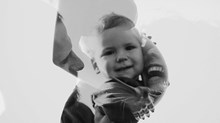
When my baby was about nine months old, he started giving out hugs with his own unique twist: He’d wrap his chubby arms around whomever he was hugging, and then gently pat their back. It made sense; his bedtime routine usually consists of Daddy holding him in his arms and gently patting his back until he falls asleep. The logic behind the behavior didn’t diminish my gut-level reaction, however, at the sight of my son snuggled up in Daddy’s arms, his small hand barely reaching around the curve of Daddy’s broad shoulders, patting away.

3829941936_34f92ffe7a.jpg

Now 14 months old, my son says “Pat-pat” as he hugs and pats, and what we’ve dubbed “baby hugs with pat-pats” are a big part of family life. Along with the cuteness factor, my curiosity has been piqued: is my son just mimicking the behavior he’s observed? Or does he possess some rudimentary understanding of the meaning of a hug, a pat on the back? In the middle of a difficult day recently, I sat down on the couch and put my head in my hands, trying not to cry in front of my children. Seconds later my 14-month-old was in my lap, his arms around my neck, patting my back. “Pat-pat,” he breathed as he hugged me.

I’ve written elsewhere about watching my children develop empathy and a sense of morality, so it was with great interest that I read Yale psychologist Paul Bloom’s lengthy article in The New York Times on the moral capacities of babies. In graduate school, one of my professors was renowned for telling his students that the more studies we do on babies, the more we discover they are much smarter than we think — and Bloom would apparently agree. His article details a set of increasingly complicated experiments that he and his wife, also a Yale psychology professor, designed to measure babies’ morality.

In the first experiment, six- and ten-month-old babies were shown three puppets acting out a basic morality play: one puppet is trying to climb a hill while a second puppet helps the first and a third puppet pushes the first back down. At the end of the play, babies are offered the “helping” and “hindering” puppets to play with, and the experimenters tracked which puppet the babies reached for. (The basic assumption, of course, is that what an infant reaches for is what the infant desires; Bloom actually delves at some depth into the presuppositions behind the experiments, and the controls taken, in the NYT article.)

The result? Babies overwhelmingly preferred the “helping” puppet. Further experiments introduced a neutral character, and those results showed that babies prefer a helping character to a neutral one, and a neutral character to a hindering character. “To have a genuinely moral system,” Bloom writes, “some things first have to matter, and what we see in babies is the development of mattering.” In other words, actions carry a moral weight: it matters that one puppet is helping another, and vice-versa.

3970772392_8b7f920966.jpg

(I must admit, my favorite part of the article is the description of how some of the experiments are derailed by uncooperative babies: “. . . some of the babies are either sleeping or too fussy to continue; there will then be a short break for the baby to wake up or calm down, but on average this kind of study ends up losing about a quarter of the subjects.” I found it reassuring to discover that even the Yale Infant Cognition Center is affected by the vagaries of babies, who — moral or not — aren’t always known for their cooperation.)

Back to that matter at hand, Bloom writes, “what’s exciting here is that these preferences are based on how one individual treated another, on whether one individual was helping another individual achieve its goals or hindering it. This is preference of a very special sort; babies were responding to behaviors that adults would describe as nice or mean.” Behaviors, in other words, indicate a moral code.

It’s perhaps impossible to discuss innate morality without addressing where that morality comes from, and the article doesn’t avoid asking that question. Quoting Dinesh D’Souza in What’s So Great About Christianity?, Bloom addresses the argument that evolutionary biology can only account for so much in terms of altruism: namely, that altruistic acts toward genetic family can be explained using the Darwinian model of evolution, but acts of “higher altruism,” (for example, kindness to strangers) cannot.

Evolutionary psychology has an answer to that argument, Bloom goes on to say: Just because a biological trait has evolved for a purpose doesn’t mean it always functions for that purpose. Besides, kindness to strangers could be nothing more than an evolutionary development designed to make individuals appear more attractive to potential mates.

D’Souza’s “general argument,” however, “still needs to be taken seriously,” writes Bloom. “The morality of contemporary humans really does outstrip what evolution could possibly have endowed us with,” he writes. “Moral actions are often of a sort that have no plausible relation to our reproductive success and don’t appear to be accidental byproducts of evolved adaptations.”

So where does this leave us? If a type of “higher altruism” was discovered in infants, Bloom submits that “the case for divine creation would get just a bit stronger.” But it’s not. Babies’ morality is highly skewed toward an “in-kind preference,” research has shown, meaning that babies prefer people who look like them, sound like them, eat the same foods that they do. And because the infant morality code lacks “generality and universality,” Bloom says, “there is no need to posit divine intervention.”

Yet the fact of an infant moral code remains. Babies may need to be taught a “higher altruism,” but I don’t think that negates the evidence pointing to a Designer. Babies need to be taught a lot of things — how to sit up, how to crawl, that food goes in the mouth, not the nose or ear. It’s logical that a more developed morality would be on the list.

Share |

Comments

The comment in the third paragraph from the end really cuts to the heart of it:

“The morality of contemporary humans really does outstrip what evolution could possibly have endowed us with,” he writes. “Moral actions are often of a sort that have no plausible relation to our reproductive success and don’t appear to be accidental byproducts of evolved adaptations.”

Hmm.....so after we get through all the human folderol, does this mean we should see all human beings as 'inherently good' at birth?
I'm just asking, simply because we humans hide behind high sounding words and have created a study called human psychology which in many cases negates our need for the SAVIOR.
So what, in plain old everyday language, is this article really saying.
P. S. - Reading this gave me a headache. Although I have a 'higher education' degree, sometimes we make what is simple harder than it needs to be.

Hi Katelyn

Fascinating article! Thanks for sharing your thoughts. I haven't seen a lot of this research before but the way babies 'think' (from what we can tell) seems to bring a whole other dimension to learning about human experience.

I get the designer thing and it's amazing to find God's fingerprints as we learn more about our world! But the lack of a 'higher altruism' doesn't have to unsettle that does it? Can't we see altruism as God's design and a lack of 'higher altruism' as part of living in a fallen world?

I realise that's a somewhat convenient way to argue - whatever we like we ascribe to a designer and whatever we don't we say is part of the fall. I guess our presuppositions will shape how we interpret the scientific evidence.

Thanks so much for these reflections. I was interested in that article too, especially after also reading that the "building blocks" of morality are being studied in chimpanzees. I suppose that only complicates things, but as one who firmly believes in a Creator, it makes sense to me that moral order could be discerned in and among us, even as we also demonstrate selfishness, as babies and as adults.

Thanks again.

Having read the New York Times story, I must say the best part was the video! The babies are so cute!

Thanks Katelyn.

Fascinating article. It piqued my interest since I regularly have discussions with a psychologist friend regarding nature versus nurture. We constantly debate especially whether homosexuality is an inborn trait. It is my belief that homosexuality is a trait established early in a childs development: an unfortunate result from painful experience and this article helps clarify that I think. There is other data showing that gene expression is no longer set in stone and how early experiences and development are important. Thanks again.

@ Helen - I think that from a Christian perspective the implication of this study is that we are creatures of a good Creator and any goodness in us is a reflection of Him. However, of course we know that we also have a sinful side to our nature as well. Sure the baby might pick the nice puppet, but it might turn around and smack its sibling after. I have known my 2 year old nephew to hit and hug his little sister in the space of about 10 seconds. Good and evil are a struggle that occurs within us.

This study also demonstrates that we might have an inherent ability to DIFFERENTIATE between good and evil, whether or not we choose to indeed do what is right. This is why my 2 year old nephew looks extremely guilty and runs away when his parents catch him hitting his sister, because he knows its wrong, and he knew it was at the time, or realized it shortly thereafter, but did it anyway because his sinful will overtook his desire to be good.

"I do not understand what I do. For what I want to do I do not do, but what I hate I do. And if I do what I do not want to do, I agree that the law is good." (Romans 7:15-17).

Just because we know what's good doesn't mean we will always do it (re: Adam and Eve).

@Helen, wow you just brought up a good point... does a baby really need a savior? I think that might depend if you believe in baptism early in life or by choice later...

I tend to think that God's grace covers us and if I didn't get my baby baptized and he passes away, he's still going to heaven. I think it's very difficult to sin when you don't yet know right from wrong. In this case, the babies don't know how to DO right, but they know wrong when they see it.

Helen, I also have a headache from reading this article. I am not sure of the purpose behind the narrative, and still do not get the point.

Romans 7:15-17 was written by the apostle Paul, a maturing Christian, to other Christians. I see no correlation between this passage and the behavior of infants who cannot yet read and cannot make informed choices. I have read other studies that have found that infants respond to people who smile more often than to those who frown or scowl at them. Don't we all?

Scripture is filled with other passages that speak to the war between our spirit and our flesh (in the lives of Christians). For instance, in Colossians 3:1-17 we are told to "put off the old man with his deeds"(v. 9)--anger, malice, wrath, filthy language, lying, etc. We are to "put on the new man who is renewed in knowledge according to the image of Him who created him" (v. 10).

I fail to see how this observed behavior in infants (Bloom's increasingly complicated experiments designed to measure an infant' morality) is needed to prove or disprove the existence of Creator God.

They are not, according to Scripture. Specifically, Romans 1:18-23. "For the wrath of God is revealed from heaven against all ungodliness and unrighteousness of men, who suppress the truth in unrighteousness, because what may be known of God is manifest in them, for God has shown it to them. For since the creation of the world His invisible attributes are clearly seen, being understood by the things that are made, even His eternal power and Godhead, so that they are without excuse,...Professing to be wise, they became fools" (vv. 18-20,22).

I would ask these questions: 1. How large is the grant awarded to the Professors Bloom for this superfluous study on infant behavior? 2. Does the amount of the grant increase as the level of intricacy rises, thus making the experiments more difficult to understand and analyze?

Babies mimic what they experience and what they observe.
We would do well to remember this as we interact with babies and children of all ages: they are watching, absorbing, and are smarter than we give them credit for being.

@Susan F. "We would do well to remember this as we interact with babies and children of all ages: they are watching, absorbing, and are smarter than we give them credit for being."

Isn't that what the thinking behind the study and the purpose of this article is?

I agree with about 98% of your points, but I have to disagree when you say that babies need to be taught that "food goes in mouth." My 4 certainly didn't need to be taught that. They knew from day one!

Nice post, by the way.

Jim

Behaviors as moral code.... That is fascinating and the babies preference for behaviors regarded as nice is well... heart warming. I like the 'nature vs nurture' arguments as much as the next guy, but this type of information is priceless.

We should definitely take care of our kids and teach them the real values of life. Parents have such a big responsability... and they have to start from the first day the new child is born!

Great article! I do believe that babies are a lot smarter than we think they are at a given age, and that subconsciousness plays a great part in it. I agree with you that a baby's empathetic abilities are truly amazing...

One of my favorite blog posts on your site Elrena! Very funny comments too.

Post a comment:


Verification (needed to reduce spam):

tags

May 2012
Sun Mon Tue Wed Thu Fri Sat
    1 2 3 4 5
6 7 8 9 10 11 12
13 14 15 16 17 18 19
20 21 22 23 24 25 26
27 28 29 30 31